
 Chat with us now!
 Send Email!

Instant Delivery
.png) Get Free Invoice
Get Free Invoice-
 24 X 7 Customer Support
Wyoming Paycheck Calculator
Generate paystubs with accurate Wyoming State Tax Withholding Calculations.

Wyoming Paycheck Calculator
Wyoming has no state income tax, and none of its cities levy local income taxes on wages; it is one of the most tax-friendly states for workers. However, people who live in Wyoming are still ‘on the hook’ for paying their federal income tax obligations, such as federal withholding, Social Security, and Medicare taxes.
To compare your take‑home pay and deductions under current tax rules, try using a paystub creator that’ll help you calculate accurate paycheck amounts based on your income and filing status.
TOTAL
YTD TOTAL
Earnings
$0.00
$0.00
Taxes
$0.00
$0.00
Take Home
$0.00
$0.00
How Does the Wyoming Payroll Calculator Work?
Wyoming residents are fortunate to be exempt from paying state income taxes, allowing them to retain a larger portion of their earnings. Nevertheless, certain deductions, such as FICA taxes and federal income taxes, still apply to workers in Wyoming. Therefore, it remains essential to develop a well-thought-out tax planning strategy to optimize financial outcomes.
The Federal Insurance Contributions Act (FICA) taxes include Social Security and Medicare taxes. In 2026, your employer will take a flat rate of 6.2% in Social Security tax from the wage portion of your paycheck up to $171,000. Employers must also match it with another 6.2%. For Medicare, you pay 1.45% on all wages, and your employer pays an equal amount for a total of 2.9%.
If your income surpasses $200,000 for single filers, $250,000 for married filing jointly or $125,000 for married filing separately, though, an additional 0.9% Medicare surtax kicks in on any wages above those amounts. Employers do not have to match this additional tax.
Important Note: The StubCreator provides a paycheck calculator designed to provide essential guidance. This should not be relied upon to calculate exact taxes, payroll, or other financial data. You should seek a professional accountant regarding any particular requirement.
Taxable Base Wage
Taxable Base Wage for Wyoming (the SUI wage base) is as follows:
| Year | Wyoming Taxable Base Wage |
| 2026 | $33,800 |
| 2025 | $32,400 |
| 2024 | $30,900 |
| 2023 | $29,100 |
| 2022 | $27,700 |
| 2021 | $27,300 |
SUTA Rates
Wyoming SUI rates vary based on employer experience.
| Year | Wyoming SUTA Rates (Employer Only) |
| 2026 | 0.14% – 8.50% (approximate state experience range) |
| 2025 | 0.14% – 8.50% |
| 2024 | 0.14% – 8.50% |
| 2023 | 0.14% – 8.50% |
| 2022 | 0.14% – 8.50% |
FUTA Rates
Most employers receive the maximum credit when they timely pay state unemployment taxes, resulting in a net FUTA rate of 0.60%.
| Year | Wyoming FUTA Rates |
| 2026 | 0.60% (after state credit) |
| 2025 | 0.60% |
| 2024 | 0.60% |
| 2023 | 0.60% |
| 2022 | 0.60% |
FICA Rates
In Wyoming, the FICA tax rates for 2026 are as follows:
For Employees and Employers:
- Social Security Tax: 6.2% on wages up to the annual Social Security wage base.
- Medicare Tax: 1.45% on all wages, plus an additional 0.9% Medicare surtax on wages above $200,000 (single) or $250,000 (married filing jointly).
| Year | Wyoming FICA Rates |
| 2026 | 7.65% (6.2% Social Security + 1.45% Medicare) |
| 2025 | 7.65% |
| 2024 | 7.65% |
| 2023 | 7.65% |
| 2022 | 7.65% |
Other Taxes
Employers do not withhold state income tax from employee paychecks since there is no state income tax in Wyoming. All federal income tax withholding is determined from the employee’s Form W‑4 and IRS withholding tables.
Wyoming Payroll Tax Calculator
If you earn $65,000.00 per year in Wyoming, your net pay, or take‑home pay, will be approximately $52,960 after deducting federal income tax and payroll taxes in 2026. These deductions consist of $7,068 (about 10.87%) for federal income tax, $0 (0.00%) for state income tax, $4,030 (6.20%) for Social Security tax, and $943 (1.45%) for Medicare tax. The total tax withheld comes to around $12,041, leaving an average take‑home pay of $52,960 per year, or about 18.5% in total tax.
Wyoming Paystub Generator
Below are the details of Wyoming:
- In Wyoming, the first step towards payroll taxes involves employees filling out Form W-4. This crucial information enables you to determine the appropriate amount that should be withheld.
- Life events such as marriage, divorce, the birth or adoption of a child, and other similar circumstances require employees to update their Form W-4 to reflect any changes that may affect their tax liabilities.
- Wyoming does not have a personal income tax rate.
Create Your Professional Paystub Online and Download It in Just a Few Clicks.
Accurate state tax calculations for all 50 states — no spreadsheets needed.
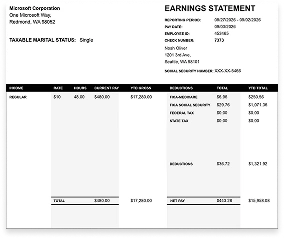
Why choose Stubcreator?

Get your 1st default stub free*
Or Get $4.99 OFF on your first order
Instant delivery by email and download
Get Free Corrections
24/7 customer support
Seamless automated calculations
100% secure payment with paypal
Resolution of query in 24 hours
Questionnaires:
- Does Wyoming have a state income tax?
No, Wyoming does not impose a state income tax on wages or salaries. This means that residents of Wyoming do not have state income tax withheld from their paychecks.
- What deductions are typically withheld from Wyoming paychecks?
Common deductions from Wyoming paychecks include federal income tax, FICA (Social Security and Medicare) taxes, and any voluntary deductions such as retirement contributions, health insurance premiums, and charitable contributions.
- Are there any specific considerations for calculating pay in Wyoming?
While Wyoming does not have a state income tax, employers and employees should still ensure compliance with federal wage and hour laws, such as minimum wage and overtime regulations.
Still Have a Questions? Get Support Now!


Download Now & Get Free Paystub