
 Chat with us now!
 Send Email!

Instant Delivery
.png) Get Free Invoice
Get Free Invoice-
 24 X 7 Customer Support
Utah Paycheck Calculator
Generate paystubs with accurate Utah State Tax Withholding Calculations.

Utah Paycheck Calculator
Utah has an exceptionally basic personal expense framework with a single rate. All citizens in Utah pay a 4.55% state personal income tax rate, regardless of documentation status or pay level. No urban communities in the Bee colony state have annual neighborhood expenses. If you want to organize your earnings into a clear paycheck format, using a free paystub generator can make the process much more structured. Utah citizens likewise need to make good on government personnel assessments.
TOTAL
YTD TOTAL
Earnings
$0.00
$0.00
Taxes
$0.00
$0.00
Take Home
$0.00
$0.00
How Does the Utah Payroll Calculator Work?
Determining your net pay can be a complex task due to various deductions made by your Utah employer each pay period. Some of these deductions go toward FICA taxes and federal income taxes. FICA taxes are made up of Social Security and Medicare taxes, which are applied uniformly across every state.
You contribute Social Security taxes at a rate of 6.2% on your income, matched by your employer. However, if your wages surpass $200,000 (for single filers) or $250,000 (for joint filers) or $125,000 (if you are married and file separately), then you must also pay a 0.9 percent Medicare surtax. Bear in mind that your employer does not match this surtax.
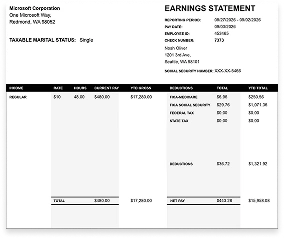
In general, people are responsible for paying 50% of their FICA taxes themselves. However, be careful that without an employer to pay the other half of the 50%, you are left holding the full percentage. To better visualize how these deductions appear on an actual paycheck, you can review a free paystub template before generating the final document.
Utah Salary Tax Calculator
If you make $80,000.00 per year in the state of Utah, then your net pay (or salary) will be $59,872 after taxes, which lowers your gross pay by 25.16% (or $20,128.00). Derivations include the total of 12.96% (or $10,368.10) for the government individual obligation, 4.55% (or $3,640.00) for state individual expense, 6.20% (or $4,960.00) for the government-operated retirement charge, and 1.45% (or $1,160.00) for federal health care.
Important Note: The StubCreator provides a paycheck calculator designed to provide essential guidance. This should not be relied upon to calculate exact taxes, payroll, or other financial data. You should seek a professional accountant regarding any particular requirement.
Taxable Base Wage
Utah is one of just a handful of states without rates or minimum wage laws. Instead, it draws upon the federal government’s required rates under the Fair Labor Standards Act (FLSA) when necessary.
| Year | Utah Taxable Base Wage |
| 2026 | $41,600 |
| 2025 | $41,200 |
| 2024 | $40,800 |
| 2023 | $40,400 |
| 2022 | $40,000 |
SUTA Rates
| Year | Utah SUTA Tax Rates |
| 2026 | 0.20%–5.40% |
| 2025 | 0.20%–5.40% |
| 2024 | 0.20%–5.40% |
| 2023 | 0.20%–5.40% |
| 2022 | 0.20%–5.40% |
FUTA Rates
| Year | Utah FUTA Tax Rate |
| 2026 | 0.6% |
| 2025 | 0.6% |
| 2024 | 0.6% |
| 2023 | 0.6% |
| 2022 | 0.6% |
FICA Taxes:
In Utah, the FICA tax rates for 2026 are as follows:
For Employees and Employers:
- Social Security Tax: 6.2% up to $168,600
- Medicare Tax: 1.45% (no wage limit)
Additional Medicare Taxes:
- Employees: 0.9% on wages over $200,000
| Year | Utah FICA Rates |
| 2026 | 7.65% |
| 2025 | 7.65% |
| 2024 | 7.65% |
| 2023 | 7.65% |
| 2022 | 7.65% |
Other Taxes
Taxes on Gasoline: $0.37 per gallon
Taxes on Diesel: $0.35 per gallon
Other Deductions on Pay Stub
In addition, Utah allows you to deduct a few business-expense-type charges that you’ve paid that your employer didn’t reimburse, like travel and transport expenses, as well as union fees and the costs once in a while associated with uniforms.
Utah Payroll Tax Withholding
For those identifying a zero or one exemption, here are the rates: 4.55% on all taxable wages. If you are claiming the married exemption, the rates would be: 4.55% on all taxable wages.
Utah Paycheck Tax Calculator
Below are the details of Utah:
- Collecting Utah payroll tax requires employees to complete form W-4 so that the employer can figure out exactly how much to withhold.
- Utah doesn’t exchange information with other states.
- Utah currently has a 4.85% personal income tax rate.
Create Your Professional Paystub Online and Download It in Just a Few Clicks.
Accurate state tax calculations for all 50 states — no spreadsheets needed.
Why choose Stubcreator?

Get your 1st default stub free*
Or Get $4.99 OFF on your first order
Instant delivery by email and download
Get Free Corrections
24/7 customer support
Seamless automated calculations
100% secure payment with paypal
Resolution of query in 24 hours
Questionnaires:
- How is Utah income tax calculated?
Utah has a flat income tax, so everyone pays the same fraction of their income in taxes. Utah's individual income tax rate is 4.55% as of 2026. A paycheck calculator factors in this rate, along with other deductions, to determine your net pay.
- What deductions are typically considered in a Utah paycheck calculator?
Common deductions include federal and state income taxes, Social Security, Medicare, and any other pre-tax deductions like health insurance or retirement contributions. A paycheck calculator helps individuals understand how these deductions impact their take-home pay.
- Are there local taxes in Utah that affect my paycheck?
Utah has no local income taxes. But people must understand additional taxes like a local sales tax and property taxes, which will be different by county or municipality, but won’t touch your paycheck directly.
Still Have a Questions? Get Support Now!


Download Now & Get Free Paystub