
 Chat with us now!
 Send Email!

Instant Delivery
.png) Get Free Invoice
Get Free Invoice-
 24 X 7 Customer Support
Alaska Paycheck Calculator
Generate paystubs with accurate Alabama State Tax Withholding Calculations.

Alaska Paycheck Calculator
Alaska’s inhabitants are fortunate in terms of taxation, as they enjoy the privilege of residing in the sole state in the nation that does not impose state income taxes. Additionally, while there is no statewide sales tax, some local municipalities may levy small sales taxes.
This advantageous situation is primarily due to Alaska’s reliance on petroleum revenue to fund its operations. Nevertheless, it is important to note that Alaskans are still subject to federal taxes, which are deducted from their paychecks based on factors such as supplementary income, marital status, and the presence of dependents.
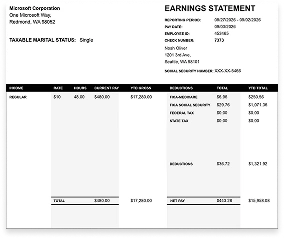
For accurate paycheck estimates in Alaska, you can use a paystub generator tool to calculate your earnings and deductions quickly.
TOTAL
YTD TOTAL
Earnings
$0.00
$0.00
Taxes
$0.00
$0.00
Take Home
$0.00
$0.00
How Does the Alaska Paycheck Tax Calculator Work?
Like residents of other states, Alaskans have federal income tax and FICA taxes taken out of their paychecks. These amounts are then sent over to the IRS to settle yearly income taxes.
FICA taxes include Social Security and Medicare contributions. As of 2026:
- Social Security tax is 6.2% of a worker’s wages, up to the annual wage limit: $171,000. The employer pays a further 6.2% on behalf of the employee,
- The Medicare tax is 1.45% of all wages, and there is no wage limit.
However, since these taxes are withholding taxes, your end-of-year total of paychecks would be lower than your gross yearly salary, accounting for the federal and FICA deductions throughout the year.
Alaska Payroll Calculator
If you earn $77,000 per year in Alaska, your net pay (the amount you take home after federal and payroll taxes) will be approximately $61,148 for the 2026 tax year. This reflects total tax deductions of about 20.6% (around $15,852) taken from your gross pay. Those deductions include approximately $9,708 (12.6%) for federal income tax, $0 (0.0%) for state income tax, about $4,774 (6.2%) for Social Security tax, and roughly $1,117 (1.45%) for Medicare tax.
Important Note: The StubCreator provides a paycheck calculator designed to provide essential guidance. This should not be relied upon to calculate exact taxes, payroll, or other financial data. You should seek a professional accountant regarding any particular requirement.
Taxable Base Wage
For 2026, the Alaska Unemployment Insurance (UI) taxable wage base — the maximum portion of an employee’s wages subject to UI tax is $54,200. Which means employers (and, by some accounts, employees) only pay UI taxes on the first $54,200 of every worker’s yearly wages. 0.50% is the employee UI tax rate applicable to standard employees.
| Year | Alaska Taxable Base Wage |
| 2026 | $54,200 (current) |
| 2025 | $51,700 |
| 2024 | $49,700 |
| 2023 | $47,100 |
| 2022 | $45,200 |
| 2021 | $43,600 |
SUTA Rates
Alaska’s 2026 SUTA rate for new employers is 1.00%, with experienced employer rates ranging up to 5.40%.
| Year | SUTA Rate |
| 2026 | 1.00%–5.40% |
| 2025 | 1.00%–5.40% |
| 2024 | 1.00%–5.40% |
| 2023 | 1.00%–5.40% |
| 2022 | 0.56% |
| 2021 | 0.56% |
FUTA Rates
For 2026, Alaska employers pay an effective FUTA rate of 0.60% on the first $7,000 of each employee’s wages after the standard state tax credit.
| Year | Alaska FUTA Rate |
| 2026 | 0.60%* |
| 2025 | 0.60%* |
| 2024 | 0.60%* |
| 2023 | 0.60%* |
| 2022 | 0.60%* |
| 2021 | 0.60%* |
FICA Rates
For 2026, the FICA tax rates for both employees and employers are as follows:
- Social Security Tax: 6.2% on wages up to the annual wage base of $171,000
- Medicare Tax: 1.45% on all wages (no wage limit)
| Year | Alaska FICA Rates |
| 2026 | 7.65% |
| 2025 | 7.65% |
| 2024 | 7.65% |
| 2023 | 7.65% |
| 2022 | 7.65% |
| 2021 | 7.65% |
Other Taxes
Municipalities in Alaska are able to impose use and sales taxes. Companies that operate in these regions need to be aware of the deadlines and requirements for local taxes.
Alaska Income Tax Withholding
Alaska does not require state income tax withholding on earnings.
Alaska Paystub Generator
Below are the details of Alaska:
- Alaska finance charges start with representatives finishing up Form W-4. This data assists you with deciding the amount you ought to hold back.
- If any of the employees do not fill this form, you shall withhold tax as though no exemptions were declared.
- Alaska does not have a personal income tax.
Create Your Professional Paystub Online and Download It in Just a Few Clicks.
Accurate state tax calculations for all 50 states — no spreadsheets needed.
Why choose Stubcreator?

Get your 1st default stub free*
Or Get $4.99 OFF on your first order
Instant delivery by email and download
Get Free Corrections
24/7 customer support
Seamless automated calculations
100% secure payment with paypal
Resolution of query in 24 hours
Questionnaires:
- Is there a state income tax in Alaska?
No, Alaska does not impose a state income tax on individuals. This means that employees in Alaska do not have state income tax withheld from their paychecks.
- What deductions are typically considered in an Alaska paycheck calculator?
While Alaska does not have a state income tax, common deductions in a paycheck calculator include federal income tax, Social Security, Medicare, and any other pre-tax deductions like health insurance or retirement contributions.
- Are there local taxes in Alaska affecting my paycheck?
Alaska does not have local income taxes. However, residents should be aware of potential local taxes such as property taxes, which can vary by borough or municipality but do not directly impact your paycheck.
- Can a paycheck calculator factor in bonuses or overtime pay in Alaska?
Yes, a reliable paycheck calculator allows you to input additional income sources like bonuses or overtime pay. While Alaska's lack of state income tax simplifies these calculations, it's still important to consider federal taxes and other deductions.
Still Have a Questions? Get Support Now!


Download Now & Get Free Paystub