
 Chat with us now!
 Send Email!

Instant Delivery
.png) Get Free Invoice
Get Free Invoice-
 24 X 7 Customer Support
Wisconsin Paycheck Calculator
Generate paystubs with accurate Wisconsin State Tax Withholding Calculations.

Wisconsin Paycheck Calculator
Wisconsin employees are governed by a state income tax system that follows a progressive structure consisting of four tax brackets. The tax brackets are determined based on the individual’s income level and filing status, with tax rates varying from 3.50% to 7.65%.
Navigating these shifting percentages can be complex, but utilizing a professional free paystub maker can provide a seamless way to verify your earnings and tax liabilities are documented correctly.
TOTAL
YTD TOTAL
Earnings
$0.00
$0.00
Taxes
$0.00
$0.00
Take Home
$0.00
$0.00
How Does the Wisconsin Payroll Calculator Work?
When you receive your paycheck in Wisconsin, you will observe deductions for FICA taxes, federal income taxes, and state income taxes. This is based on the Federal Insurance Contributions Act (FICA), which necessitates the withholding of Social Security and Medicare taxes.
Your paycheck is subject to deductions based on fixed percentages for these taxes. The federal government receives 6.2 of an employee’s income for Social Security Tax during each pay period.
This amount is split into two portions: 6.2% is withheld from the employee’s paycheck, and the employer matches that amount by contributing another 6.2%. The Medicare tax follows a comparable procedure: Employees contribute 1.45% of their paychecks, and employers are responsible for the remaining 1.45%.
Wisconsin Paycheck Tax Calculator
In the state of Wisconsin, if your annual gross pay is $69,943.00, your net income, also referred to as take-home pay, will amount to $52,905 after tax deductions. These deductions, totaling 24.36% or $17,038.95, include 11.78% or $8,230.12 for federal income tax, 4.82% or $3,374.10 for state income tax, 6.20% or $4,336.47 for social security tax, and 1.45% or $1,098.26 for Medicare.
Important Note: The StubCreator provides a paycheck calculator designed to provide essential guidance. This should not be relied upon to calculate exact taxes, payroll, or other financial data. You should seek a professional accountant regarding any particular requirement.
Taxable Base Wage
Taxable Base Wage for Wisconsin is as follows:
| Year | Wisconsin Taxable Base Wage |
| 2026 | $14,000 |
| 2025 | $14,000 |
| 2024 | $14,000 |
| 2023 | $14,000 |
| 2022 | $14,000 |
| 2021 | $14,000 |
SUTA Rates
Applying the state charge rate, which begins at 1.5%, to every worker’s profit is the most important phase in Wisconsin finance estimations. Since it’s an ever‑evolving personal duty, the expense rate increments as your workers’ pay rises.
| Year | Wisconsin SUTA Tax Rates |
| 2026 | 0.00%–12.00% |
| 2025 | 0.00%–12.00% |
| 2024 | 0.00%–12.00% |
| 2023 | 0.00%–12.00% |
| 2022 | 0.00%–12.00% |
FUTA Rates
The Government Joblessness Duty Act (FUTA), notwithstanding state joblessness charges. It shows up on the first $7,000 paid to every worker and is recorded on IRS Form 940, at times known as Timetable H. The duty rate under the FUTA is 6.0 percent.
| Year | Wisconsin FUTA Rates |
| 2026 | 6.0% |
| 2025 | 6.0% |
| 2024 | 6.0% |
| 2023 | 6.0% |
| 2022 | 6.0% |
FICA Rates
In Wisconsin, the FICA tax rates for 2026 are as follows:
For Employees and Employers:
- Social Security Tax: 6.2%
- Medicare Tax: 1.45%
Additional Medicare Taxes
- Employees: 0.9%
| Year | Wisconsin FICA Rates |
| 2026 | 7.65% |
| 2025 | 7.65% |
| 2024 | 7.65% |
| 2023 | 7.65% |
| 2022 | 7.65% |
Other Taxes
The corporate annual expense rate in Wisconsin is 7.9%. The typical complete state and neighborhood deals charge rate in Wisconsin is 5.44 percent, while the state deals charge rate is 5.0 percent. The viable local charge rate for proprietor-involved residences in Wisconsin is 0.44 percent.
To get a better look at how these local and state figures translate to your actual check, you can explore a free paystub template to preview your paystub’s layout and data before you generate a final copy.
Wisconsin Payroll Tax Withholding
Wisconsin follows a unique obligation rate recipe, with the cost contrasted with laborer checks. The appraisal rates range from 3.50% to 7.65%. Under state legislation, the state’s yearly obligation rates may be adjusted in the following years based on economic targets.
Wisconsin Payroll Calculator
Below are the details of Wisconsin:
- The commencement of Wisconsin payroll taxes involves employees completing the WT-4 form. This essential step assists employers in determining the precise amount that should be deducted from employee earnings.
- Should an employee neglect to fill out this form, it will be incumbent upon you to withhold tax as if no exemptions had been claimed.
- Personal Income Tax Rate is 3.54%–7.65%.
Wisconsin Paycheck Generator
Below mentioned are the details of Wisconsin:
- The commencement of Wisconsin payroll taxes involves employees completing the WT-4 form. This essential step assists employers in determining the precise amount that should be deducted from employee earnings.
- Should an employee neglect to fill out this form, it will be incumbent upon you to withhold tax as if no exemptions had been claimed.
- Personal Income Tax Rate is 3.45%-7.65%.
Create Your Professional Paystub Online and Download It in Just a Few Clicks.
Accurate state tax calculations for all 50 states — no spreadsheets needed.
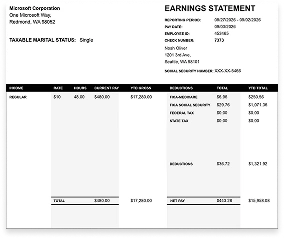
Why choose Stubcreator?

Get your 1st default stub free*
Or Get $4.99 OFF on your first order
Instant delivery by email and download
Get Free Corrections
24/7 customer support
Seamless automated calculations
100% secure payment with paypal
Resolution of query in 24 hours
Questionnaires:
- How is Wisconsin state income tax calculated?
Wisconsin has a progressive income tax system with multiple tax brackets. The Wisconsin Income Tax rate is applied to your taxable income after federal deductions. Ensure you input your gross income accurately when using a Wisconsin paycheck calculator and consider any applicable credits or deductions.
- Are there local taxes in Wisconsin that affect my paycheck?
Wisconsin does not impose local income taxes at the state level. However, it's important to check for any local taxes or additional obligations imposed by specific municipalities or counties within the state, as they can impact your net pay. Verify with local tax authorities or use a calculator that includes these local taxes.
- What is the impact of federal taxes, including FICA, on my Wisconsin paycheck?
Federal taxes, such as Social Security and Medicare (FICA), are applicable to your income in Wisconsin. These deductions are standard across all states and are calculated based on your gross income. Understanding how federal taxes affect your paycheck is crucial for accurate financial planning.
Still Have a Questions? Get Support Now!


Download Now & Get Free Paystub