
 Chat with us now!
 Send Email!

Instant Delivery
.png) Get Free Invoice
Get Free Invoice-
 24 X 7 Customer Support
South Carolina Paycheck Calculator
Generate paystubs with accurate South Carolina State Tax Withholding Calculations.

SC Paycheck Calculator
In South Carolina, the state imposes a sales tax rate of 6%. However, it is essential to factor in the variations at the local level. Local taxes can raise this rate by up to 3%, resulting in an average combined rate of 7.49%.
To see how these local variables and state brackets specifically impact your bottom line, utilizing a tool can provide the precision needed for your financial records.
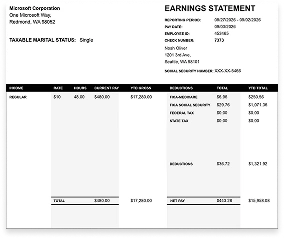
To keep your payroll records accurate, you can also use a paystub generator to create professional pay stubs alongside your South Carolina paycheck calculator.
TOTAL
YTD TOTAL
Earnings
$0.00
$0.00
Taxes
$0.00
$0.00
Take Home
$0.00
$0.00
How Does the SC Paycheck Calculator Work?
Your paychecks may not accurately reflect your quoted salary or hourly rate because your employer withholds a portion of your earnings to cover South Carolina taxes. Regardless of the state you work in, you are required to pay both FICA taxes and federal taxes. FICA taxes consist of Social Security and Medicare taxes.
Every pay period, 6.2% of your income is allocated towards Social Security taxes, while 1.45% is allocated towards Medicare. South Carolina employers match these amounts, resulting in double the total contributions to FICA taxes compared to what you pay. However, if your income exceeds $200,000 (for single filers, or $250,000 if married filing jointly), you will also be required to pay a Medicare surtax of 0.9%, which your employer does not match. Additionally, your Social Security tax contributions will stop once your income exceeds $182,500.
Typically, most employers cover 50% of the FICA taxes for their employees. Nevertheless, if you are self-employed or working on a contract basis, you may be responsible for paying the entire amount.
South Carolina Paycheck Tax Calculator
When earning a gross wage of $62,542.00 per year in South Carolina, your net pay, or take-home pay, will amount to $51,352.54 after tax deductions of 17.89%. These deductions encompass $4,180.00 (6.68%) for federal income tax, $2,225.00 (3.56%) for state income tax, $3,877.60 (6.20%) for social security tax, and $906.86 (1.45%) for Medicare.
South Carolina does not impose any local income taxes in most areas, making it easier for employees to estimate their take-home pay. Factors such as pre tax deductions, tax credits, and pay period frequency can also affect your final taxable income and overall tax withholdings.
Important: The StubCreator is designed to provide the South Carolina payroll tax calculator. This should not be relied upon to calculate exact taxes, payroll, or other financial data. You should seek a professional accountant regarding any particular requirement.
To visualize exactly how these updated brackets look on a finalized document, you can check a free paystub template for a clear preview of your paystub before creating it.
Taxable Base Wage
Taxable Base minimum Wage for South Carolina is as follows: Use that while using the South Carolina wage calculator.
| Year | South Carolina Taxable Base Wage |
| 2026 | $14,000 |
| 2025 | $14,000 |
| 2024 | $14,000 |
| 2023 | $14,000 |
| 2022 | $14,000 |
| 2021 | $14,000 |
SUTA Rates
Applying the State Unemployment Insurance Tax rate, which begins at 2.0% for new businesses. Since it is an employer expense, the tax rate is determined by the number of former employees who file for unemployment benefits, rather than your current workers’ salaries.
| Year | South Carolina SUTA Tax Rates |
| 2026 | 0.06%–5.46% |
| 2025 | 0.06%–5.46% |
| 2024 | 0.06%–5.46% |
| 2023 | 0.06%–5.40% |
| 2022 | 0.06%–5.40% |
FUTA Rates
The Federal Unemployment Tax Act (FUTA), notwithstanding state insurance taxes. It shows up on the first $7,000 paid to every worker and is recorded on IRS Form 940, at times known as Schedule H. The duty rate under the FUTA is 6.0 percent, but typically drops to 0.6% after the state tax credit.
| Year | South Carolina FUTA Rates |
| 2026 | 6.0% |
| 2025 | 6.0% |
| 2024 | 6.0% |
| 2023 | 6.0% |
| 2022 | 6.0% |
FICA Rates
In South Carolina, the FICA tax rates for 2026 are as follows:
For Employees and Employers:
- Social Security Tax: 6.2%
- Medicare Tax: 1.45%
Additional Medicare Taxes
- Employees: 0.9%
| Year | South Carolina FICA Rates |
| 2026 | 7.65% |
| 2025 | 7.65% |
| 2024 | 7.65% |
| 2023 | 7.65% |
| 2022 | 7.65% |
The corporate annual expense rate in South Carolina is 5.0%. The typical complete state and neighborhood deals charge rate in South Carolina is 7.49%, while the state deals charge rate is 6.0 percent. The viable local charge rate for proprietor-involved residences in South Carolina is 0.57 percent.
South Carolina Payroll Tax Withholding
South Carolina follows a unique obligation rate recipe, with the cost contrasted with laborer checks. The appraisal rates range from 0% to 6.0%. Under state legislation, the state’s yearly obligation rates may be adjusted in the following years based on economic targets.
Paycheck Calculator South Carolina
Below are the details of South Carolina:
- The process of South Carolina payroll taxes commences with employees completing the SC W-4 form. This crucial information aids in calculating the appropriate amount to be withheld from their wages.
- If the employee does not submit this form, it will be incumbent upon you to deduct taxes as if no exemptions had been claimed.
- The personal income tax rate in South Carolina is 0%–6.0%.
Create Your Professional Paystub Online and Download It in Just a Few Clicks.
Accurate state tax calculations for all 50 states — no spreadsheets needed.
Why choose Stubcreator?

Get your 1st default stub free*
Or Get $4.99 OFF on your first order
Instant delivery by email and download
Get Free Corrections
24/7 customer support
Seamless automated calculations
100% secure payment with paypal
Resolution of query in 24 hours
Questionnaires:
- How is South Carolina income tax calculated?
South Carolina uses a progressive income tax system with six tax brackets. The rates range from 0% to 7%, depending on your taxable income. A paycheck calculator factors in these rates, deductions, and exemptions to provide an estimate of your net pay.
- What deductions are considered in a South Carolina paycheck calculator?
Common deductions include federal and state income taxes, Social Security, Medicare, and any other applicable pre-tax deductions like health insurance or retirement contributions. The calculator helps employees understand how these deductions impact their take-home pay.
- Are there local taxes in South Carolina affecting my paycheck?
South Carolina does not have local income taxes. However, it's crucial to consider other factors like county and municipal taxes, which can impact property taxes but do not directly affect your paycheck.
Still Have a Questions? Get Support Now!


Download Now & Get Free Paystub