
 Chat with us now!
 Send Email!

Instant Delivery
.png) Get Free Invoice
Get Free Invoice-
 24 X 7 Customer Support
Arkansas Paycheck Calculator
Generate paystubs with accurate Arkansas State Tax Withholding Calculations.

Arkansas Paycheck Calculator
In Arkansas, the application of a progressive income tax rate is contingent upon taxpayers’ income levels. As a result, individuals with higher earnings will be required to pay a larger amount in taxes. To better arrange these varying deductions into a structured paycheck format, a free paystub maker can be a useful option. It is worth mentioning that the tax brackets remain uniform regardless of one’s filing status. It is worth mentioning that the tax brackets remain uniform regardless of one’s filing status.
TOTAL
YTD TOTAL
Earnings
$0.00
$0.00
Taxes
$0.00
$0.00
Take Home
$0.00
$0.00
How Does the Arkansas Paycheck Tax Calculator Work?
All residents of Arkansas, just like any other U.S. resident, have the responsibility to pay taxes. This includes federal income taxes and FICA taxes, which employers deduct from each paycheck. The collected funds are then transferred to the IRS, which utilizes them for your annual income taxes.
Medicare and Social Security. Your W-4 form contains the necessary details for your employer to determine the appropriate amount to withhold for federal taxes. Hence, it is crucial to complete a W-4 form whenever you begin a new job. Furthermore, you can update your W-4 form if your filing status changes, such as getting married, or if you have additional non-wage income that is not subject to withholding.
If you want to see how these withholdings are typically presented, reviewing a paystub template can give you a practical preview before generating your pay stub.
Important Note: The StubCreator provides a hourly paycheck calculator designed to provide essential guidance. This should not be relied upon to calculate exact taxes, payroll, or other financial data. You should seek a professional accountant regarding any particular requirement.
Taxable Base Wage
Taxable Base Wage for Arkansas is as follows:
| Year | Arkansas Taxable Wages |
| 2026 | $7,000 |
| 2025 | $7,000 |
| 2024 | $7,000 |
| 2023 | $7,000 |
| 2022 | $7,000 |
SUTA Rates
The State Unemployment Insurance (SUI) tax rate in Arkansas for new employers will be 2.025% for the first half of the year and 2.00% for the second half as of 2026. The Arkansas Department of Workforce Services will designate a new tax rate based on the employer’s experience rating following the three years this rate is in effect.
| Year | Arkansas SUTA Rates |
| 2026 | 1st half: 2.025% & 2nd half: 2.00% |
| 2025 | 1st half: 2.025% & 2nd half: 2.00% |
| 2024 | 1st half: 2.025% & 2nd half: 2.00% |
| 2023 | 3.1% |
| 2022 | 0.1% – 14% |
FUTA Rates
The employer’s taxable earnings are multiplied by 6.0% to determine FUTA taxes. The first $7,000 in wages paid to each employee in a calendar year is considered the taxable wage base.
| Year | Arkansas FUTA Rate |
| 2026 | 0.6% |
| 2025 | 0.6% |
| 2024 | 2.025% (1st half) & 2.00% (2nd half) |
| 2023 | 0.6% |
| 2022 | 6.0% |
FICA Rates
In California, the FICA tax rates for 2024 are as follows:
For Employees and Employers:
- Social Security Tax: 6.2% on wages up to the annual wage base
- Medicare Tax: 1.45% on all wages
Additional Medicare Tax (Employees Only):
- 0.9% on income over:
- $200,000 (single filers)
- $250,000 (married filing jointly)
- $125,000 (married filing separately)
| Year | Arkansas FICA Rate |
| 2026 | 7.65% |
| 2025 | 7.65% |
| 2024 | 7.65% |
| 2023 | 7.65% |
| 2022 | 7.65% |
Other Taxes
Additionally, the average total state and local sales tax rate in Arkansas remains 9.45%, with a state sales tax rate of 6.50%. The effective property tax rate in Arkansas is 0.53% on the value of owner-occupied homes. Arkansas does not levy an inheritance or estate tax.
- ETT (Employment Training Tax): Arkansas does not impose an Employment Training Tax (ETT). This tax applies to certain other states but is not applicable in Arkansas for 2024, 2025, or 2026.
- SDI (State Disability Insurance): Arkansas does not have a State Disability Insurance (SDI) withholding program. Therefore, no SDI withholding applies in 2024, 2025, or 2026.
Arkansas Payroll Tax Withholding
Personal expenses in Arkansas are set at a flat rate of 3.9%. Managers deduct government pay and FICA charges from your checks and channel them to the IRS for federal medical care, federal retirement aid, and yearly duties. Marital status, charge sections, pay recurrence, and approved derivations will shape your check size.
Arkansas Payroll Tax Calculator
When earning a gross pay of $50,000.00 per year in Arkansas, your net pay, or take-home pay, will amount to $39,984.50 after accounting for tax deductions of 20.03%. These deductions consist of 8.48% ($4,240.50) for federal income tax, 3.90% ($1,950.00) for state income tax, 6.20% ($3,100.00) for social security tax, and 1.45% ($725.00) for Medicare.
Arkansas Paycheck Calculator
Below are the details of Arkansas:
- The commencement of Arkansas payroll taxes involves employees completing Form AR4EC. This essential step enables the determination of the precise amount that needs to be withheld from their income.
- The personal income tax rate is 3.90%.
- Employees must revise Form AR4EC whenever significant life events occur (such as marriage, divorce, the birth or adoption of a child, etc.) that might impact their tax liabilities.
Create Your Professional Paystub Online and Download It in Just a Few Clicks.
Accurate state tax calculations for all 50 states — no spreadsheets needed.
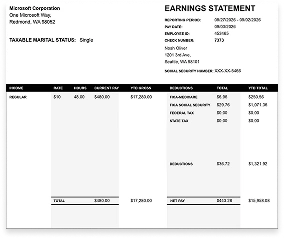
Why choose Stubcreator?

Get your 1st default stub free*
Or Get $4.99 OFF on your first order
Instant delivery by email and download
Get Free Corrections
24/7 customer support
Seamless automated calculations
100% secure payment with paypal
Resolution of query in 24 hours
Questionnaires:
- How is Arkansas state income tax calculated?
Arkansas state income tax is calculated using a progressive tax system with rates ranging from 0.9% to 6.9% of taxable income. The amount withheld depends on factors such as filing status, exemptions, and any additional income sources.
- What deductions are typically withheld from Arkansas paychecks?
Deductions commonly withheld from Arkansas paychecks include federal income tax, FICA (Social Security and Medicare) taxes, Arkansas state income tax, and any voluntary deductions such as retirement contributions, health insurance premiums, and charitable contributions.
- Are there any specific considerations for calculating pay in Arkansas?
Employers in Arkansas should be aware of local taxes, such as city or county income taxes, which may affect paycheck calculations for employees working in certain jurisdictions.
Still Have a Questions? Get Support Now!


Download Now & Get Free Paystub