 Chat with us now!
 Send Email!

Instant Delivery
.png) Get Free Invoice
Get Free Invoice-
 24 X 7 Customer Support
How to Use a Pay Stub Generator: A Step-by-Step Checklist
At first glance, a pay stub generator may appear to be complex, with dropdown menus, tick boxes, dollar signs scattered across various parts of the tool. This guide breaks down the interface into sections so anyone reading it will be able to go from an empty template to an accurate pay stub.

FREE GUIDE
Free Pay Stub Reading Guide
Want to keep this information handy?
Download our free guide to learn how to understand earnings, deductions, taxes, YTD totals and net pay.
Quick heads-up before you get started!
If you want to create a pay stub online, you can use our pay stub generator to enter your employment and pay information — no sign-up, no credit card, and it's delivered instantly. It's a quick way to try the tool out before deciding on a template for your full run of stubs.
Getting Started
StubCreator works through these three steps. Before entering any fields of information, check the heading bar to see where you are in the process.
STUBCREATOR PROCESS

1
Step 1
Input the information, which is the stage where most of the work takes place.
2
Step 2
Preview the paystub & make payment for the final product.
3
Step 3
Download the final paystub without a watermark.
Lost Data?
Note that if you click the "Lost Data?" link, you will be able to recover this session if you accidentally leave the page.
Set Up Employment & Pay Details
This part defines how math is computed within the stub, so being accurate is critical on this front.
STUBCREATOR PROCESS

Select State
This field shows which state taxation applies to the deduction section.
State Paycheck Guides
Because tax calculations can vary by state, you can also review our state paycheck guides for more information.
Marital Status
It influences federal/state tax withholding calculation. Select the option that reflects your current filing status:
Single
For unmarried, divorced, or legally separated individuals; typically has the highest withholding rate.
Married
For legally married individuals filing jointly (or separately); usually results in a lower withholding rate.
Head of Household
For unmarried individuals supporting a qualifying dependent; offers a more favourable withholding rate than Single.
How Are You Paid?
Details how often one’s pay is disbursed (weekly, bi-weekly, monthly, etc.) to provide a basis for the "Reporting Period."
Hourly or Salary
Make sure the data reflects the correct compensation method, whether it's hourly or salary-based.
If Hourly is selected:
Hourly Rate*
Enter the employee's pay rate per hour.
If Hourly is selected:
Total Hours*
Enter the number of hours worked within the reporting period.
If Salary is selected:
Annual Salary*
Enter the employee's total yearly salary amount.the employee's total yearly salary amount.
Pay Period YTD
This field tells the system how many pay periods have already occurred this year, so totals are calculated correctly.
Auto
The system automatically calculates the count starting from January of the current year, based on your selected pay frequency (e.g., weekly, biweekly, monthly).
Number (1, 2, 3...)
Select a specific number if you want to manually indicate how many pay periods have already been paid out this year. For example, selecting 5 means the employee has already received 5 pay periods' worth of pay in the current year.
Template
Choose the visual design/format for your final pay stub. Each template has an associated price, and you can preview any template using the eye icon before purchasing.
Templates range from simple to better designs (e.g., Standard Silver, Standard Midnight, Standard Snow) to more customizable options. For example, Standard Multicolor lets you set your own color scheme instead of using a fixed template color, giving you more control over the stub's appearance. Prices vary by template style, starting at $4.99.
Explore Templates
You can also explore our pay stub templates to compare different layouts and designs.
Company Logo
Upload your company logo here. We suggest using a portrait (vertical) logo for the best display on the pay stub.
Reader tip:
Any field marked with * is required. The pay stub won't generate correctly until all starred fields are filled.
Understand the Optional Add-Ons (Checkboxes)
The majority of the generators offer extra options through selection. One must understand the meaning of the options to make the right selections.
OPTIONAL ADD-ONS

Contractor
Removes all automatic tax withholdings from the pay stub since self-employed workers handle their own taxes.

Contractor

Tax Exemptions
makes changes to tax withholding that you want to add or remove on the pay stub.

Tax Exemptions

Deposit Slip (+$2)
places the direct deposit slip on the stub.

Deposit Slip

Edit Label (+$2)
enables renaming the titles found on the pay stub.

Edit Label

Hired in [Year]?
Check this box if the employee was hired during the current year and you're unsure which YTD (Pay Period YTD) value to select. When checked, the system will automatically calculate and set the correct YTD number based on the Hire Date you enter, so you don't have to figure it out manually.
![Hired in [Year]?](data:image/svg+xml,%3Csvg%20xmlns='http://www.w3.org/2000/svg'%20viewBox='0%200%20306%2061'%3E%3C/svg%3E)
Hired in [Year]?
![Hired in [Year]?](https://stubcreator.com/wp-content/uploads/2026/09/Hire-Date.webp)
Advance Tool (+$2)
Add or remove benefits and deductions as per your preference. Each addition or deduction includes the following fields.

Advance Tool

Description*
Enter the name of the addition or deduction (e.g., "Overtime," "Bonus," "Health Insurance," "401k").
Current Pay
Enter the amount for this addition or deduction for the current pay period.
Select Stub
Choose which stub(s) this addition or deduction should apply to. Select Apply to all if it should be included on every stub you're generating, or select a specific stub if it only applies to one.
Last YTD
Enter the year-to-date amount for this addition or deduction as of the previous pay period. This ensures the YTD total on the stub stays accurate once the current pay period is included. As noted by the ℹ️ icon, leave this field blank if you want the Last YTD amount calculated automatically.
Use Remove to delete an addition or deduction you no longer need.
Add Last YTD (+$2)
Lets you include prior year-to-date totals so they're factored into the YTD calculations. You have two ways to add this information.

Add Last YTD

Select from dropdown
Use the Select Last YTD dropdown to choose from previously saved YTD records, if available.
Enter manually
Fill in the individual fields yourself Last YTD Gross, Last FICA Medicare, Last FICA Social Security, Last Federal Tax, and Last State Tax.
Example: If an employee's prior YTD Gross was $10,000 and their current pay stub adds $1,000, the new stub's YTD Gross will correctly show $11,000; since the old amount is carried forward and included in the calculation.
Edit Taxes (+$2)
Lets you manually override the automatically calculated tax amounts (e.g., FICA-Medicare, FICA Social Security, Federal Tax, State Tax).
Once enabled, automatic tax calculation stops; you'll need to manually manage and enter the correct Total and YTD Total for each tax line on every pay stub. You can also add your own custom deductions or remove existing ones using the (+) and (–) icons under Statutory Deductions.

Once enabled, automatic tax calculation stops; you'll need to manually manage and enter the correct Total and YTD Total for each tax line on every pay stub. You can also add your own custom deductions or remove existing ones using the (+) and (–) icons under Statutory Deductions.
Contractor

Saved Company/Employee profiles (+ button)
Save time by storing your company and employee details as a profile. Once saved, you can simply select the company and employee from the dropdown for future pay stubs instead of re-entering the information each time, making it quick and easy to reuse the same details when creating new pay stubs.
Reader tip:
Paid add-ons are optional and not mandatory. Use them only if your specific requirements call for it.
Fill In Company & Employee Information
COMPANY & EMPLOYEE INFORMATION

Company Information
* Company Name
Compulsory required.
* Address Line 1
Compulsory required.
Address Line 2
optional
Employee Information
*Employee Name
Compulsory required.
*Employee Address
Compulsory required.
Employee Address Line 2
optional.
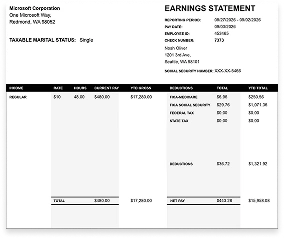
Read the Earnings Statement Itself
This is the actual pay stub preview; the part readers most need help decoding.
Earnings Statement
EARNINGS STATEMENT HEADER

Earnings Statement title confirms the document type.
SSN
Enter your SSN. For security, only the last 4 digits will be shown on your pay stub.
Pay Date
Select the most recent (latest) date on which the payment is issued, using the calendar picker. For example, if today is 09/11/2026 and you're generating a stub for the current period, select 09/11/2026 as the Pay Date rather than a past or future date.
Reporting Period
The date range the pay stub covers. By default, this is auto-adjusted based on your selected pay frequency (e.g., weekly, biweekly, monthly). However, you can also manually set your own custom reporting period if needed.
Stub/Document #
A unique reference number for record-keeping.
Add Employee
Add Employee number information
Income Table
INCOME TABLE

Income Type
Type of income (e.g., "Gross Earnings").
Rate
pay rate used for this line ( you need to add).
Hours
hours applied to this line ( you need to add).
Current Pay
Rate × Hours for hourly, or Annual Salary ÷ Pay Periods for salary (automated calculation).
Deductions Table (Statutory Deductions)
DEDUCTIONS TABLE

FICA – Medicare
current period + YTD total.
FICA – Social Security
current period + YTD total.
Federal Tax
current period + YTD total.
State Tax
current period + YTD total.
Bottom Summary Row
BOTTOM SUMMARY

YTD Gross
total earnings for the year so far. ( Automatic Calculated)
YTD Deductions
total withheld for the year so far. ( Automatic Calculated)
YTD Net Pay
take-home pay for the year so far. ( Automatic Calculated)
Total
gross pay for this specific period. ( Automatic Calculated)
Deductions
total withheld for this specific period. ( Automatic Calculated)
Net Pay
take-home amount for this period (Total − Deductions). ( Automatic Calculated)
Net Pay = Gross Pay − Total Deductions
Use this basic formula as a quick check when reviewing your pay stub.
Finalize Before Checkout
FINAL PREVIEW

"How many stub periods do you want?"
choose the number of stubs you wish to create.
Email area (marked *)
Please add your email address carefully to ensure you receive your final pay stub.
Preview key
The last thing to do before proceeding to final payment. Check each pay stub carefully before purchase, and click Edit if you need to make any corrections.
THANK YOU page details:
where the user can download the pay stub and also email it; the user can get feedback too.
Quick Reference: The 7-Point Reader Checklist
- Verify your position in the tripartite progress bar.
- Populate the pay setup details (choose state, status, frequency, payment rate, and hours worked).
- Determine whether the paid add-ons are needed.
- Fill in the company information as well as the employees’ personal details.
- Double-check the calculations in the earnings statement (Rate × Hours = Current Pay; Gross − Deductions = Net Pay).
- Make sure that the watermark appears, which shows that it is still in the preview stage.
- Put in your email address and click on Preview before proceeding with checkout.
Ready to Continue?
Want to estimate your take-home pay before reviewing your pay stub? Try our paycheck calculator.
Common Paystub Knowledge
How to Read a Paystub
A pay stub can look like a flood of numbers if you don't know what you're looking at, but once you know the complete breakdown, it takes about thirty seconds to check.
1. The header
It indicates the name of the employee and their address, along with the name of the company and its address, as well as the date on which the employee received the paycheck and the period when the services were rendered.
2. The earnings section
It presents the information about the income earned in a particular period. Those employees who work on an hourly basis usually receive the information about their rate and the number of hours worked, along with the income earned during this particular period of time. Salaried workers receive one line that gives their earnings for a specific period of time.
3. The deductions section
This section captures the deductions that happen before the employee sees the money. The statutory deductions that should be made as a condition of law include Social Security and Medicare (FICA), federal income tax, and state income tax, if applicable.
4. The summary
Gross pay is everything earned before deductions have been made. Total deductions are everything that was deducted. The net pay is what remains – the amount that goes to the bank account. Most stubs also provide details of the year-to-date totals of each of them.
The formula to memorise is
Net Pay = Gross Pay − Total DeductionsIf this formula does not apply to the stub you are viewing, there must have been some mistake somewhere upstream.
Employee vs Employer Information
Every pay stub contains two distinct identities: the employer and the employee.
Why Pay Stubs Matter (Proof of Income)
A pay stub is considered one of the most frequently requested documents used to prove legitimate income.
- Renting an apartment: Pay stubs are always required for a rental application, typically at least the last two or three pay stubs as proof of income for a rental apartment.
- Loans: When applying for a mortgage loan, an auto loan, or a personal loan, one must provide proof of his or her salary and employment status via a pay stub.
- Government services: Proof of income may be required when applying for a visa, going through certain legal procedures, or getting benefits from the government. The pay stub is among the acceptable documents in all these cases.
- Personal use: Finally, pay stubs can come in handy even when no one asks for them; one may use them for payroll error spotting, record keeping, year-to-date earnings checks, etc.
Income verification:
Learn more about using a pay stub for income verification
Paystub for Self-Employed / Freelancers
For traditional employees, a paystub is provided by the employer, or the employee can issue a paystub on every payday through their payroll system. In the case of self-employed individuals or freelancers, the absence of a pay stub is common unless the individual issues it.
It becomes quite an issue when the landlord or bank or any organization asks for "your last two pay stubs", and the individual does not have any stubs to show.
In such cases, a self-made pay stub will help you bridge the gap, and this can be made based on your invoices, contracts or even bank statements and not through the payroll system of a company.
Here are some things you need to maintain consistency in:
- You should always use the same name and address on all pay stubs as on your invoice or business registration details.
- Accurately reflect the tax withholdings - Freelancers are known to pay quarterly estimates rather than withholdings on every paycheck.
- Consistency in numbers as reflected in tax filing.
This is what the "Contractor" option of the pay stub generator aims at providing you ; it changes the format to suit 1099 income.
Self Employed:
Learn more about self-employed pay stub.
1099 vs W-2 Paystub
The W-2 paystub is issued to employees. Taxes are withheld from the paycheck by the employer, which includes federal income tax, state income tax where required, and FICA. All of those are listed in the deductions section, and the end-of-year tax form will be a W-2.
On the other hand, the 1099 stub is issued to independent contractors and freelancers. As this business is not considered an employer for the contractor/freelancer in question, it does not withhold any payroll taxes as it would with an employee. The contractor pays taxes themselves, often on a quarterly basis. A 1099-style paystub will only include gross payments without any statutory withholdings. The corresponding year-end tax form will be a 1099-NEC (sometimes 1099-MISC).
Choosing the wrong one while making a pay stub will affect what the deductions section means.
Common Paystub Mistakes to Avoid While Making Paystubs
- Dates of pay periods are out of orde Dates of pay periods should match the date range, and the next stubs should be in line.
- YTD figures that don’t add up YTD figures need to get higher with every stub.
- Bad math Rate times hours with the Current Pay, and Gross minus deductions equals the Net Pay; it might be wrong if you used the wrong equation.
- The chosen state is wrong- calculations differ by state, and if you choose the wrong state, then your deductions are going to be different.
- Required fields (*) are missing- without required fields, the paystub won’t be made.
Before creating your next pay stub, double-check your dates, YTD figures, state selection, and calculations using our pay stub generator.
Paystub vs Payslip
The two terms essentially denote the same thing; their differentiation is mainly regional.
"Paystub" (sometimes also called "paycheck stub") is the most frequently employed term in the United States and Canada.
"Pay slip" is the more commonly used term in the United Kingdom, Ireland, Australia, and in other regions around the world where English is spoken.
Both denote the document that is issued to an employee with information about his/her earnings, deductions, and net pay during a certain period of time.
There may be slight variations in the format and/or terminology of the pay stub based on regional differences (for instance, line items indicating the tax deduction would be different for each country, as it depends on its taxation system; FICA and Federal/State Tax in the US vs. PAYE and National Insurance in the UK).
Create Your Professional Paystub Online and Download It in Just a Few Clicks.
Accurate state tax calculations for all 50 states — no spreadsheets needed.