.png)


 Chat with us now!
 Send Email!
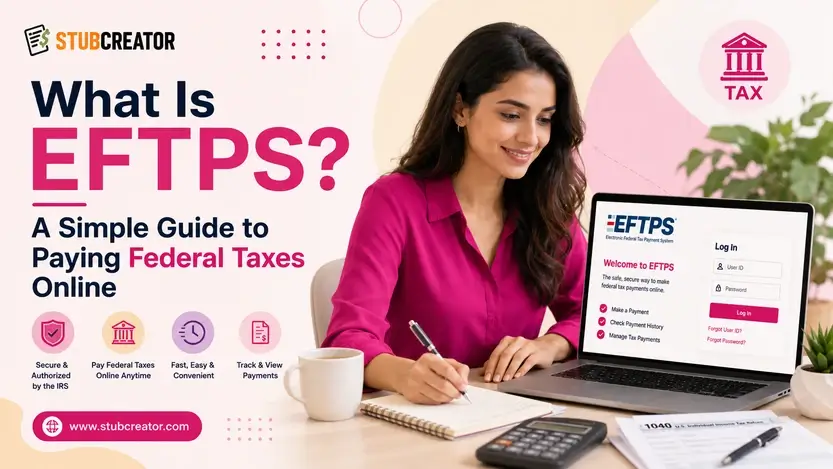
If you have ever run payroll, filed self-employed, or owed the IRS money at any point in your life, then you may have encountered something known as EFTPS. It sounds technical, but it’s actually hitched to a simple concept: the term is really just an official-sounding way of letting you send tax payments directly from your bank account instead of in the mail on a check.
This guide explains what is EFTPS, how the Electronic Federal Tax Payment System EFTPS works, information you need to sign up for EFTPS and the latest changes affecting individual taxpayers in 2026.
If you need to keep accurate income records for tax purposes, a pay stub generator can help you create organized pay stubs that clearly show earnings and deductions.
What Does EFTPS Stand For?
EFTPS stands for Electronic Federal Tax Payment System. It’s a free service run by the U.S. Department of the Treasury, not the IRS directly, though the IRS uses it to collect the money you owe.
This is like an online, secure bridge from the bank account to the U.S. Treasury. You tell IRS EFTPS how much to pay, which tax it’s for, and when to pay it. On your chosen date, the money moves out of your account and goes to the Treasury’s; no paper coupons at all, no trip to the bank, not even a danger that a check will get lost in the mail.
Who Actually Uses EFTPS?
EFTPS was designed primarily for businesses, and that remains its core user base today:
- Small-business owners who are paying payroll tax
- Corporations paying estimated corporate taxes
- A self-employed person making quarterly estimated tax payments
- Deposits on behalf of clients by payroll companies and accountants
- Government debt in the US or agencies processing their own tax-related disposals
Effective each January 1, 2026 first the rules were tightened even further, virtually all businesses with a federal tax deposit obligation must pay taxes online. This means that for the vast majority of employers EFTPS is not just an option but essentially manditory.
Important 2026 Update: Individuals Are Being Moved Off EFTPS
So, here’s what few guides on this subject will bother to mention and it’s important if you’re an individual taxpayer.
Beginning in late 2025, the Treasury ceased new individual enrollments in EFTPS. Individual accounts that are already open are being closed up until 2026, with the full system for individuals expected to sun-setting more details on that later this year.
If you’re an individual who wants to pay estimated taxes or a personal tax bill electronically, the government now points you to Internal Revenue Service Direct Pay EFTPS instead. Direct Pay doesn’t require enrollment, has no waiting period for a PIN, and works well for one-time or occasional payments straight from your checking or savings account.
Bottom line:
- Businesses → still use EFTPS.
- Individuals → use IRS Direct Pay going forward.
If you already have an active individual EFTPS account, you can generally keep using it until the transition is complete.
How Does EFTPS Work?
Once you’re enrolled, using EFTPS is fairly straightforward:
- You log in at EFTPS.gov (or call the automated phone line).
- You select the EFTPS tax type, tax period, and payment amount.
- You choose the date for making EFTPS payments withdrawn; you can schedule it up to 365 days ahead of time.
- EFTPS sends the debit instruction to your bank through the ACH network.
- On your chosen date, the funds move from your account to the Treasury, and your payment history updates.
You must schedule a payment by 8 p.m. Eastern Time the day before it’s due for it to count as on-time, so it’s smart not to wait until the last minute.
How to Enroll in EFTPS
Enrollment is a one-time process, and it’s free. Here’s the general flow for a business:
- Go to www eftps gov login and select “Enroll.”
- Choose whether you’re enrolling as a business or an individual.
- Enter your EIN (or SSN for individuals), address, and banking details.
- Submit the form. The system sends your information to the IRS for verification.
- Wait for your Personal Identification Number in the mail. This typically takes 5 to 7 business days and is mailed to your IRS address of record.
- Activate your account. Once you have your PIN, call the EFTPS phone line to get a temporary internet password, then log in to EFTPS.gov to set a permanent password.
EFTPS Login: How to Sign In
To do EFTPS sign in, you’ll need three things:
- Your Taxpayer Identification Number (EIN or SSN)
- Your PIN (the 4-digit number mailed to you)
- Your internet password (created after activation)
If you’ve forgotten your password or PIN, don’t guess repeatedly; too many failed attempts can lock your account.
Making a Payment by Phone
If you don’t want to give it up online, EFTPS has a voice response system. You dial in, follow the automated prompts, and input your EIN/PIN/payment. When the call is over, you will be given an EFT Acknowledgment Number; make a note of it. If someone questions you later, it is your proof of payment defense.
EFTPS vs. IRS Direct Pay: What’s the Difference?
Since these two systems get mixed up constantly, here’s a quick difference:
| EFTPS | IRS Direct Pay | |
| Who it’s for | Businesses (and existing individual users) | Individuals |
| Enrollment required? | Yes, with a mailed PIN unlike direct pay | No |
| Payment types | Payroll, corporate, excise, estimated taxes | Individual income and estimated taxes |
| Scheduling ahead | Up to 365 days | Up to 365 days |
| Cost | Free | Free |
| Setup time | 5–7 business days | Immediate |
If you’re a business or need to make recurring, high-volume federal tax deposits, EFTPS remains the right tool. If you’re an individual making a personal payment, Direct Pay is simpler and faster to set up.
What Can You Pay Through EFTPS?
Businesses use EFTPS to pay nearly every type of federal tax, including:
- Federal payroll taxes (Social Security, Medicare taxes, federal income tax withholding)
- Estimated tax payments
- Corporate income taxes
- Excise taxes
- Self-employment taxes (for existing individual users still on the system)
What Happens If You Pay Late?
Failing to meet a federal deposit deadline is no mere annoyance; it carries a heftier price. The IRS assesses a failure-to-deposit penalty that begins at 2% for payments made 1–5 days late and rises the longer the payment goes unpaid. Perhaps the simplest way to avoid this altogether is to schedule your EFTPS payment a couple of days in advance since you are able to set the date and then let the system automatically handle it.
EFTPS Customer Service Numbers
Here are the official contact numbers from the Treasury, all of which are staffed 24/7:
| Purpose | Number |
| Business Customer Service | 1-800-555-4477 |
| Individual Customer Service | 1-800-316-6541 |
| Payments by Phone (Voice Response) | 1-800-555-3453 |
| Internet Password Help | 1-800-982-3526 |
| Spanish Support | 1-800-244-4829 |
If you haven’t received your PIN within about a week of enrolling, that’s your cue to call and check on it rather than wait longer.
Final Thoughts
For decades, EFTPS has been the backbone of federal tax payments for businesses, and with electronic payments now a requirement for most business deposits beginning in 2026, it is more central than ever. As a business owner, signing up well in advance- before you even need to process a payment- avoids the high-pressure last-minute panic of waiting for your PIN.
If you’re an individual taxpayer, you should now simply bypass EFTPS entirely and go to IRS Direct Pay, because that’s where the Treasury is headed no matter what.
Either way, it boils down to getting your federal tax payments turned in on time with a paper trail without going to the bank.
FAQs
1) What does EFTPS stand for?
EFTPS stands for Electronic Federal Tax Payment System. It’s the official name for the Treasury Department’s online and phone-based tax payment service.
2) What is EFTPS in simple terms?
It’s a free government system that lets you pay federal taxes directly from your bank account instead of mailing a check or dropping off a paper coupon.
3) Is EFTPS the same as EFTPS.gov?
Not exactly. EFTPS is managed and maintained by the Bureau of the Fiscal Service, which is a part of the U.S. Department of the Treasury.
4) Is EFTPS run by the IRS?
Not exactly. EFTPS is operated by the Bureau of the Fiscal Service, part of the U.S. Department of the Treasury.
5) Is EFTPS the same as making a United States Treasury payment?
Yes; when you pay through EFTPS, the money is deposited into a U.S. Treasury account. It’s one of the main ways the federal government collects electronic tax payments, alongside IRS Direct Pay and card-based options.
6) Is “AFTPS” a real thing?
No; that’s simply a common misspelling of EFTPS. If you’re searching for “AFTPS,” you’re looking for the Electronic Federal Tax Payment System at EFTPS.gov.
7) How do I log in to EFTPS with my PIN?
Go to EFTPS.gov, select “Login,” and enter your EIN or SSN, your 4-digit PIN, and your internet password. If this is your first login after activation, you’ll be prompted to replace your temporary password with a permanent one.
8) I can’t log in ; what’s wrong?
Double-check that you’re entering your PIN and password exactly as issued; both are case- and format-sensitive. Too many incorrect attempts can lock the account for security reasons. If that happens, call EFTPS customer service rather than continuing to retry.
9) How do I register for EFTPS (EFTPS registration)?
Visit EFTPS.gov, select “Enroll,” choose business or individual, and submit your EIN/SSN, address, and bank account details. You’ll get a PIN by mail in 5–7 business days, then activate your account by phone before your first login.
10) Where can I download EFTPS forms?
Downloadable paper enrollment forms (like IRS Form 9779 for businesses) are also available from EFTPS. gov or contact EFTPS customer service to have one mailed to you. There is no individual “EFTPS app” to download — everything goes through the website or phone system.
11) Is there an EFTPS portal I can bookmark?
Yes ; EFTPS. gov is the official site to enroll, log in, pay your bill, and check your payment history. Skip third-party portals that advertise as “the EFTPS portal” — type in the URL yourself directly or save it in your browser.
12) What is an EFTPS batch filer?
Batch filer: A bulk provider; typically a payroll company, tax professional, or financial institution that submits large groups of EFTPS payments in one submission instead of individually.
13) Is EFTPS the same as “IRS electronic payment”?
IRS electronic payment is really a collection of several types: you have EFTPS, IRS Direct Pay, and debit/credit card payments through IRS-approved processors. EFTPS is one of the systems in the wider category but is more commonly used by businesses.
14) What’s the difference between EFTPS online and EFTPS by phone?
Neither pays you to schedule the same payments. EFTPS online (through EFTPS. The web option in gov(gov) requires an internet password in addition to your PIN; the phone method (1-800-555-3453) only needs you EIN/SSN and PIN. In the event of a website going down, you can always rely on the phone system as your payment is still due no matter if there is an operational site at that time.
15) Can I make an EFTPS payment without enrolling first?
No. Enrollment and the mailed PIN are required before you can make any payment, whether online or by phone.
Also Read:
FAQ's
How long does EFTPS enrollment take?
+
Typically 5–7 business days to receive your PIN by mail, plus a short activation call before you do log in and pay.
Is EFTPS free to use?
+
Yes, completely free. There's no enrollment fee or transaction fee from the Treasury. (Your own bank may have its own policies, but standard ACH debits through EFTPS don't carry a government fee.)
Can I cancel a scheduled EFTPS payment?
+
Yes, but you need to cancel online or by phone by 11:59 p.m. Eastern Time at least two business days before the scheduled payment date.
What if I lose my PIN or forget my EFTPS password?
+
Call EFTPS customer service at 1-800-555-4477 (business) or 1-800-316-6541 (individual). They can help you recover access without starting the enrollment process over.
Can international taxpayers use EFTPS?
+
Yes, as long as you have a U.S. bank account, you can enroll and use EFTPS from outside the country. There's a dedicated international support line (303-967-5916) for this.
Does EFTPS work for self-employment taxes?
+
EFTPS will continue to enable self-employed as well as estimated tax payments for individual users. Because new individual EFTPS enrollments are ending, you should use IRS Direct Pay instead to pay a tax bill as an individual.
Why does my EFTPS payment show as "pending" or not appear right away?
+
Payments are usually withdrawn on the date you scheduled, and it takes a day or more for your bank and the Treasury to completely agree on the transaction in your payment history. If you booked your payment online (creation of EFT Acknowledgment Number), although the online history has not been refreshed, as long as the EFT Acknowledgment Number is executed, then it is on record.
Are there any common scams related to EFTPS I should be aware of?
+
Yes. Be cautious of fake EFTPS emails, texts, calls, or websites that request personal or banking information or demand immediate payment.
What should I do if the EFTPS website is down?
+
If EFTPS.gov is unavailable, you can make your payment through the EFTPS Voice Response System at 1-800-555-3453.
How do I set up an EFTPS account for federal tax payments?
+
For eligible taxpayers, enroll through EFTPS.gov or by calling 1-800-555-4477; after enrollment, you’ll receive a PIN and can set up your online access.