.png)


 Chat with us now!
 Send Email!




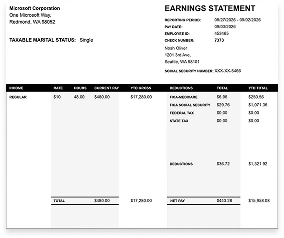
No matter where you look when examining the pay stub, you will discover a bunch of words like FED MED EE, OASDI, or FIT. Each thing relates to payroll taxes, and people need to understand that. Some amounts are taxes that must be paid. Other amounts are voluntary payroll deductions. To see how each line appears on a real pay stub, you can generate a sample with a free paystub maker.
This article explains what payroll taxes are, how much payroll taxes are, which ones apply to your wages, how to calculate tax withholding, and how to change it if the withholding is wrong.
What Are Payroll Taxes? (Definition and Meaning)
Payroll tax refers to a tax on wages, which is shared between workers and their employers, and is used to pay for various programs, such as Social Security tax, Medicare, and unemployment insurance.
You can more easily understand what payroll taxes mean by looking at your paycheck. Additionally, the employer has to make the matching contribution.
In the USA, payroll taxes are significant – in 2025, they accounted for about of total federal revenues, after income tax.
Another term you may come across is that of employment tax. The IRS considers employment tax as a general category for Social Security, Medicare, federal unemployment tax, and federal income tax withholding.
It is crucial to distinguish between payroll and income tax. The former involves flat rates that account for the cost of certain initiatives shared by the company and its employees. The latter follows a progressive rate system, supports general public services, and is your personal responsibility.
Common Payroll Taxes Withheld From Your Earnings
Here are the taxes that most often come out of a US paycheck:
| Tax | Rate | Who pays | Notes |
| Social Security | 6.2% | Employee and employer (each) | Applies to wages up to $184,500 in 2026 |
| Medicare | 1.45% | Employee and employer (each) | No wage cap |
| Additional Medicare | 0.9% | Employee only | On wages above $200,000 |
| Federal income tax | Varies | Employee only | Based on your Form W-4 |
| State and local income tax | Varies | Employee only | Some states have none |
1. Social Security Payroll Tax
The employer and employees pay the Social Security payroll tax only on the employee’s earnings up to a certain maximum limit. If we take an example from 2023, the maximum limit on the earnings of an employee on which the tax will apply is set at the amount of $160,200. The tax stops once your earnings hit the yearly cap.
For 2026, that cap is $184,500, so the most an employee can pay is $11,439 for the year. Earnings above the cap are not subject to this tax.
2. Medicare Tax
In case you are unsure about what FED MED EE indicates on your salary slip, it represents Federal Medicare, Employee’s portion. This 1.45% amount refers to the Medicare tax deducted from your earnings. Medicare is funded to address hospital coverage for those who are 65 years and older and those with specific incapacities.
Medicare has no ceiling like Social Security. Your employer contributes the same 1.45% tax. A 0.9% additional medicare tax applies to higher incomes of more than $200,000 since the employer does not bear this contribution.
Social Security payroll deduction is commonly referred to as FED OASDI/EE. The abbreviation OASDI stands for Old-Age, Survivors, and Disability Insurance.
3. Federal Income Tax Withholding (IRS Tax Withholding)
IRS Tax withholding is a prepayment of your annual taxes. Your employer makes payments to the IRS so that you won’t owe a large sum at the end of the year.
This deduction is calculated based on your gross income, tax status, and your information on Form W-4. Unlike Social Security, there is no matching contribution by the employer.
How Much Taxes Are Taken Out of Paycheck?
Two of the components of the answer remain constant, while the other two do change:
- Social Security and Medicare: a total of 7.65% of your salary (6.2% and 1.45%).
- Federal tax: this is determined by your W4, income level, and your status when filing.
- State and local taxes: this is again dependent on where the person resides and works.
- Pre-tax and post-tax deductions: this is totally contingent on the benefits chosen.
Here is a simple example for someone earning $2,000 gross every two weeks:
| Item | Amount |
| Social Security (6.2%) | $124.00 |
| Medicare (1.45%) | $29.00 |
| Total FICA withheld | $153.00 |
Federal and state income tax come on top of that, and those vary from person to person.
How Much Are Payroll Taxes in Total?
In regard to payroll tax rates in the USA, consider both components. The combined rate of Social Security is 12.4% (6.2% for each side), and the combined rate of Medicare is 2.9% (1.45% for one side), thus resulting in the total payroll tax amount of 15.3% that is equally divided between the worker and the employer.
What is more, employers pay for unemployment tax, which is not specified in employee paystubs. It is estimated that the total payroll tax bill of any employer may be anywhere between 8% and 15% of an employee’s gross pay, based on other factors.
What Are Employer Payroll Taxes (ER Taxes)?
On a paystub, ER taxes are the amounts your employer pays on your behalf, considered employer contributions.
They are a cost to the company, and they don’t reduce your take-home pay.
They include:
- Matching Social Security and Medicare: 6.2% and 1.45%.
- Federal Unemployment Tax Act (FUTA): the rate is 6% on the first $7,000 wage base limit. Most employers get a credit of up to 5.4%, which brings the effective rate down to 0.6%, or $42 per employee per year.
- State Unemployment Tax Act (SUTA): rates and wage limits vary by state and by the employer’s claims history.
Employers deposit these taxes with the government and report them on Form 941 each quarter. Federal unemployment tax is reported separately on Form 940.
What Are Payroll Deductions?
Payroll deductions are amounts taken from your gross pay before you receive your net pay. They cover taxes, benefits, savings and other obligations.
When people inquire about paycheck deductions, they generally refer to two categories:
- Mandatory Deductions: These deductions include federal income tax withholding, state income tax withholding, Social Security, Medicare, and any court-mandated child support garnishments.
- Voluntary Deductions: These deductions consist of health insurance premiums, retirement savings, HSA contributions, life insurance premiums, and payment of union dues (which will need the employer’s permission to carry out).
It’s important to highlight the definition of tax deductions. Tax deductions refer to expenses that reduce taxable income. Unlike payroll deductions which are deducted from gross wages, tax deductions are applied after the calculations have been done.
What Are Pre-Tax Deductions?
A pre-tax deduction is money taken out of your paycheck before income tax is calculated, so it lowers your taxable income. To define pre-tax deductions simply: you aren’t taxed on that money in the current pay period.
Pre-tax deductions and contributions commonly include:
- Traditional 401(k) or 403(b) retirement contributions
- Health, dental and vision premiums paid through an employer plan
- Health savings account (HSA) contributions
- Flexible spending account (FSA) and dependent care FSA contributions
Post-tax deductions work the other way. They come out after taxes are calculated and don’t reduce your taxable income.
| Pre-tax deduction | Post-tax deduction | |
| When it’s taken | Before taxes are calculated | After taxes are calculated |
| Effect on taxable income | Lowers it | None |
| Examples | Traditional 401(k), HSA, FSA, health premiums | Roth 401(k), wage garnishments, union dues |
One detail matters here. Health premiums paid through a Section 125 plan usually reduce both income tax and Federal Insurance Contributions Act Wages. A traditional 401(k) contribution lowers your income tax, but Social Security and Medicare are still calculated on the full amount.
How Are Payroll Taxes Calculated?
The math follows the same order every pay period:
- Start with total income, consisting of salary, hourly wages, bonuses, and overtime.
- Subtract deductions that come before tax, like health contributions, 401(k) contributions, and HSA/FSA deposits.
- Calculate Social Security tax and Medicare tax. The rates are 6.2% till the maximum limit and 1.45% on all income and an additional 0.9% for income more than 200,000.
- Calculate the federal withholding tax using IRS withholding tables and your W-4 form.
- Add state and local tax if needed.
- Subtract all deductions that are applied even after tax.
How to Calculate Tax Withholding and How Much to Withhold for Taxes?
For the purpose of withholding taxes, employers either follow the IRS wage bracket or percentage approaches. They determine withholding by checking the estimate according to the specific employee’s status and deducting any tax credits claimed. Then they add on any extra withholding requested by the taxpayer.
How to Adjust Your Withholding?
Getting the amount wrong costs you either way. Too little leads to a tax bill and possible penalties. Too much means an interest-free loan to the government that you only get back as a refund.
To adjust withholding:
- Check your current numbers with the IRS Tax Withholding Calculator.
- Fill out a new Form W-4.
- Give it to your employer. Changes usually show up in your next few paychecks.
Update the form after big life events like a marriage, a new child, a second job or a raise. Your state may have its own withholding form too.
Final Thoughts
While federal payroll tax can initially seem challenging, it’s easy to interpret a paycheck once you’ve grasped the information presented in it.
The deductions for Social Security and Medicare are fixed; the income tax is determined according to the information provided on the W-4, while the deductions relate to your employee benefits selections. If there seems to be an issue with the withholdings, it is simple to rectify it by updating the W-4 form.
FAQ's
What payroll taxes are withheld from my paycheck?
+
Social Security, Medicare, national income taxes, and state income taxes where applicable.
Are payroll taxes federal or state?
+
The answer is both. Social Security, Medicare tax, and FUTA are federal taxes. State unemployment taxes and state income taxes are decided by the state.
Do employers pay payroll taxes too?
+
Yes, employers have to match Social Security and Medicare taxes, plus pay federal income tax and state unemployment tax.
Is a pre-tax deduction better than a post-tax one?
+
Pre-tax deductions will reduce your taxable income at this time, whereas post-tax deductions may not do so but can give qualified withdrawals tax-free in the future. So it depends.
Is payroll tax the same as income tax?
+
No, payroll tax funds Social Security, Medicare, and unemployment insurance and is shared with the employer, while income tax is spent on the government budget and is paid by you alone.