.png)


 Chat with us now!
 Send Email!

Ask most people what “compensation” means, and they’ll say one word: salary. That’s fair, but it’s also only about half the story.
When HR teams and finance departments talk about financial compensation, they mean everything an employer gives an employee in exchange for their work; not just the number that lands in a bank account every two weeks, but the insurance, the stock, the 401(k) match, the extra vacation days, even the free lunch on Fridays.
None of that is trivia. If you’re negotiating an offer, running payroll, filing for workers’ comp, or just trying to make sense of your own pay stub, knowing which bucket each type of pay falls into actually matters: for taxes, for budgeting, and for figuring out whether an offer is as good as it looks on paper.
So let’s go through it properly, from the basic definition all the way down to creating paystubs with proper employee compensation using a pay stub generator.
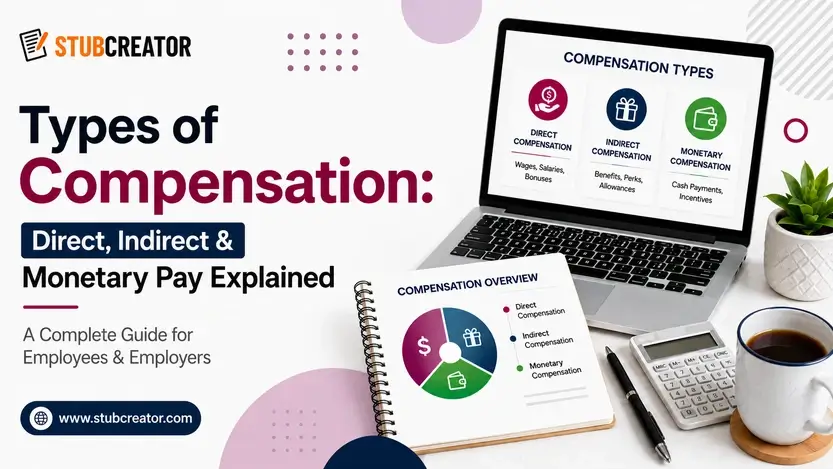
Quick answer: Compensation splits into two broad types; direct compensation and indirect compensation. Add them together and you get an employee’s total compensation.
What is Compensation?
Compensation is the full economic value an employer provides to someone for their labor. Outside North America, people often call this “remuneration compensation” instead; same idea, different word, and you’ll see both used interchangeably in HR literature, job postings, and labor law.
It’s worth separating a few terms that get used almost interchangeably, but they are not the same:
- Salary/wages – one of the compensations, not the entire compensation
- Compensation – your complete compensation package: pay and benefits and everything
- Remuneration – a global word of art used non-lavishly in the UK, EU, and abundant parts of Asia
- Total compensation – the entire price of all that package dollar-wise cumulatively
Getting this right matters most in two moments: when you’re comparing competitive salaries, and when a company is trying to build a pay structure that’s actually fair and defensible across roles.
Compensation in Business: Why It’s Not Just an HR Topic
Just from a business point, compensation is one of the largest line items on a balance sheet of company income. It means that the gearing of cash compensation is not just a factor in generosity or competitiveness; it is a key strategic input into management thinking around cash flow, hiring capacity to retain risk, and investor perception at public companies.
Types of Compensation
If you’re trying to map out the full classification of a well-structured compensation plan, it generally breaks down along two axes: how it’s paid (direct vs. indirect) and why it’s paid (base pay vs. incentive pay vs. benefits). Here are some:
- Direct/cash compensation – salary, wages, commission, bonuses
- Indirect/non-cash compensation – insurance, retirement contributions, perks
- Incentive compensation – pay explicitly tied to performance, whether cash or equity
- Deferred compensation – earned now, paid later
- Equity compensation – ownership or the right to future ownership
Some organizations also add a sixth bucket for statutory or legally mandated compensation.
Monetary vs. Non-Monetary Compensation
This is probably the most-searched topic, so let’s be direct about it.
- Monetary compensation – It is known as financial compensation, cash compensation, or simply money compensation. Pay with a clear dollar amount, paid in cash (or equivalent), or convertible into cash. It includes salary, wages by the hour, commission, and cash bonuses. In one line, what is monetary compensation: it’s payment an employee can spend in the supermarket, save, or put in the bank with no intermediary conversion step.
- Non-monetary compensation – It is of actual value to the employee but not exchanged in currency form; for example: additional PTO, flexible schedules, or a company laptop.
A few quick examples of compensation, sorted:
- Monetary: salary, hourly wage, commission, cash bonus, tips, piece-rate pay
- Non-monetary: health insurance, extra vacation days, company phone, gym membership, flexible hours
- Mixed/deferred: stock options, RSUs, 401(k) match, pension contributions
The Two (Really Three) Types of Compensation
Almost every compensation plan you’ll ever encounter is built from these layers:
| Category | What’s included | Cash in hand? |
| Direct compensation | Salary, wages, commission, bonuses, tips | Yes |
| Indirect compensation | Insurance, retirement plans, equity, PTO | Not immediately |
| Total compensation | Direct + indirect, combined | Mixed |
Direct Compensation: The Cash Part
Direct compensation is what most people mean when they ask “what are employee expectations as in direct compensation?” It’s the number you’d write on a loan application, and it’s the part payroll systems track most closely.
1. Hourly wages: It is the go-to for part-time, hourly based employees and contract workers, especially in retail, hospitality, and construction. Hourly employees generally qualify for overtime once they cross a set number of hours, and every employer has to stay above local minimum wage requirements.
2. Salary: A solid yearly sum that is generally saved for full-time workers and management positions. It does not tick to the same rhythm as the clock, and it is often a sign that a company views the position as more of a long-term play. Base pay is the combination of salary and hourly wages.
3. Commission: It is variable pay, which is most prevalent in sales. Some roles are 100% commission-based, while others combine a base salary plus commission on top to soften the swings in income a bit.
4.Bonuses: They come in more flavors than people usually realize:
- A signing bonus gets a new hire through the door; common when a company’s competing hard for talent.
- A retention bonus rewards someone for sticking around through a specific period.
- A performance or merit bonus is tied to hitting targets.
- A discretionary bonus isn’t guaranteed by any formula.
Types of Salaries
“Salary” itself isn’t one flat thing either. Depending on where you are and how the offer is structured, you’ll run into:
- Gross salary– total pay before any deductions.
- Net salary (take-home pay) – what actually lands in your account after deductions.
- CTC (Cost to Company) – used mostly outside the U.S., this is the full cost an employer bears for an employee.
- Fixed salary – a set amount that doesn’t change regardless of performance.
- Variable salary/pay – a portion that fluctuates based on performance, company results, or targets.
- Consolidated salary – a single lump figure that already bundles in allowances rather than breaking them.
Types of Deferred Compensation Plans
Deferred compensation is money you’ve earned now but won’t actually receive until later.
- Non-qualified deferred compensation (NQDC) plans let highly paid employees push part of their salary or bonus into the future.
- Qualified retirement plans like a 401(k) or pension come with tax advantages in exchange for locking the money up.
- Deferred bonus plans pay out performance bonuses years down the line instead of immediately.
- Annuities are structured future payments, often built into comprehensive compensation packages.
- Supplemental Executive Retirement Plans (SERPs) are deferred retirement benefits offered specifically to executives.
Indirect Compensation: Everything Beyond the Paycheck
If you’ve searched something like “forms of employer compensation in addition to pay are called” — this is the answer. It’s called indirect compensation, though most people just say “benefits.”
It’s compensation with genuine financial value that isn’t dropped into your bank account as cash:
- Health, dental, vision, and life insurance
- Retirement contributions (401(k) matching, pensions)
- Paid time off, sick leave, parental leave
- Disability coverage and workers’ comp
- Flexible or remote work options
- Tuition reimbursement
- Company car, phone, laptop, meals
On 401(k) matching specifically, there are three common structures:
- Dollar-for-dollar match — the employer matches contributions 100%, up to a cap
- Partial match — the employer matches a percentage, like 50% of the first 6%
- Discretionary match — the employer decides year by year whether to match at all
Types of Equity Compensation
Equity compensation is common at startups that can’t yet compete on cash salary but want to offer long-term upside instead.
- Stock options give you the right to buy shares later at a locked-in price, usually after a 3–5 year vesting period
- RSUs (Restricted Stock Units) are actual shares handed over once you hit certain conditions — no purchase required
- ESPPs (Employee Stock Purchase Plans) let employees buy company stock, often at a discount
- SARs (Stock Appreciation Rights) pay out the increase in stock value in cash or stock, without requiring you to buy anything
- Profit-sharing plans distribute a slice of company profits to employees, in cash or deferred form
Total Compensation: Adding It All Up
Total compensation is direct pay plus indirect pay plus equity; the real value of a job offer, not just the salary line.
Companies tend to present it one of two ways. Either as two simple buckets:
- Direct: salary, bonuses, commission, stock
- Indirect: benefits, retirement, PTO
Or broken down further:
- Cash compensation (salary, bonuses, commission)
- Retirement and long-term benefits (401(k) match, pension)
- Health and wellness benefits
- Growth benefits (tuition, professional development)
More companies now send employees a total compensation statement each year, mostly because base salary alone tells a misleading story about what a job is actually worth.
Compensation Structure: How Companies Actually Decide Pay
A compensation structure is the internal logic a company uses to figure out who gets paid what. The main pieces are:
- Pay grades or bands – salary ranges tied to specific job levels
- Market pricing – checking what competitors pay for similar roles
- Pay equity reviews – making sure two people doing the same job aren’t paid differently for reasons that have nothing to do with performance
- Progression paths – how pay actually moves up over time, whether through tenure, promotion, or performance
Without a real structure, pay decisions end up inconsistent and hard to defend; which is exactly the kind of thing that erodes trust fast.
Compensation Techniques and Methods
There’s also a whole discipline around how companies decide what a role should pay in the first place. The most common compensation techniques include:
- Job ranking method – roles are ranked relative to each other by overall importance, then pay follows the ranking
- Job classification/grading method – roles are sorted into predefined grades or classes, each with its own pay band
- Point-factor method – roles are scored against factors like skill, responsibility, and effort, and points translate into pay
- Market pricing method -pay is set by directly benchmarking against what other companies pay for comparable roles
- Factor comparison method – a more granular version of point-factor, comparing roles factor-by-factor against benchmark jobs
Most mid-size and large companies use some blend of market pricing and job grading rather than picking just one method in isolation.
Compensation and Benefit Planning
Compensation and benefit planning is the forward-looking process of deciding how a company will pay people this year and several years out. It usually involves:
- Setting a compensation philosophy (lead the market, match it, or lag behind it deliberately)
- Building or updating pay bands and job grades
- Budgeting for merit increases, bonuses, and benefit costs
- Reviewing pay equity across gender, role, and location
- Deciding which benefits to add, cut, or expand based on cost and employee demand
Done well, this planning process is what keeps a compensation structure from becoming outdated or unfair a few years down the line.
Types of Workers’ Compensation Insurance
Worth flagging separately: workers’ compensation isn’t really “pay” in the usual sense ; it’s insurance that kicks in when someone’s hurt or gets sick because of their job.
- Medical benefits cover treatment for a workplace injury or illness
- Temporary disability benefits replace part of an employee’s wages while they recover and can’t work
- Permanent disability benefits apply when the impairment doesn’t go away, whether partial or total
- Vocational rehabilitation helps retrain someone who can’t go back to their old role
- Death benefits go to dependents if a workplace incident is fatal
This is almost always mandated by law and funded through employer-paid insurance premiums, not deducted from an employee’s own pay.
Types of Legal Compensation (Damages)
Compensation shows up outside the workplace too; in courtrooms, where “compensation payment” usually means damages: payment meant to make an injured or wronged party whole again.
- Compensatory damages cover real financial losses: medical bills, lost wages, property damage
- Non-economic damages cover things like pain, suffering, or emotional distress
- Statutory compensation comes from specific laws, like state funds that compensate people who were wrongfully convicted
Where This Shows Up on Your Pay Stub
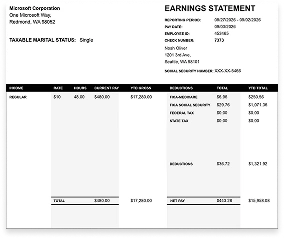
All of this has to end up accurate on a pay stub; base pay, overtime, commissions, bonus deductions for benefits and so on; it all needs to come together somehow. Heavy when you incorrectly classify a bonus as regular wages or omit separate reporting of the retirement contribution; boing, instant compliance nightmare!
That’s the exact problem Stub Creator is built to solve: generating accurate, professional pay stubs that reflect direct pay, deductions, and benefits correctly, whether you’re running payroll for a team or documenting income as a freelancer.
People May Ask
1) What is monetary compensation?
Pay with a direct cash value: salary, wages, commission, bonuses. Anything you could deposit, basically.
2) What is financial compensation?
Same idea as monetary compensation: pay with a clear dollar value, whether it lands in your account right away or has future cash value.
3) What’s the difference between direct and indirect compensation?
Direct compensation is cash – salary, bonuses, commission. Indirect compensation has real value but isn’t paid as cash, such as insurance, retirement contributions, equity.
4) What compensation are you seeking?
A classic interview question about your expected pay.
5) What type of account is unearned compensation?
In accounting, this is treated as a liability, not an asset, as it represents money the company owes because the service or time period tied to that pay hasn’t been fully delivered yet.
6) How much does workers’ compensation actually pay?
Usually a percentage of average wages, often around two-thirds, depending on the state or country, plus coverage of medical costs.
7) Is a bonus direct or indirect compensation?
Direct. It’s paid in cash, even though the amount varies and isn’t guaranteed like base salary.
8) Are stock options monetary or non-monetary?
Technically indirect financial compensation; real monetary value, but not immediate cash, and dependent on vesting and how the stock performs.
9) What does compensation payment mean?
Outside of employment, it usually refers to a payment awarded to compensate someone for a loss, injury, or wrong scheme.
10) What’s the difference between compensation and remuneration?
Practically none; remuneration for employees is just the term more commonly used outside the U.S. and Canada for the same overall concept.
Also Read:
Pay Stubs Meaning: The Complete Guide for US Employees & Employers
IRS EITC ACTC Refund Delay Explained: 2026 PATH Act Timeline
FAQ's
What is the method of compensation in a job offer?
+
It refers to how you're paid: salary, hourly, commission, or a mix, plus how often (weekly, biweekly, monthly) and through what channel (direct deposit, check).
What types of compensation did Carlton Lewis receive since being released?
+
Lewis was exonerated in 2023 after more than three decades of wrongful imprisonment and filed a claim for state compensation for wrongful conviction.
What's the difference between compensation and a salary?
+
Salary is one component. Compensation is the whole package of salary plus bonuses, benefits, equity, and anything else with value tied to the job.
Are "types of compensators" the same as types of compensation?
+
No - a compensator is a different, unrelated term used in electronics and control systems (referring to circuits that adjust signal behavior).