.png)


 Chat with us now!
 Send Email!

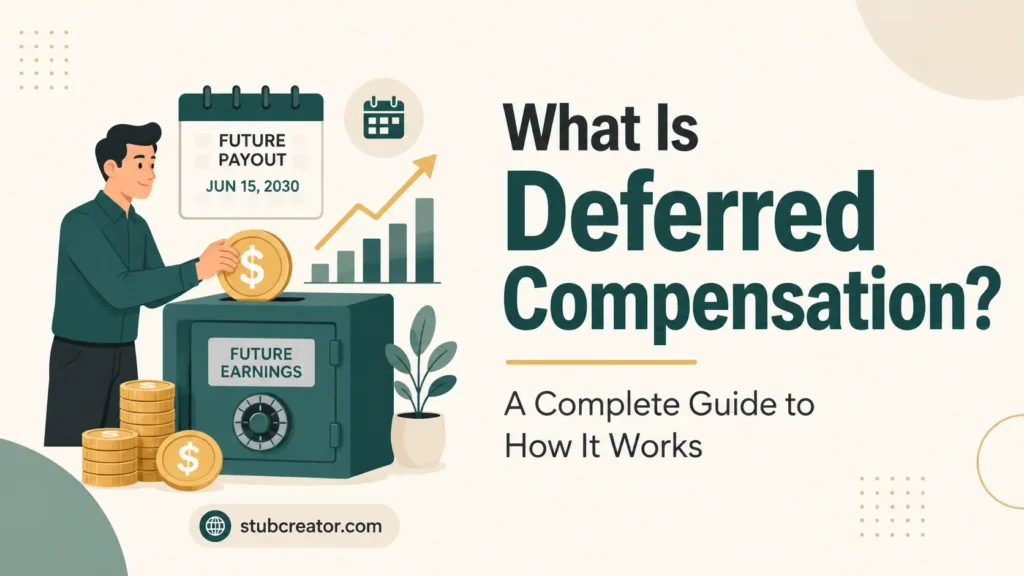
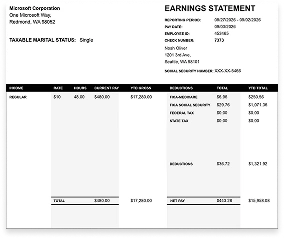
This is how most paychecks work: you earn it, then you get it. Deferred compensation changes that rule intentionally. You don’t just take all your pay now; instead, you (or your employer, on your behalf) agree to defer part of it to the future, which is why pensions come into play at or near retirement.
That all sounds simple enough, but the details are where things get very tricky. The type of plan you’re in changes your tax bill, your risk if your employer runs into trouble, and even what shows up on your W-2. If you need to document deferred earnings or review payroll deductions, a pay stub generator can help create accurate paycheck records that reflect compensation and withholding details.
For employees deciding whether to enroll or employers seeking to build a benefits package, this guide breaks down exactly what deferred compensation is. How it works, and the different types of plans and pitfalls.
What Is Deferred Compensation?
Deferred compensation is an arrangement in which the employee agrees to receive part of their salary, bonus, or other income at a later date (usually retirement) rather than when earned. Because the income tax on the deferred amount is likewise delayed until it is paid out, this is most commonly done for taxation benefits.
Deferred Compensation Meaning
In simple terms, deferred compensation is money that you have earned but have not paid out by your own decision. An employee chooses to defer a portion of his/her pay (salary, bonus, commission, or equity) until some date or event in the future, typically at retirement/separation from the company.
The arrangement is formalized in a written plan or agreement that spells out:
- How much income is being deferred
- When will the money be paid out
- What happens if the employee leaves the company early
- How the deferred amount is taxed
Deferred compensation plans are most often offered to executives and other highly compensated employees because they have generally already reached the annual limits for contributing to employer-sponsored retirement accounts.
Deferred Compensation vs. Deferred Income
You will regularly see “deferred income” used synonymously with deferred compensation, and this is correct; they refer to the same thing.
Deferred income, in other words, means income that has not yet been recognized as taxable income because it will be paid at a later date.
The only true difference is context: “deferred compensation” generally describes the actual plan or arrangement, and “deferred income”, in a general sense, which means the money that is sitting there in that deferred state.
How Does Deferred Comp Work?
Def comp is essentially the same process: you choose to defer, the money just sits (often working for you in the form of investments), and then pays out per the rules established at your original enrollment.
The Deferral Timeline – Election, Vesting, Distribution
- Election period: Prior to earning the compensation, the employee selects his/her deferral level and a payment timing (when to pay out against that compensation; post-retirement, in certain future years, upon termination of employment, disability, etc.). Once made, this election is typically irrevocable for non-qualified plans.
- Taxation: This means you only pay income tax when the money is actually paid out, rather than when you originally earned it.
- Deferral and growth period: The deferred comp amount is set aside, sometimes in an actual account, sometimes as a bookkeeping entry, and may grow based on investment options the plan offers, such as mutual funds or company stock.
- Vesting (if applicable): You are required by the plans to remain with the company for a contractual time period before you own the deferred amount in its entirety. If you leave before vesting fully and early, amounts unvested may also be lost.
- Distribution event: So payout happens after the specified event: retirement, a certain date, separation from service, or even, in some cases, an unforeseeable financial emergency.
Qualified vs. Nonqualified Deferred Compensation Plans
The particular rules vary as per the deferred compensation plan, whether it is qualified or non-qualified.
Almost all deferred compensation plans can be classified into one of two buckets, but the bucket that you fall in determines almost everything else about how your plan behaves.
Qualified Deferred Compensation Plans
A qualified deferred compensation plan is the one most people are already familiar with: 401(k)s, 403(b)s, and traditional pensions. They’re called “qualified” because they meet IRS and ERISA (Employee Retirement Income Security Act) requirements, which means:
- They must be offered to employees on a nondiscriminatory basis (not just executives)
- Contributions are capped by annual IRS limits
- Funds are protected from company creditors; even if the employer goes bankrupt, your money is safe
- Plans typically allow rollovers to an IRA or another qualified plan when you change jobs
Nonqualified Deferred Compensation (NQDC) Plans
Unlike qualified retirement plans, nonqualified deferred compensation (NQDC) plans typically fall outside of the protections afforded under ERISA. Payouts are typically selective, to executives, key employees, or top performers, not the entire workforce.
You may also hear these referred to as Section 409A plans (the section of the IRS code that governs them) or “golden handcuffs” because they are often used to retain critical employees.
While NQDC plans allow you to be more creative (you are not bound by IRS contribution caps, you can construct your own payout schedule), there is real risk here:
- Until that runs out, the deferred income is technically still a company asset, not an employee asset
- If the employer goes bankrupt, NQDC participants rank as general creditors, and they could, in fact, lose part or all of the deferred amount
- Distribution timing is set once you own the asset & much less flexible than qualified plans.
Qualified vs. Nonqualified – Comparison Table
| Feature | Qualified Plans (e.g., 401(k)) | Nonqualified Plans (NQDC) |
| Eligibility | All employees | Select executives/key employees only |
| Contribution limits | Set annually by the IRS | No IRS-imposed limit |
| ERISA protection | Yes | No |
| Risk if the company fails | Protected | At risk as a general creditor |
| Rollover to IRA | Yes | No |
| Distribution flexibility | More flexible, can adjust over time | Locked in at the election, rarely changeable |
Types of Deferred Compensation Plans
Deferred comp isn’t one single plan; it’s a category that includes several distinct plan structures.
401(k) and 403(b) Plans
These are the most widely used qualified deferred compensation plans. Employees defer a percentage of every paycheck pretax (or post-tax in Roths) to an investment account and are limited annually on how much they can contribute, as dictated by the IRS. 403 (b) plans are similar but are available for non-profit and educational employers.
457(b) Plans
457(b) plans are deferred compensation plans for state and local government employees, as well as some nonprofit organizations. They work similarly to a 401(k) in that savers contribute pretax dollars and see their savings grow tax-deferred, but have their own rules, such as sometimes no early withdrawal penalty before retirement age, unlike the 401(K).
Nonqualified Deferred Compensation Arrangements
As discussed above, these are non-qualified contractual agreements, usually with executive employees only, where the employee gets to defer salary or bonus income beyond what qualified plans would allow, as defined under Section 409A.
Deferred Bonus and Stock-Based Deferral Plans
Some companies allow employees to defer the whole or part of their annual bonus, commission, or equity award (such as restricted stock units) from one year until the future. This is not unusual when it comes to offerings in finance, tech, or executive compensation packages, which often include long-term incentives based on how well a company performs.
Pension/Defined Benefit Deferral Arrangements
Indeed, a traditional pension is also technically a form of deferred compensation. The firm promises (at least in principle) a specific benefit paid out at retirement and funded over the employee’s career. While conceptually similar to deferred comp, it is structured and governed differently enough, as discussed below, that it deserves a separate explanation.
Pros and Cons of Deferred Compensation
Benefits for Employees
- Tax timing advantage: Essentially, income tax is deferred, and most employees anticipate they’d be in a lower tax bracket when they retire to receive payouts.
- Higher savings potential: Unlike 401ks, which are subject to IRS contribution limits, nonqualified plans can allow high earners to stash away much larger amounts.
- Retirement readiness: Offers a systematic way for saving in excess of normal Retirement arrangements.
Benefits for Employers
- Retention tool: Golden handcuff structures and vesting schedules encourage key employees to remain with the company.
- Recruiting advantage: An attractive deferred comp plan helps draw and retain executives.
- Cash flow flexibility: Pushing out compensation payments can help cash flow for payroll in the short run.
Risks and Drawbacks
- Limited liquidity: After deferring, you typically cannot withdraw the funds before retirement without an eligible hardship.
- Administrative complexity: Solely for the purposes of Section 409A, plans must be drafted and maintained in such a way that mistakes may result in immediate taxation plus penalties.
- No ERISA protection for NQDC plans: If the company goes bankrupt, deferred amounts in nonqualified plans can be lost.
- Lack of portability: Unlike qualified plan balances, which can be rolled into an IRA tax-free, deferred comp balances are generally not eligible to roll to an IRA.
How Is Deferred Compensation Taxed?
Here are some ways you can check how deferred compensation is taxed.
Deferred Compensation on Your W-2 (Box 11 & Box 12)
Deferred compensation shows up on your W-2 in specific places, and understanding them helps you avoid tax-filing confusion:
- Box 11 (Nonqualified Plans): This shows distributions you actually received during the year from a nonqualified deferred compensation plan — this amount is taxable income for that year.
- Box 12: Contributions you made into certain deferred compensation arrangements (such as 401(k) elective deferrals, coded “D,” or 457(b) deferrals, coded “G”) appear here with a corresponding letter code. These amounts are typically excluded from Box 1 taxable wages for the year they’re deferred.
When You Pay Taxes on Deferred Income
Deferred compensation is subject to federal (and typically state) income tax when it is paid out to you, not the year it was earned. This is the primary tax advantage to these plans, you save on your total tax bill as long as you are in a lower bracket at the time of distribution (commonly retirement).
FICA and Social Security Timing
This is a detail that many miss: FICA taxes (Social Security and Medicare) owed on nonqualified deferred compensation are generally due in the year the money is earned and vested, not when it’s paid out.
This is known as the “special timing rule” at times. This means you might be subject to FICA tax on income that is deferred for years before you actually get the cash, something worth strategizing around with your tax advisor.
Is Deferred Compensation Right for You?
Whenever deferred compensation is going to make the most sense:
- You are making good money and have already funded your 401(k)and IRA
- You are in a lower tax bracket in retirement than you are today
- You trust that your employer will remain financially sound in the long haul
- You don’t need the deferred income for liquidity needs in the near term
Ideally, you should be a little more careful if:
- Your employer is in an uncertain financial position
- You might need to access that money prior to the distribution date
- You have no clarity on the vesting and forfeiture terms of the plan
Like any major financial choice, it’s a good idea to have a tax advisor or other knowledgeable professional go over your particular plan documents before deciding to defer large amounts of compensation.
Conclusion
One way to effectively create long-term savings is through deferred compensation, which may reduce your current tax burden. If you are in a qualified plan like a 401(k), or a non-qualified deferred compensation arrangement, it’s important to become educated about the rules, risks, and tax consequences before locking up part of your income for future payments.
Which deferred compensation strategy fits best depends on your financial goals, how long you expect to work for your employer, and how much you trust that the company will be there in 10 or even 30 years. When reviewing your pay, a free online pay stub generator enables you to maintain accurate payroll records and understand the interrelations among deferred earnings and deductions with respect to total income.
Frequently Asked Questions
1) What is deferred compensation in simple terms?
It is an agreement between your employer and you in which you agree to take part of your salary later, not now, typically for tax breaks and retirement savings.
2) What is “def comp” on my paycheck?
Def comp, or deferred comp, on a pay stub that says the amount from that paycheck is being withheld and sent to a deferred compensation/retirement plan instead of being paid out directly to you.
3) How does deferred comp work when you leave a job?
It depends on the plan. Retaining balance in qualified plans such as 401(k)s is normally yours, and they usually roll over. Nonqualified plans may have a vesting schedule, in which case, you forfeit any unvested amounts if you leave before the end of that schedule.
4) What is better, 401k or deferred compensation?
For most employees, a 401(k) is going to be superior due to its protections and flexibility, while deferred compensation may work well for high-income earners looking for extra savings.
5) What are the cons of deferred compensation?
Deferred compensation can restrict access to these funds, as well as risk the loss of them if the employer runs into financial trouble.
6) Can I cash out my deferred compensation?
Deferred compensation is often only accessible as stated in the investment and payment schedule of that plan or under special conditions.
7) What is the 2.5 month rule for deferred compensation?
The 2.5-month rule permits particular payments occurring shortly after year-end to be exempt from being treated as deferred compensation under IRS regulations.
8) What happens to deferred compensation if I quit?
Your payout is subject to the terms of your plan when you terminate, with an unvested amount forfeited and possibly not paid until later if it was vested.