.png)


 Chat with us now!
 Send Email!
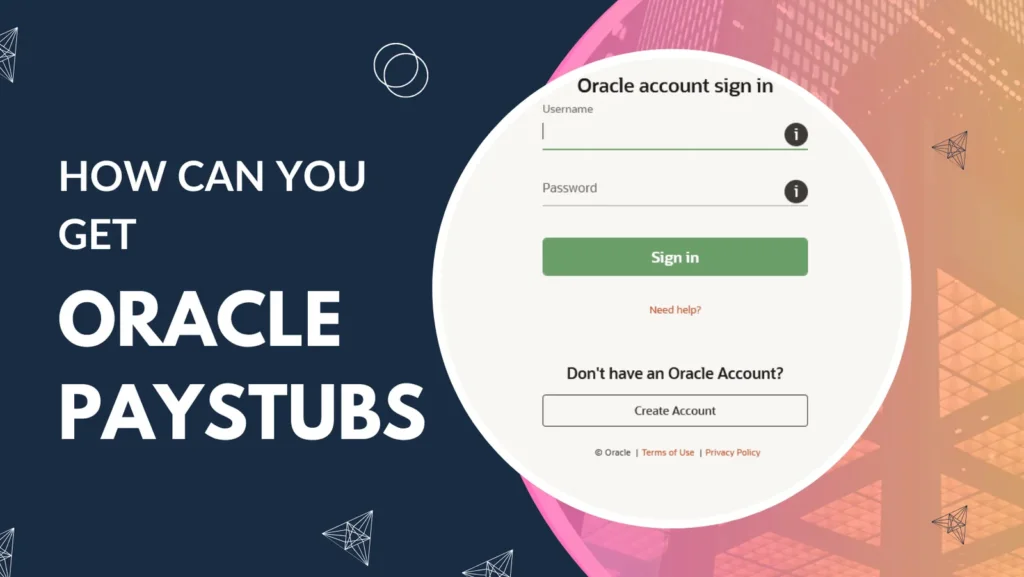
Accessing Oracle payroll information quickly and safely is essential. Whether you need to log in and download your Oracle paystub, verify deductions, or use the Oracle login employee portal, the Oracle login employee process is straightforward.
Many employees search online for terms like oracle login worker, oracle worker login, oracle login worker paystub, oracle fusion login worker, oracle cloud login worker when trying to find their payroll information. This manual explains everything about accessing your Oracle paystub, troubleshooting login issues, and accessing Oracle payroll services.
Also, you can use the reliable check stub generator, to get your pay stub at your fingertips.
Burning Question: How to get your Oracle paystubs easily?
- Go to the Portal: Visit your company’s Oracle HCM login URL.
- Log In: Enter your employee username and password. Use SSO if your company requires it.
- Navigate to Pay: Go to: Me → Pay → Payslips.
- Select Your Paystub: Choose the pay period you need from the list.
- View or Download: Click to view online or download as PDF.
Understand the Oracle Payroll System
Oracle Payroll is a body of worker value solutions that enables groups to manage employee compensation.
Key features include:
- Automated payroll processing
- Tax calculations
- Direct deposit management
- Global payroll support
- Employee self-service
- Payroll reporting
- Compliance management
Oracle Payroll is integrated with Oracle Fusion Cloud HCM and helps international companies with payroll operations.
What is the Oracle Login Employee Portal?
The Oracle Login Employee Portal is a secure self-service platform that allows employees to access benefits, personal information, and employment records online. Depending on your employer’s Oracle implementation, you might access:
- Payslips and paystubs
- Payroll history
- Tax forms
- Direct deposit details
- Benefits information
- Time and attendance records
- Employee profile data
- Leave balances
- Compensation details
Oracle’s Human Capital Management (HCM) platform brings together employee self-service features and payroll management, allowing employees to handle employment-related information through a single dashboard. My Oracle Employee Login system is built to handle worldwide payroll operations and incorporates employee self-service features.
How to access your paystubs via the Oracle Login Employee Paystub Dashboard?
If you’re searching for an Oracle login employee paystub, follow these simple steps.
1) Visit the Employee’s Oracle Portal
Your company will provide a unique Oracle login page, and click on it.

2) Insert your Credentials
To insert your credentials, use: Use your Oracle login username and password.
3) Finish Security Verification
Employers require: two-factor authentication (MFA), Security questions, & Authentication codes.
4) Open Pay Section
Once logged in, click on the Me section, select pay, then select open payslips.
5) Download Your My Oracle Login Paystub
You can: View current paystubs, Access previous pay periods & Download PDF copies.
Oracle Login Employee Information That You Need
| Requirement | Description |
| Username | Company-issued username |
| Password | Secure login password |
| Employee ID | Required by some organizations |
| MFA Verification | Optional security setup |
Oracle Fusion Login Employee Guide
An Oracle Fusion Login Employee account allows access to:
- Payroll information
- Payslips
- Tax forms
- Benefits
- Leave requests
- Personal records
- Performance reviews
Oracle Fusion provides employee self-service tools that enable workers to manage payroll and employment data without contacting HR for routine requests.
Oracle Cloud Login Employee Explained
The Oracle Cloud Login employee account is used when employers run Oracle Cloud HCM.
Via Oracle Cloud, employees can:
- Access payroll information
- Download paystubs
- Update personal information
- Review tax records
- Check direct deposits
- Manage benefits
How to Sign into My Oracle Login?
Many employees search for my Oracle login while trying to access payroll services. The process involves:
- Opening your company’s Oracle login page
- Insert your username
- Insert your password
- Finishing security verification
- Accessing employee services
My Oracle Employee Login Features
Payroll Records
View current payroll information.
Tax Documents
Access annual tax forms and payroll tax records.
Direct Deposit
Review banking information connected to payroll.
Benefits
Manage health insurance and retirement benefits.
Personal Information
Update contact information and emergency contacts.
Oracle Login Common Issues
If you’re searching for an Oracle Login Username and Password, follow these solutions:
Forgot Username
Contact the HR department or the IT helpdesk.
Forgot Password
Use the reset password feature, which is available on your login page.
Locked Account
Accounts may lock after multiple failed login attempts.
How to Download Oracle Paystub PFDs?
- Log in to the Oracle Employee Portal
- Open Payroll section
- Select the desired pay period
- Open the paystub
- Click on the download PDF button.
- Save the paystub
Best Practices for Protecting Your Oracle Account
Follow the security tips mentioned below:
- Use strong passwords.
- Enable multi-factor authentication.
- Avoid public Wi-Fi.
- Log out after each session.
- Monitor account activity regularly.
- Never share login credentials.
Key Takeaways
Oracle Login Employee Portal is a very handy tool that gives easy, secure access to payroll details, benefit options, tax forms, and work records. So, it doesn’t matter if you are looking for an Oracle login for employees; the portal remains the one-stop place to handle your payroll and other related HR services.
For users who need to create payroll documents on their own, the best free paystub generator can help generate accurate pay stubs.
Disclaimer: StubCreator is not affiliated with Oracle or its Associates. Oracle brands or logos are trademarked or registered trademarks. The article general guidance for Oracle paystub access. Refer to Oracle‘s official resources and consult HR for specific details.
People May Also Ask
1) What are the common Oracle login problems?
Oracle login failures often start with common system conflicts, network instability, outdated authentication protocols, or configuration mismatches.
2) What is P1, P2, P3 in Oracle?
In Oracle Database, P1, P2, and P3 are specific parameter columns in wait event views.
3) Does Oracle EBS have a future?
Yes, the fate of Oracle E-Business Suite (EBS) is, however, shifting its status. Rather than being phased out, it transforms from a stand-alone in-house device into a modern cloud hosting backbone.
4) Is Oracle laying off 30,000 employees?
Yes, Oracle is undertaking a major restructuring that affects up to 30,000 employees globally.
5) How to launch the Oracle EBS login page?
A- Run the rapid install, B- Test web listener virtual directories, C- Test Oracle HTTP server configuration, D- Generate DBC files, E- Test Java Servlet setup, F- Set Web Server profile options.
6) How to unlock a user in Oracle without changing password?
The administrator can release the money owed without requiring a password reset. If a user’s account is locked, and neither the consumer nor the administrator releases the account, Oracle Identity Cloud Service will automatically release it. The administrator can set this time period from five minutes to 24 hours.
7) How to reset Oracle user password if forgotten?
A- Go to the GUI login screen and click on the Forgot password option, B- Click on the download service ser key file, C- end the key file to Oracle, D- Oracle support will log in to the library and reset your password.
8) What happens after multiple failed login attempts?
After more than one failed login attempt, most systems initiate an account lockout to protect against possible brute force attacks with the help of hackers or bots.
9) What is chr 32 in Oracle?
In Oracle, it represents a standard blank space character.
10) Why is the Oracle user locked?
If you enter an incorrect password 5 times in a row, your account gets locked. To unlock a locked account, you need to reset your password.
FAQ's