.png)


 Chat with us now!
 Send Email!

Working part time generally implies working less than 35 hours each week. Usually, part-time workers work between 15 and 34 hours every week, with the average being around 20 to 30 hours a week. There isn’t an officially stated definition from the federal government, so the limits depend on the employer’s definition instead.
In the USA, around 27.8 million people are employed as part time employees. Employers and employees frequently struggle to define how many hours is part time, because there is no universal definition in federal law. Without an official definition in place, managers may feel uncertain about how best to classify their staff, and part-time hours and wages are not tied to any fixed federal standard.
Part-time roles typically require working fewer hours than full-time jobs; most employers coPart-time jobs are generally defined as those requiring fewer hours than full-time positions are thought to do; well under 40 hours per week is considered part-time by employers in most cases. However, your particular schedule can vary quite a bit depending on the organization you are with, your state of residence, or your industry. According to the BLS, anyone who usually works less than 35 hours a week is considered a part-time employee.
But there are still several people who have questions:
- How many hours can a part-time worker work?
There is no federal rule of maximum for part-time hours. Under the BLS definition, it is up to 34 hours a week, and overtime pay applies to non-exempt employees once they pass 40 hours in a workweek.
- How many work hours are in a month?
Full-time is about 173 hours a month (2,080 hours a year ÷ 12), and part-time is usually 65 to 147 hours a month.
- What are part-time hours?
It is any regular schedule below the employer’s full-time threshold, generally under 35 hours a week.
In this guide, we cover what part time employment entails: its definition, hour ranges, and its advantages and disadvantages for both employers and employees. However, if you manage part-time staff, a pay stub creator can help you record hours, wages, and deductions.
How Many Hours Is Part Time?
Part-time work is typically anything under 35 hours per week.
However, no legal standard exists that specifies exactly how many hours is part time employment; rather, this number depends entirely on how your business defines full-time employment.
What Is Part-Time?
Part time work means working fewer hours than a full-time job; typically, it is considered 1 to 34 hours weekly. Part-time job hours per day offer flexibility, but fewer opportunities and benefits than full-time jobs, such as health insurance.
For example,
“If 40 hours per week constitutes full-time work in your company, anything below that threshold would qualify as part-time mostly. Therefore, an employee who works 20, 30, 35, or 39 hours in any given week might still fall under that category, depending on your policies.
However, it’s usually unfair to schedule part-time employees for just an hour less than the full-time requirement; doing so may leave employees feeling overworked while missing out on full-time benefits.”
The Fair Labor Standards Act (FLSA) does not distinguish between part-time and full-time employment, thus leaving the decision entirely up to employers. Therefore, companies often set their own hourly thresholds to classify workers into full or part-time status.
Examples of Common Part-Time Schedules
- 20 hours a week: four 5-hour shifts or five 4-hour shifts
- 24 hours a week: three 8-hour days
- 30 hours a week: five 6-hour shifts or three 10-hour shifts (part-time under BLS, but full-time for ACA purposes)
- Per day: most part-time shifts run 4 to 6 hours
Part-Time Hours Per Week, Month and Year
The table below shows how common weekly schedules translate into monthly and yearly hours, and how they are usually differentiated.
| Hours Per Week | Hours Per Month (approx.) | Hours Per Year (approx.) | Usual Classification |
| 10 | 43 | 520 | Part-time |
| 20 | 87 | 1,040 | Part-time (half-time) |
| 25 | 108 | 1,300 | Part-time |
| 30 | 130 | 1,560 | Part-time under BLS, but full-time under the ACA |
| 34 | 147 | 1,768 | Part-time under BLS |
| 35 | 152 | 1,820 | Full-time under BLS; employer policy may vary |
| 40 | 173 | 2,080 | Full-time |
Note: Monthly and yearly figures are estimates based on 52 weeks a year.
Rules For Part-Time Workers In the USA
United States law does not define part-time work hours explicitly. Employers have the ability to select their own classification based on factors like full-time threshold, staffing needs, and internal benefit policies when classifying part-time workers.
Despite the lack of a specific legal definition, certain records of conduct are known to be considerable. The Affordable Care Act (ACA) considers those whose average hours of work are 30 or more as full-time employees regarding health insurance coverage purposes, while any hours worked less than that will be counted as part-time according to the Bureau of Labor Statistics (BLS).
Key Laws That Affect Part-Time Workers
- FLSA and overtime: Part-time employees are covered by minimum wage rules. Non-exempt employees must receive overtime pay for hours worked beyond 40 in a workweek.
- ACA: Employers with 50 or more full-time equivalent employees must offer health coverage to employees averaging 30+ hours a week; you can check IRS guidance on applicable large employers.
- FMLA: An employee must have worked at least 1,250 hours in the previous 12 months to be eligible.
- 401(k) eligibility: Under SECURE 2.0, long-term part-time employees who work at least 500 hours in each of 2 consecutive years may be eligible to make 401(k) contributions.
- State and local laws: Some states and cities require paid sick leave for part-time employees, and some have predictive scheduling rules. Check the rules where you operate.
How Many Hours For Full Time Is Considered?
As part-time jobs are not defined, the time is considered as per the full-time hours. So it is important to be aware of the full-time hours per week, month, or even year.
What Is Full-Time?
Full-time means working around 35 to 40+ hours per week (the ACA treats 30+ hours as full-time for health coverage purposes). However, the hours vary as per state law and the employer. The FLSA, enacted in 1938, set the 40-hour standard workweek, and employers must pay overtime to non-exempt employees for hours beyond 40 in a workweek.
Difference Between Part Time vs Full Time
Hours part time job per week differ; however, their differences extend further into benefits, compensation, and legal protections.
- Full-time employees generally work more each week and typically enjoy comprehensive benefits packages that may include health coverage, paid time off plans, retirement accounts, etc.
- Part-time staff typically work less weekly and may receive limited or even no benefits depending on employer policy.
Employers typically offer certain benefits to part time workers, with part timers receiving proportional shares of paid leave or retirement contributions. And for the full-time employees, Laws like the Affordable Care Act (ACA) mandate that large employers (50 or more full-time equivalent employees) provide health insurance to employees working 30 hours or more each week.
Note: You can also use a customizable pay stub template to create accurate and professional payroll records.
Below is a simplified comparison of part time and full time.
| Aspect | Part-Time Employment | Full-Time Employment |
|---|---|---|
| Weekly Hours | Employees often work under 35 hours (commonly 15 to 30) | General aligned with a typical 35-40 hour workweek |
| Benefits Access | Only receive minimal or reduced benefits, if available | Employees generally qualify for full benefit packages and employer programs |
| Pay Structure | Hourly wages are common practice | Employees are often paid a fixed salary, though some are paid hourly too |
| Job Protections | Coverage may differ based on employer benefit plans and services | Broader protections and easier access to company policies |
What Are The Benefits Of Part-Time Work?
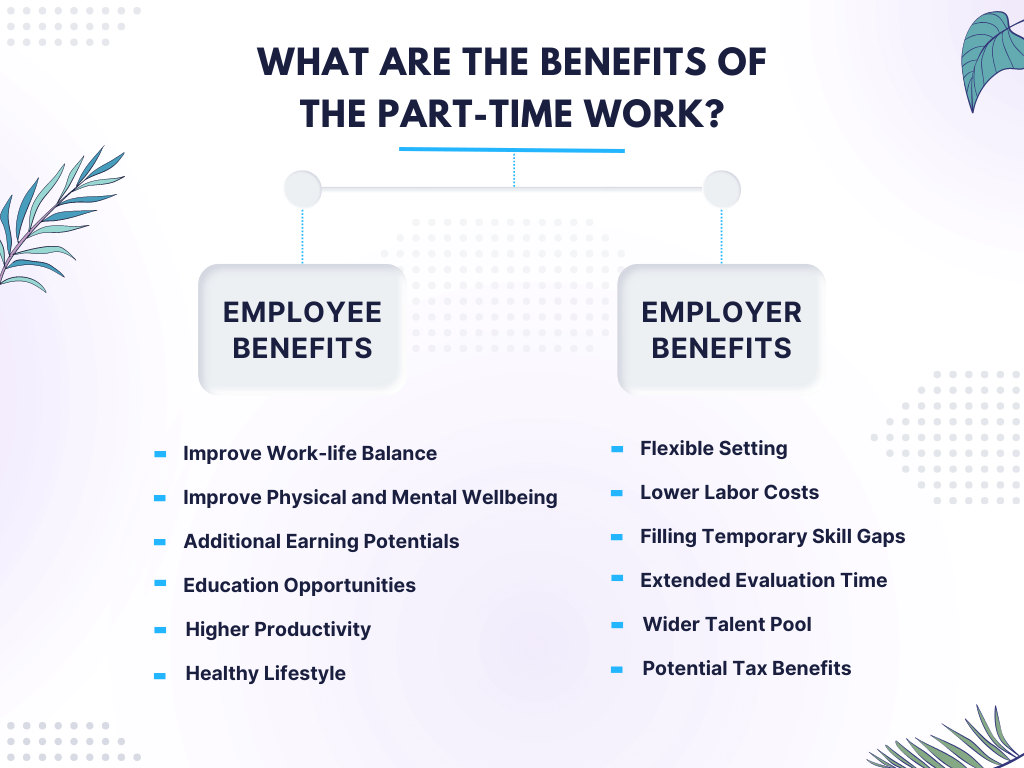
Part-time roles are becoming more prevalent across industries with fluctuating staffing needs such as retail, hospitality and healthcare. There are several benefits you can get as part-time workers.
✅ Employee Benefits
Here are some employee benefits you can check.
1. Better Work-life Balance
Part time employees entitled to get flexibility in scheduling work around personal responsibilities like education, caregiving, and other commitments. Many workers take advantage of this arrangement to pursue degrees, certifications, or hobbies while still earning income.
2. Improve Physical and Mental Wellbeing
Less work time may be connected to less stress and burnout. Part-time jobs could result in more opportunities to relax and take care of one’s health.
3. Additional Earning Potentials
Being employed part-time, workers can combine different occupations to gain income from various sources or supplement their full-time job.
4. Education Opportunities
Employees can learn new skills and receive certifications while still being employed.
5. Higher Productivity
Many part-time workers are much more effective during their short shifts, as part-time jobs allow them to have greater concentration and productivity.
6. Healthy Lifestyle
With more leisure time, part-time employees can spend more time exercising and practicing self-care.
Many part-time opportunities are available in the retail and hospitality industries, especially during busy periods. Depending on the hours worked and company policy, such employees may qualify for employer-sponsored benefits like paid sick leave/ sick pay, retirement benefits/ retirement plans.
In some states, employers are also required to follow the local minimum wage laws for part-time staff. Additionally, eligible workers may receive overtime pay if they work beyond the allowed hourly limits.
✅ Employer Benefits
Here are some employer benefits you can check.
1. Flexible Setting
.
Businesses that seek a talented workforce often do so through the hiring of part-time employees. In some instances, companies may use part-time staff only sporadically during peak times of the year or throughout certain busy periods without requiring the commitment necessary in full-time jobs.
2. Lower Labor Costs
Part-time workers provide a cost-efficient way to manage budgets because businesses pay only for hours worked by these employees, which diminishes the requirement to offer benefits.
3. Filling Temporary Skill Gaps
Since part-time professionals are available to help with short-term assignments, small businesses are able to acquire experts without incurring the expense associated with hiring full-time specialists.
4. Extended Evaluation Time
Hiring part-time staff can act as an extended trial period, employers can assess a worker’s performance, skills, and cultural fit before offering full-time employment.
5. Wider Talent Pool
Part-time positions appeal to workers with flexible schedules, such as students, parents, artists and anyone managing multiple commitments simultaneously.
6. Potential Tax Benefits
Part-time workers employed through certain targeted groups may provide employers with access to the Work Opportunity Tax Credit (WOTC). However, employees must possess a sufficient number of hours worked in order for their employers to use this tax credit.
How To Calculate Part-Time Pay?
To calculate part-time pay, all of the hours worked should be multiplied by the hourly rate. For example, a worker working 20 hours a week at 15 dollars per hour will earn $300 in gross weekly salary or about $1,300 a month. After that, taxes will be deducted from the gross salary, and net pay will be calculated.
Streamline Part-Time Employee Payments
Managing an employee pool made up of full-time and part-time workers is not an easy task, especially when it comes to monitoring various pay rules, deductions, and pay rates. A quality paystub generator can come in handy for any organization to calculate its staff’s wages in a quick manner. The tool minimizes the need for manual computations, ensures no errors are made in the payroll process, and provides clarity to the employees.
People May Also Ask
1) How many work hours are in a month?
An employee working full-time typically clocks 160 to 172 hours each month depending on the number of working days. Still you need to check with your employer.
2) Is 40 hours in 2 weeks part-time?
No. The total of 40 hours spread over two weeks equals 20 hours per week and would therefore constitute part-time work.
3) Do you get paid days off part-time?
Part-time workers may or may not get paid days off depending on company policy and local labor regulations.
4) Do part time employees get paid time off?
Some part-time employees receive prorated paid time off from many employers, although this varies by employee and job site.
5) How many hours is part time a day?
Part-time work typically lasts from 4-6 hours per day, though there is no federal rule sets.
6) Is part-time the same as temporary?
No, part-time refers to the hours worked, while temporary describes its duration.
7) Is part-time permanent or temporary?
Part-time vs temporary jobs is one of the most confusing things while working. Part-time jobs can either be permanent or temporary depending on their employer’s needs and contract terms.
8) How many hours is a part time job per day?
Find the “part time job how many hours a day” is 4-6 houts per day as per usa rule.
9) Is a temporary job part-time?
Temporary jobs may be either full- or part-time depending on their employer and role.
10) How many hours are considered part time?
Generally speaking, working under 30-35 hours a week would qualify as part-time.
11) How many hours a week is part time?
Part-time work is generally considered less than 35 hours per week, though exact hours may vary by employer.
12) How many hours a week is a part time job?
A part-time job usually involves 20 to 35 hours per week, depending on the company and job role.
13) How many hours a week is part time employment?
Part-time employment typically means working under 35 hours a week, but some employers may define it differently.
FAQ's
What if I don't like my temp job?
+
Temporary jobs offer you flexibility: should the situation not suit your needs, you are free to search for another one quickly and find another job.
What is the 3 3 3 rule for working?
+
The 3-3-3 Rule suggests working three days and taking three days off each month; reviewing performance or schedule every three months.
How many hours is part-time usually a day?
+
Part-time employees typically work between four and six hours each day, depending on their schedule.
What are the rules for part-time workers?
+
Part-time workers must adhere to their employer's policies and labor laws, which often cover hours, pay, and benefits.
What are the minimum hours for a part-time worker?
+
Part-time employees typically work 1-30 hours each week. There is no universal minimum.
Is 3 days a week part-time?
+
Yes, working three days per week is considered part-time work.
How many hours is considered part time?
+
Part-time employment is usually defined as any work schedule that contains no more than 30-35 hours per week.