.png)


 Chat with us now!
 Send Email!
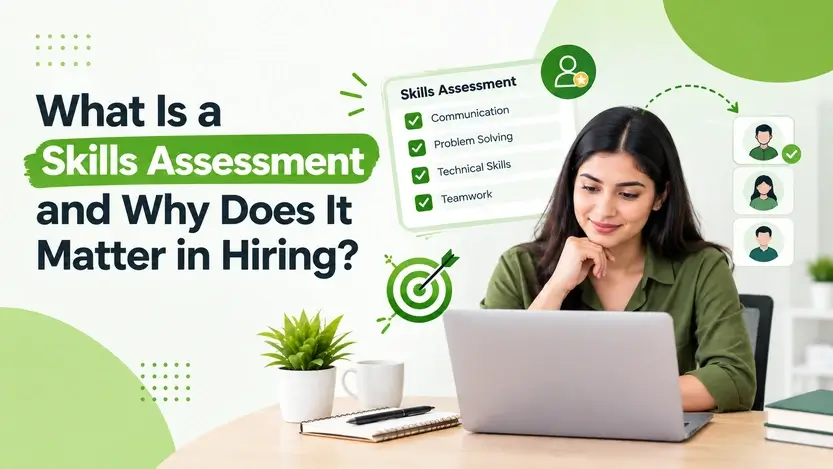
Here’s a question worth sitting with for a second: when was the last time a resume told you whether someone could actually do the job? Is it a skill assessment or something else?
Not where they worked. Not their title. Whether they could do the work.
That’s the whole reason skills assessments exist, whether it’s technical skills or personality tests, and why so many hiring teams have quietly stopped trusting resumes as the main filter. A great resume is a great story. It’s not proof. Let’s understand how skills assessment tests help in the hiring process.
What Is Skills Assessment Test?
A skills assessment test is a task, a set of questions, or a simulation designed for a candidate to be hired for a specific position. This work sample test helps to understand what someone can actually do in a given area, instead of asking them to describe it.
For example:
- A developer might get a small coding problem.
- A marketer might be asked to write actual copy against a brief.
- A support rep might work through a mock customer ticket.
- An analyst might get a messy spreadsheet and fifteen minutes.
The format changes by role after the job interview process.
Why Do Skills Assessments Exist in the First Place?
The first phase of the recruitment procedure is interviewing job seekers. Individuals who are good at interviews do not necessarily mean they will be good at work once they start functioning in the actual position as per industry standards. To solve this problem, skill tests were introduced to measure cognitive ability.
The essence of the purpose has to do with a few things:
- Assurance instead of pledges. A CV is a statement. A skill assessment is proof.
- Less preconception, more regularity. Everybody gets the same task, and the same evaluation is applied to it for informed decisions.
- Improved prediction tool. Simulation-type tests tend to correspond to future performance much more closely than a 45-minute talk.
- Speedier elimination. If you can find out who can perform the job properly before you spend hours in interviews, you stop wasting time on people who would not survive week 2 of working in your company.
Indeed, this is the main aim of skills evaluations.
Also Read: Step By Step Guide To Boost Employee Productivity
“Skills Assessment” vs “Skill-Based Assessment” – Same Thing?
Essentially, yes.
The terms are used interchangeably by people. The only slight difference is that “skills assessment” usually refers to the bigger picture of skills-based hiring, which is the concept of employing people based on their skills being used in all parts of the hiring process, from sourcing to screening to promotions. “Skills assessment” generally refers to just the testing component, and skills-based is considered for deeper understanding.
Do not get stuck on the terminology, as recruiters looking for either term have the same query in mind.
The Different Types Of Skill Assessments You’ll Run Into
Not every role needs the same test, just a way. Here’s roughly how they break down:
- Technical assessments check hard, job-specific skills – code, strategies, spreadsheets, design tools, whatever the role actually runs on.
- Soft skills assessments try to get at things like communication, teamwork, or how someone handles a tricky situation — usually through scenario-based questions rather than combination approach.
- Cognitive assessments measure raw problem-solving and reasoning, independent of any specific tool.
- Job simulations are arguably the gold standard – candidates do a scaled-down version of the actual job. If you want the best predictor of performance, this is usually it.
- AI and digital skills tests are the newest category, and they’re growing fast. More roles now expect people to use AI tools well, not just tolerate them – so assessments are catching up.
What Are Employee Assessments Online?
Employee evaluations done online are tests that determine a person’s skills, knowledge, or readiness for a job remotely, meaning that there is no necessity for a testing center.
Organizations utilize these tests to assess new job seekers, evaluate existing personnel, and estimate the success of training delivered for a clearer picture. Thanks to the fact that everything is done virtually, online evaluations have become the standard method for hiring teams and have all but made offline evaluations unnecessary.
What Is a Skill Test for Employment?
An aptitude test or skill assessment test is conducted while hiring to confirm if an applicant is capable of actually doing job tasks before being hired by a company.
Aptitude tests are conducted after submitting a resume and can be administered just before or along with interviews. An aptitude test may assess technical skills, problem-solving ability, or job-related skills, depending on the type of work that needs to be done.
With an aptitude test, employers can ascertain the actual skill level of a candidate, instead of relying solely on their curriculum vitae.
Also Read: Exempt vs. Non-Exempt Employees
It’s Not Just for Hiring – Employee Skill Testing Matters Too
People often associate “skills assessment” simply with evaluating applicants. The truth is, skills assessments are valuable when applied internally to an organization.
The main purpose of an organization using these assessments is to find out whether the strengths learned through training are in fact being utilized. Organizations also use them to determine whether advancing someone’s professional career in the company is a justified decision. Skills assessments enable one to know the skills gaps that exist within the organization rather than guessing what they might be. Employees respond nicely to the feedback they get from the assessments since it is much easier to see one’s skills progress rather than receiving vague compliments.
Therefore, the organization uses skills assessments in order to understand what skills are already in place, rather than to control entry into a closed club.
An Employee Might Want to Take A Skills Assessment – Why?
An employee may take part in a skills assessment to demonstrate their actual competence for a promotion, find skill gaps that can lead them to work on their own professional growth, or create chances for being seen in a different company role through evidence instead of a request to trust them.
There are two sides to this process for workers. It is not just something done to them, but also a mechanism they can benefit from. A specified outcome provides them with evidence to use as a reference in discussions on promotions, areas for their learning, and possible internal job opportunities that could be missed without these results.
Building Skill Assessment Test That Doesn’t Suck
A poor skill assessment test is worse than no test. It wastes time for everyone, and it doesn’t provide any useful information. Here are some things that will help distinguish the good tests from the bad:
- Make it a skill assessment test similar to the real job. The closer it resembles the job, the more information it will provide, which makes it less of a pointless exercise for the candidates.
- Don’t test irrelevant things. If the job doesn’t require a specific skill, don’t test it. Each extra question means more difficulty.
- Keep it even. Same test, same conditions, same scoring for all candidates. Otherwise, you are not comparing anything at all.
- Be respectful of people’s time. The time required to complete the test should be between 20 minutes and two hours, which is optimal for most jobs.
Choose where the test is going to be placed. Some teams do testing even before looking at the resumes, while others perform it after the first interview.
Bottom Line
A resume tells you a story. An interview tells you how someone handles a conversation. A skills assessment tells you whether they can actually do the job, which, at the end of the day, is the only question that was ever supposed to matter.
And once that hire is made, the paperwork side of onboarding shouldn’t slow things down either. Tools like a paystub generator make it easy to get new employees set up with accurate pay documentation from day one.
Also Read: How Paystub Maker Keeps Employees Happy?
FAQs:
1) What is a skill assessment test?
An organized manner of assessing someone’s abilities via a test, set of questions, or simulation — rather than just taking their word for it.
2) What is a skills assessment test?
It means the same as the previous sentence but is worded differently.
3) What is the primary purpose of skill-based assessments?
To use evidence instead of making guesses; providing employers with objective information about a candidate’s real ability rather than making a decision based on resumes and interview performance only.
4) What is the purpose of a skills assessment?
To authenticate actual skills, eliminate biases, and ensure a better assessment of the candidate’s actual capabilities.
5) What does a work skill assessment measure?
It is everything that is relevant to the job: technical skills, problem-solving, and communication skills, presented in the format of tasks similar to real-life situations.
6) Can they be used for promotions, not just hiring?
Yes, many companies are already doing that ; using employee skills assessment tests to find out who is ready for promotion.
7) How long should one take?
Typically, it lasts about 20 minutes to 2 hours. Long enough to be significant but not too long for people to quit.
8) Are they actually unbiased?
It is true that nothing can be completely unbiased, but standardized scoring does provide a much better outcome compared to resume- and gut-feeling-based interviews.
9) Which tools are most reliable for staff skills assessment?
The tools that provide the greatest reliability are those with standardized assessments and are relevant to the job. Some examples of such tools include Gloat, Canditech, and TestGorilla, which are widely used.
10) How can I create an effective skills assessment template for my team?
To start, complete a list of specific tasks that need to be performed in the position, followed by designing tasks or questions that are representative of the job functions.