.png)


 Chat with us now!
 Send Email!

Whether you are a student or new employees looking for the Open Door Policy definition, curious to understand what the Open Door Policy means, or exploring its importance today, this guide explains it all in simple terms.
The open door policies highlight the importance of open communication and relationship-building for workplace morale and productivity. These policies are valuable for encouraging trust and engagement among employees, as they remove communication barriers, enabling organizations to solve problems faster, strengthen relationships between leadership and staff, and foster a culture of openness and mutual respect. Open communication and open office door policies also contribute to organizational growth by fostering collaboration, feedback, and continuous improvement.
Just as open-door policies encourage transparency and trust within organizations, modern tools like a free paystub generator help maintain clear and transparent payroll documentation for employees.
What is an Open Door Policy?
Open Door Policy is a workplace communication policy that encourages employees to communicate openly for sharing concerns, ideas, or feedback with managers or leaders without fear of retaliation.
Managers often demonstrate this by leaving their cabin door open, symbolizing accessibility and a commitment to trust-building between management and employees. It is meant to encourage openness and free-flowing communication within the organization.
For many years, workplace communication suffered when managers didn’t allow employees to communicate directly with senior management. Employees had fewer chances to share their daily challenges and experiences, which often led to low engagement and unnoticed problems.
When a company or individual understands the open door policy meaning, and establishes open door policies, the door is always symbolically open, and employees are encouraged to come in and ask questions or raise issues with management when they feel it is necessary. This means that employees feel they can access and discuss any matters important to them, without fear of retaliation, which actually gives them job satisfaction. Open communication through such policies increases employees’ motivation within the organization.
How Should the Open Door Policy Work?
Effective open door notes should mean that employees feel free to approach their organization’s senior leadership for open discussions. Senior management should also provide regular updates to employees, keeping them informed and engaged as part of ongoing communication and feedback. It is advisable to run some training for managers and executive-level employees so that they understand how the policy should work.
If the discussion appears to be one that could be resolved by the employee’s immediate supervisor, the senior leader should ask why he or she did not raise the matter with his or her direct boss..
An effective open-door policy also encourages employees to discuss administrative matters, such as payroll concerns or reviewing a free check stub template, without feeling hesitant to approach management.
What is the Open Door Policy in the Workplace?
In a business or workplace context, open door policies refer to a management practice in which leaders, managers, supervisors, and executives keep their offices accessible to employees. The idea is to foster transparency, open communication, and trust within an organization. Employees feel comfortable raising concerns, sharing ideas, or flagging issues directly with leadership, rather than navigating rigid hierarchical channels.
An open door policy in a workplace context typically involves:
- Employees feel safe to raise concerns or provide feedback without fear of retaliation.
- Leaders are making themselves accessible for informal conversations without requiring formal appointments.
- A culture of transparency where information flows more freely between levels of an organization.
- Clear communication that management values employee input and perspectives.
- Fostering collaboration between employee and management, encouraging teamwork, and building positive relationships after the recruitment process.
Common Open Door Policy Examples
In case you’re looking to set up this policy but are not sure about how to get started, below we have mentioned examples that can become more accessible:
- Pass on to managers: If you’re a C-suite executive at a large company, it may not be possible to meet every employee. Instead, encourage managers to have regular one-on-one meetings with their direct reports to gather feedback and meet with supervisors afterward to develop related action plans if necessary.
- Set office hours: Although you value open communication, you also have a lot to offer. It’s important to set boundaries so your employees aren’t constantly coming into your office when you need to focus. Try picking a certain day during the week so employees can stop by during a scheduled time.
- Specify appropriate topics: For example, you may be willing to help employees address conflict by encouraging constructive conflict management strategies and supporting conflict resolution practices. Make it clear that the policy is intended for resolving conflicts, improving working relationships, explanations of company policies, and innovative ideas—not for gossip.
Key Factors Of The Open Door Policies
| Aspect | Details |
| Primary Target | It was aimed at all foreign powers trading in China, including United Kingdom, France, Germany, Russia, and Japan. |
| Who proposes it? | Secretary of State John Hay |
| Under which president | President William McKinley |
| Key Goal | Equal trading access to China for all foreign nations |
| Was it legally binding? | No |
| Second round | 1900; expanded to defend China’s territorial integrity |
| Workplace meaning | A management practice encouraging open communication between employees and leadership |
What Are The Advantages of Open Door Policy?
There are various advantages of open door policy, which can have a positive impact on the organizational environment:
- It enables communication between employees and management in the workplace.
- It helps management improve employee experience through receiving direct feedback.
- It helps in reducing employee turnover by allowing employees to voice their concerns and resolve them with management.
- It helps establish a transparent environment that promotes employees’ self-confidence.
- Builds trust within the organization.
- Leads to positive outcomes by fostering effective communication, which support the achievement of organizational goals.
When employees feel heard and supported through an open door policy, increased trust and engagement occur. This makes employees more engaged, productive, and loyal to the organization.
What Are The Disadvantages of Open Door Policy?
Door open policy for all their benefits can have it’s downsides if it is not implemented and enforced correctly. The disadvantages include:
- There may be instances when employees approach their manager with every challenge that arises. This can lead to employees becoming overly dependent on the supervisor instead of trying to problem-solve first.
- Without boundaries, managers and supervisors can spend most of their day handling employee concerns, questions, or issues. This may reduce productivity.
- For employees, the conversation may become a vent session rather than a productive use of time with the manager to formulate a solution.
- Employees may feel forced to redirect questions or issues to senior leaders rather than their direct supervisor. Although some examples confirm this, bypassing the team hierarchy can frustrate team managers.
What Can Happen Without an Open Door Policy?
The effects are significant when you don’t foster open door policies in the workplace. Without this policy, the following things can happen:
- Managers or owners might find themselves disconnected from their teams.
- Managers might not have the visibility to appropriately address employee performance issues, which can worsen over time.
- Overall team morale might plunge in an environment where no open discussion occurs.
- The quality of the culture might decline, which can lead to a drop in productivity.
How easily employees communicate with a business owner or leader can also impact results. Someone blocked by an operational problem or obstacle cannot be as productive as they could be. They may need access to someone who can give them advice or help them solve a problem.
So it’s important to implement an open door policy that’s appropriate for your business.
Open Door V/S Closed Door Policy
Leadership that enforces a closed-door policy does not provide a way for employees to easily come forward with feedback, ideas, and questions. An open door policy welcomes conversation and can build trust, whereas a closed-door policy in the workplace can hinder open communication.
Here, we differentiated between the two policies.
| Aspect | Open Door Policy | Closed Door Policy |
| Leadership Accessibility | Leaders are approachable easily and available for discussion | Leaders are less accessible to employees |
| Employee Feedback | Employees can freely share ideas, issues, and suggestions | Employees may hesitate to share feedback |
| Communication Style | Encourages open and direct communication | Communication follows strict hierarchy |
| Workplace Culture | Promotes trust and transparency | Creates a more formal and controlled environment |
| Problem Solving | Issues can be addressed quickly through discussion | Problems may take longer to resolve |
Tips To Implement an Open Door Policy At Your Workplace
The 3 ways to implement an open door policy that work are: Before introducing an open door policy, it is crucial that trust and psychological safety are established within the organization to ensure its effectiveness.
1) Set Boundaries
Although it’s important to be available to your employees, it’s also important to set boundaries.
For example, clearly communicate a set of rules to your employees: If my door is open, please knock and come in. If my door is locked, please contact me to schedule an appointment. In case of emergency, knock on my door if it’s locked or come and find me. Before you come to me with an issue, think carefully about the following:
- Does this affect just me or the broader team?
- What can management do to help me resolve the problem?
2) Be an Active Listener
When an employee comes to talk to you about an issue, listen actively and try to understand what the other person is saying. Retell or share what you heard with the person, showing that you are paying attention and are actively engaged in the conversation.
3) Focus on the Solution
When setting your boundaries, tell employees that they should try to think of some solutions to their problem before talking to you.
During the meeting, try to steer the conversation toward a solution by asking questions like what do you think the solution is. Encouraging employees to come up with their own solutions will improve their decision-making processes and teach them to trust their abilities.
Top Practices for Executing an Open Door Policy
Are you ready for open door policies in your organization? Follow the practices mentioned below.
Upper management should actively foster transparency and handle feedback by encouraging open communication and participating in initiatives like skip-level meetings.
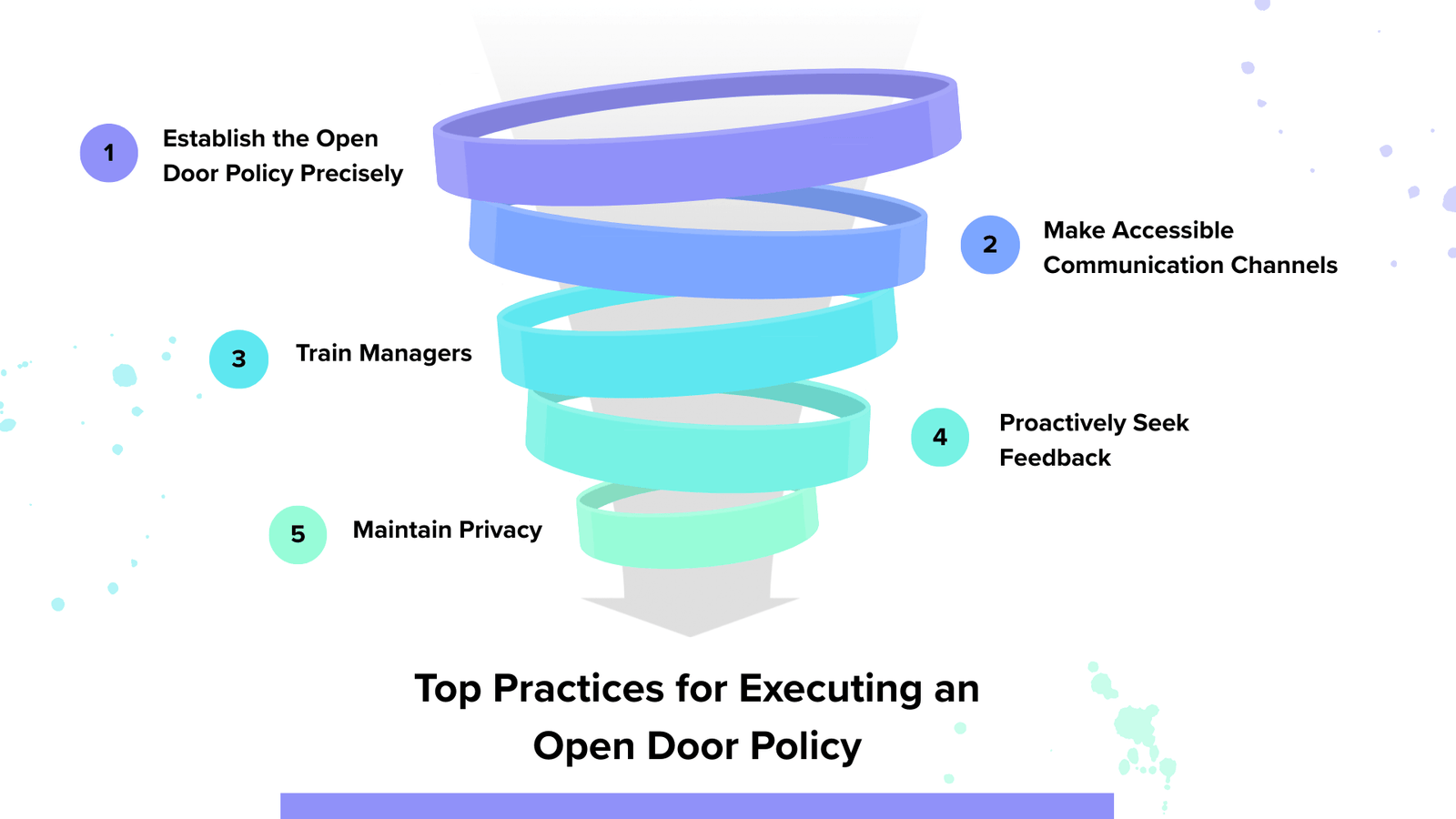
1) Establish the Open Door Policy Precisely
Documenting the open door policies in writing ensures clarity and accountability by outlining the scope and key elements of the policy for better understanding. When you draft formal policies, be sure to include:
- Purpose:You have to explain the definition of open door policy & why your organization embraces an open door policy, reinforcing leadership’s dedication to listening and making sure employees feel safe from retaliation for raising concerns.
- Types of issues: Outline the types of concerns employees can bring forward, like process improvements or policy violations.
- Feedback: Define how you’d like employees to voice concerns, whether through direct conversations or structured meetings.
- Employee and manager expectations: Set clear guidelines for sharing and receiving feedback, and for respectful and solution-oriented discussions.
- Follow-up process: Describe how leadership will acknowledge and act on feedback, which will include an escalation process if issues remain unsolved.
2) Train Managers
Provide managers with training in active listening, giving constructive feedback, and handling sensitive or difficult conversations. For example, managers should understand how to set expectations from the beginning of a conversation.
3) Make Accessible Communication Channels
Make it easy for any employee, remote or in-person, to request meetings. For individual employees, this can be done by simply providing them the ability to walk into the manager’s office.
For hybrid and remote workers, provide digital tools that allow employees to collaborate with leaders in real-time or asynchronously and access information about the organization’s larger initiatives.
4) Maintain Privacy
Reassure employees that their conversations and concerns will be kept confidential unless there is a need to escalate the issue. In the event of tension escalating, document the steps employees should take if they feel their issue has not been adequately addressed, including options for promotion to higher levels of management.
5) Proactively Seek Feedback
If feedback hasn’t been a core part of your culture, it may be up to leadership to take the first step. Send surveys regularly to get direct feedback from employees. This encourages more reticent employees to present their ideas and reinforces that your organization is committed to listening.
Over time, as trust grows, employees may be more willing to take advantage of open the door policy, knowing that their input really matters.
Key Takeaways
Define open door policy & Implement it to your workplace. It allows managers to better understand workplace concerns, strengthen trust, and encourage open communication. At the same time, maintaining transparency in administrative areas—such as payroll documentation with a pay stub generator can further support an organized and employee-friendly workplace.
FAQs
1) What is Open Door Policy Meaning?
In most companies, an open door policy indicates to employees that a supervisor or manager is open to an employee’s questions, complaints, suggestions, and concerns.
2) What is the Open Door Policy Simple Definition?
The Open Door Policy was a statement of principles introduced by the United States in 1899 and 1900. It is called for the protection of equal privileges for all countries trading with China and support for Chinese territorial and administrative integrity.
3) What is the Open Door Policy definition US History?
The Open Door Policy was a late 19th/early 20th century American foreign policy initiative aimed at ensuring equal trading privileges for all countries within China.
4) Who gave the Open Door Policy?
The Open Door Policy toward China was a diplomatic initiative expressed by U.S. Secretary of State John Hay in the late 1890s, intended to promote free trade and prevent any single power from monopolizing trade in China.
5) What was the main reason for the Open Door Policy?
The purpose of these Open Door Notes is to achieve international consensus for the U.S. policy of promoting a level playing field for international trade and commerce in China and respect for the administrative and territorial integrity of China.
6) What is another term for the Open Door Policy?
Another term for the open door policy is known as equal admission.
Also Read:
OTE Meaning & Best Practices: A Complete Guide
How To Get a Walmart W2 Former Employee Form In 2026?
What is Remuneration? Meaning, Definition & More
FAQ's
What is the opposite of Open the Door Policy?
+
The primary opposite of the open door policy is the closed door policy. This approach restricts access, limits communication, or keeps decision-making private and exclusive.
Is an Open Door Policy legally binding?
+
No, the open door policy is not a legally binding agreement.
Was the Open Door Policy good or bad?
+
An open-door policy can be a great idea to help build more open communication and trust in the workplace. However, in itself, and if done poorly, this is often not enough or may cause additional harm rather than help.
What makes an Open Door Policy fail?
+
The Open Door Policy fails to provide the opportunity for anonymity, discouraging individuals from raising important issues. Gaps in leadership skills, time wasting, and no self-improvement make the open-door policy fail.
What is Open Door Policy APUSH definition?
+
In APUSH, the Open Door Policy refers to the U.S. policy introduced in 1899 to ensure all countries had equal trading rights in China. This is introduced to prevent any one nation from controlling Chinese trade.