.png)


 Chat with us now!
 Send Email!
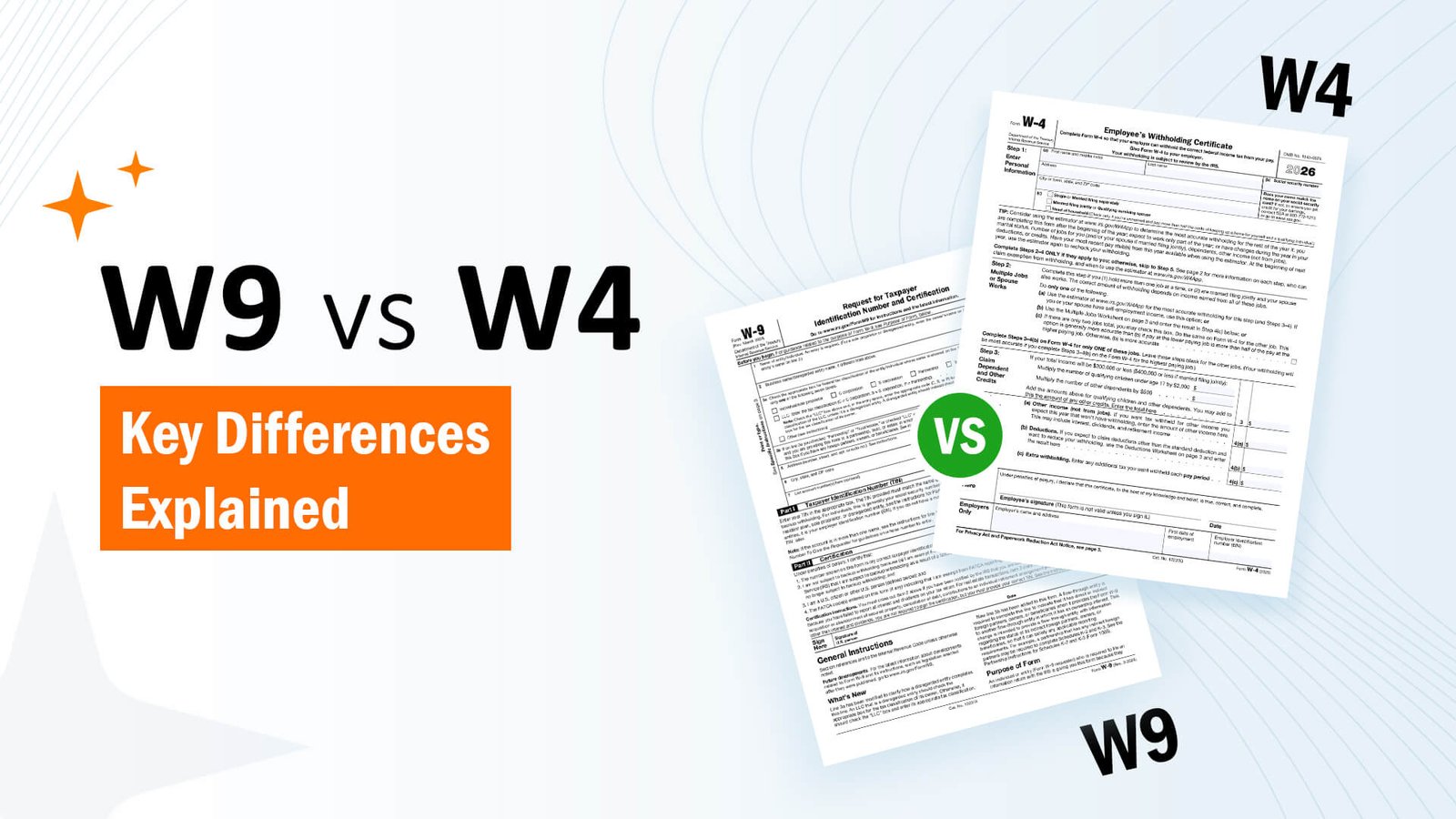
Tax season often exposes the misunderstandings that remain there quietly throughout the year. Firstly, one of the most common areas of confusion for employees, freelancers, and even small business owners is W9 vs W4 difference between a W9 and a W4.
W9 form and W4 form both sound quite similar. Both require name, address, and Social Security Number. However, they are used for entirely different purposes, and handling the incorrect one might lead to serious issues with your tax withholding, your reported income, and even your dealings with the IRS.
This confusion becomes thinner when you’re reviewing your paycheck details through a paystub creator or organizing tax documents at year-end. If your form was handled incorrectly from the start, the errors can show up in your withholdings, reported income, or contractor payments, making tax filing more stressful than it needs to be.
Whether you’re a gig worker wondering what is a W9 form, a new hire trying to figure out how to fill out a W4 for dummies, or a business owner unsure when is a W9 not required, this guide breaks it all down clearly and accurately with the latest 2026 information.
What is a W9 Form?
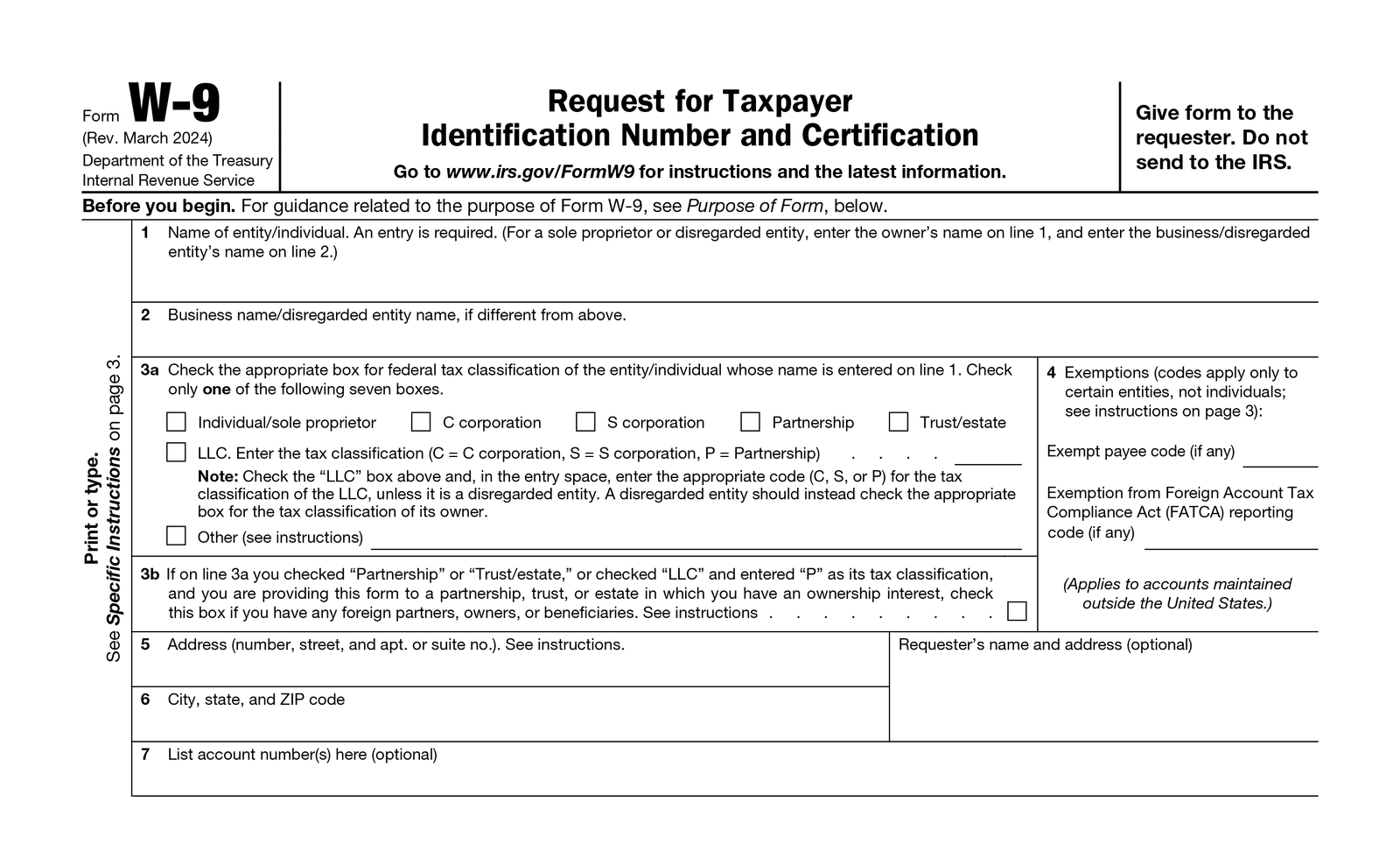
The W-9 form is used to collect your taxpayer identification details so that a business can accurately report payments made to you to the IRS. This form is most commonly associated with freelancers, independent contractors, consultants, vendors, and gig workers.
Details you must provide on IRS W 9 form:
- Your legal name
- Business name
- Federal tax classification
- Exemptions
- Address
- Taxpayer Identification Number (TIN)
What is a W4 Form?
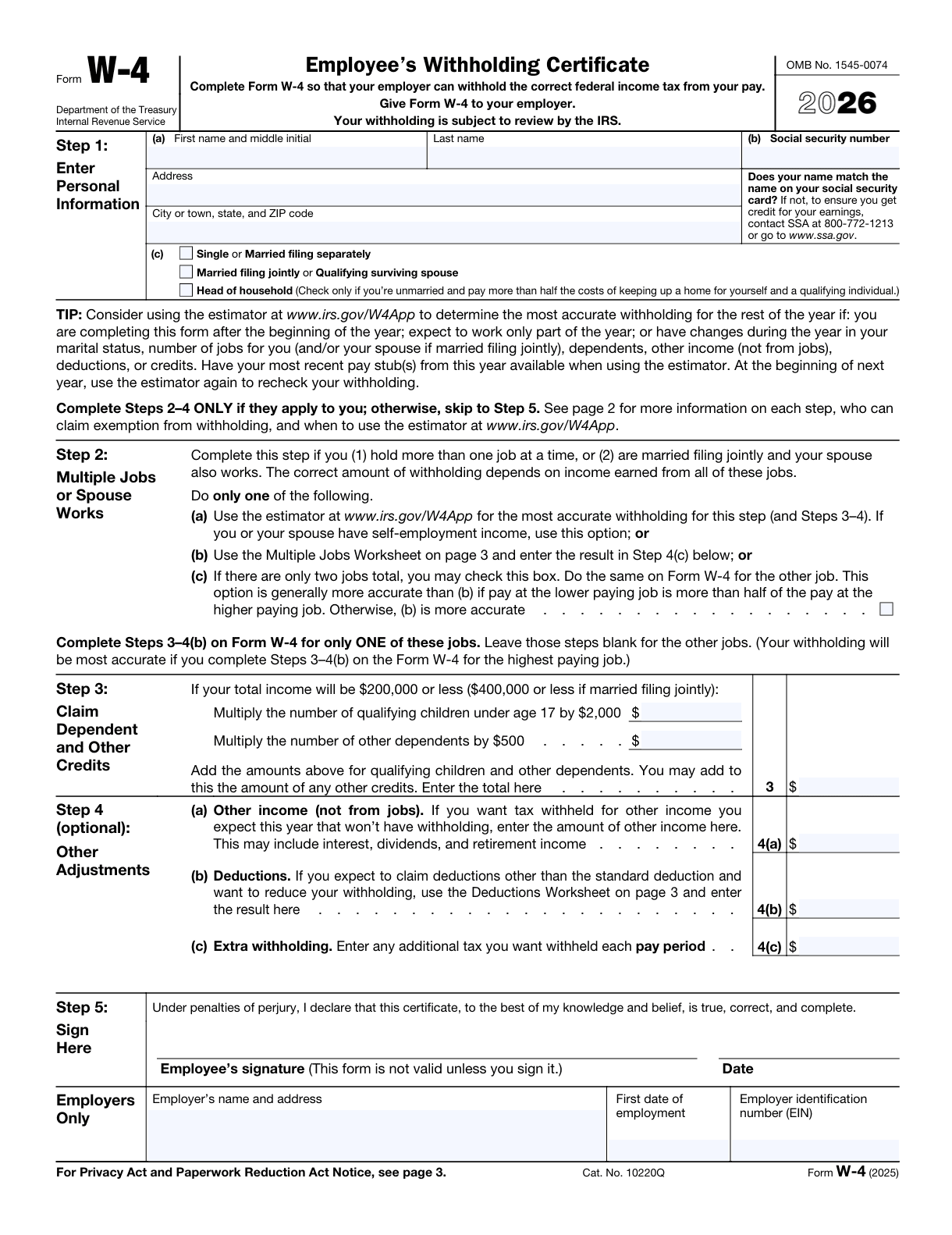
The W-4 form is used by employees to tell their employer how much federal income tax to withhold from each paycheck. You fill out a W-4 when you start a new job, and you can update it any time your financial or personal situation changes, such as getting married, having a child, or taking on a second job.
What is a W9 Used For?
Here are the most common scenarios:
- Freelance Work: Any time you earn $600 or more from a single client in a calendar year, that client is required to issue you a 1099-NEC, and they need your W-9 to do it.
- Real Estate Transactions: Buyers and sellers often provide W-9s to real estate agents or title companies.
- Bank Interest and Investment Income: Financial institutions may request a W-9 to report interest, dividends, or other earnings.
- Rental Income: Landlords may be asked to provide a W-9 to property managers.
What does a W4 Form Cover?
The W-4 still follows the redesigned format introduced in 2020, which eliminated personal allowances in favor of a cleaner, more accurate system. It includes:
- Step 1: Personal information
- Step 2: Multiple jobs or a working spouse
- Step 3: Dependents and child tax credits
- Step 4: Other adjustments
How to Fill Out a W9 Blank Form?
Filling out a W9 tax form is relatively simple, but accuracy is critical. Here’s a step-by-step breakdown:
- Line 1 Name: Enter your full legal name as it appears on your tax return.
- Line 2 Business name: If you operate under a DBA name or LLC name, enter it here. Leave blank if it doesn’t apply.
- Line 3 Federal tax classification: Check the box that applies to you. Most individual freelancers check Individual/sole proprietor or single-member LLC.
- Line 4 Exemptions: Most individuals leave this blank. Certain exempt payees will note exemptions here.
- Lines 5 & 6 Address: Enter your current mailing address.
- Part I – TIN: Enter your Social Security Number (SSN) or Employer Identification Number (EIN).
- Part II – Certification: Sign and date the form.
How to Fill Out a W-4 Form for Dummies?
Filling out a W4 form is relatively simple, but accuracy is critical. Here’s a step-by-step breakdown:
- Line 1 Personal Information: Enter your full legal name, Social Security Number (SSN), current address, and filing status (Single, Married filing jointly, or Head of household).
- Line 2 Multiple Jobs: If you have more than one job, or you are married filing jointly and your spouse also works.
- Line 3 Claim Dependents: Multiply the number of qualifying children under 17 by $2,000, multiply other dependents by $500, and insert the total amount on the given line.
- Line 4 Other Adjustments: 4(a): Enter other income (interest, dividends, side income), 4(b): Enter deductions if you itemize, 4(c): Enter any extra tax you want withheld from each paycheck.
- Lines 5 Sign and Date: Sign and date the form to certify that the information is accurate.
How to Fill Out a W-4 form for a Single Filer?
If you’re single with one job and no dependents, filling out the W-4 form is usually straightforward. Complete Step 1 with your personal info, select Single or Married filing separately, skip Steps 2 through 4 (unless they apply), and sign Step 5. That’s it. Learning how to fill out a W-4 form as a single filer is simple for most people. To better understand how your withholding affects your paycheck, you can also review your earnings by previewing pay stub template, which helps you see how taxes may be deducted from your income.
When is a W9 Tax Form Not Required?
A W 9 form is generally not required in the following situations:
- When you earn less than $600 from a single client in a year, though, some companies still request it for their own records.
- When you’re paid via certain third-party payment networks like PayPal for personal transactions.
- When the payer is an individual paying for personal services, such as hiring a babysitter through a private arrangement.
- When the recipient is a C corporation or S corporation, these entities are generally exempt from 1099 backup withholding requirements, meaning a W-9 might technically not be needed, though many businesses still request it for compliance purposes.
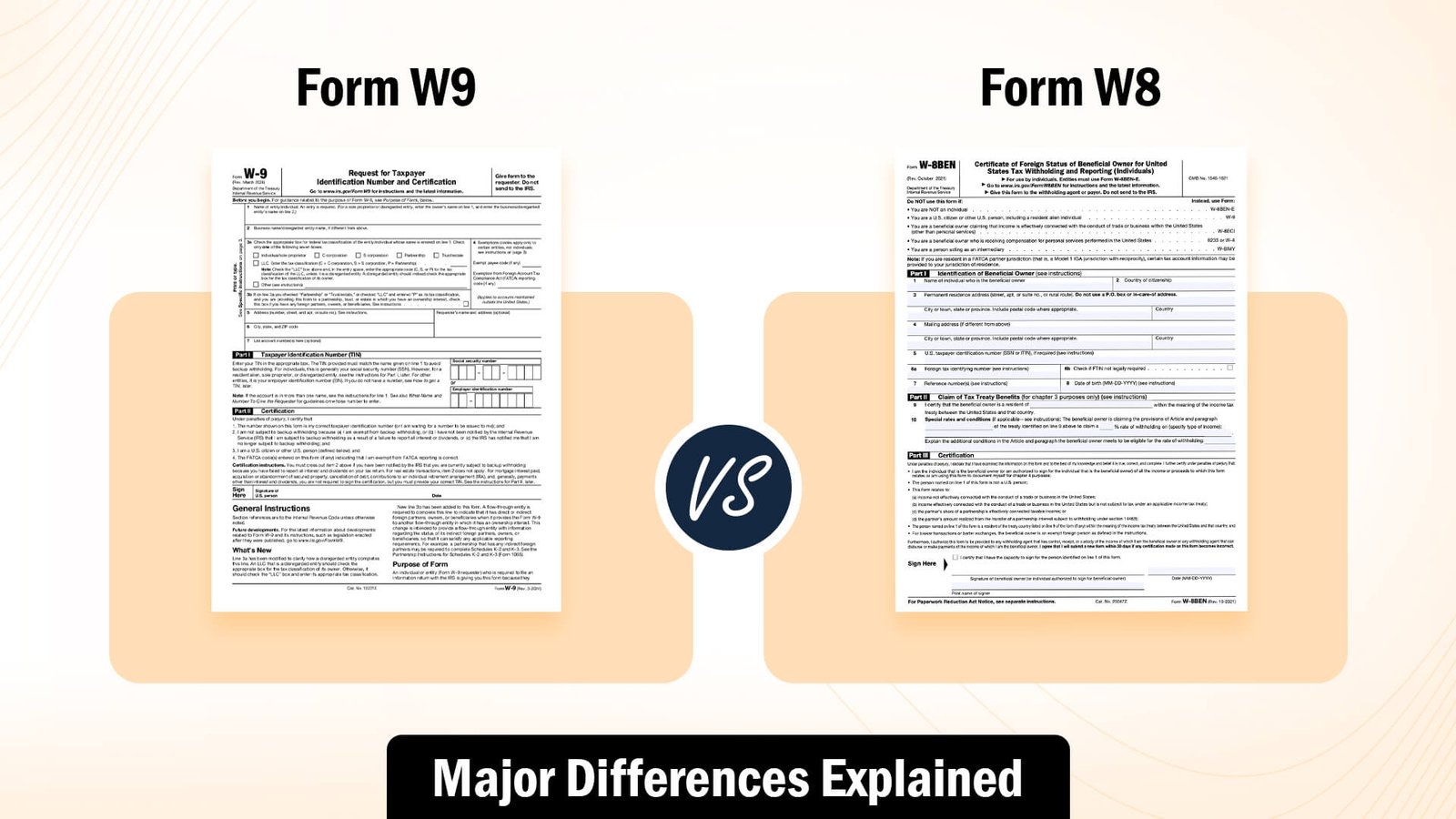
- When you’re a foreign person or entity, in that case, a W-8 series form is used instead.
When is a W4 Tax Form Not Required?
A W-4 form is not required under these circumstances:
- You’re not an employee: If you’re working as an independent contractor or a freelancer.
- You’re self-employed: If you run your own business or are self-employed, no employer is withholding federal income tax from your paycheck.
- You can claim exemption from withholding: If you qualify as exempt, you still submit a W-4, but you write exempt in Step 4(c).
Is There Such A Thing As A W9 Employee?
Technically, no. The phrase W9 employee is a misnomer. If you’re a true employee, meaning your employer controls how and when you do your work. A W-9 is for independent contractors and self-employed individuals. The legal distinction matters enormously: misclassifying employees as contractors is a serious IRS violation with significant penalties.
Is There Such A Thing As A W4 Employee?
No, it is not strictly correct to say W4 employee, as such a thing exists. What people usually mean is a regular employee who fills out Form W 4 upon starting work. The W4 form, after all, is only a tax withholding form. It provides instructions to the employer regarding the amount of federal income tax to be withheld from the employee’s paycheck and does not serve to define the nature of the worker.
The IRS bases the classification of a worker as an employee or an independent contractor on factors such as degree of control, supervision, and the nature of the working relationship. Therefore, when a person utters the phrase W4 employee, they are most probably referring to a standard W2 employee who has completed a W4 for tax withholding reasons.
Key Differences: W9 vs W4
| Aspects | W-9 Form | W4 Form |
| Who fills it out? | Independent contractor | Employees |
| Who receives it? | Hiring business | Your employer |
| Purpose | Collects taxpayer ID for 1099 reporting | Set the federal income tax withholding |
| Filed with IRS | No | No |
Tracking Your Income: Why Accurate Records Matter?
Whether you’re an employee or a contractor, maintaining accurate income records is essential, especially come tax time. Employees should hold onto their pay stubs throughout the year to verify that withholding matches what’s reported on their W-2. Contractors should track every payment received.
Tools like check stub maker are especially helpful for self-employed individuals who pay themselves and need documentation of their earnings for financial institutions or government programs.
Common Mistakes to Avoid While Accessing Forms
Always verify the source and ensure your personal information is accurate when accessing or submitting tax forms to avoid delays or errors.
W4 Form:
- Under-withholding: If too little is withheld, you may owe a large tax bill (and possibly a penalty) in April.
- Not updating after a life change: Marriage, divorce, a new baby, or a second job all affect your ideal withholding.
- Over-withholding: You’ll get a big refund, but that’s essentially an interest-free loan to the government.
W 9 Form:
- Using a nickname instead of your legal name: This can cause a mismatch with IRS records.
- Providing the wrong TIN: A mismatch triggers backup withholding at 24%.
- Forgetting to sign: An unsigned W-9 is invalid, and the payer may withhold taxes.
- Submitting to the IRS directly: This is a common misconception. The W-9 goes to the requesting company, not the government.
Key Takeaways
Understanding the distinction between W-9 vs. W-4 is foundational financial literacy, whether you’re stepping into your first job, picking up freelance clients, or running your own business. The W-4 form governs employee withholding. The W-9 form governs contractor identification and 1099 reporting. Using the right form at the right time protects you from IRS penalties, backup withholding, and end-of-year surprises, and even when using a paystub generator free to track income, proper tax form compliance remains essential.
People May Ask
1) Is the W4 same as W9?
No, W4 is not the same as the W9 form.
2) What is a W9 Tax Form?
IRS Form W-9, Request for Taxpayer Identification Number and Certification, is a document used to verify the name, address, and Taxpayer Identification Number (TIN) of an individual or business in the US.
3) Is W9 only for US citizens?
Use Form W-9 to provide your correct TIN only if you are a US person. Caution: If you do not return the Form W-9 with the TIN to the requester, you may be subject to backup withholding. See what backup withholding is later.
4) How do I claim dependents on my W-4 tax form?
On your W-4 Form, you claim allowances, which your employer uses to calculate the tax withheld from your paycheck. The number of dependents you have factors into your overall W-4 allowances. Many people simply count their family members and put that number down as the number of allowances on the W-4 Form.
5) Who is required to file a W-9 form?
A W-9 form is required to be filed by U.S. citizens or businesses hired as independent contractors or freelancers who are expected to earn $600 or more in a calendar year.
6) Do I fill out a W9 myself?
Yes, you should fill out a W9 yourself. It is used by independent contractors and freelancers to provide their correct TIN to clients for tax reporting purposes.
Also Read:
W-2 vs. W-9: Key Difference You Need To Know
1099 Vs W2: What is the Key Difference?
W-9 vs. 1099: What Are The Key Differences?
Types of Payroll Services: A Complete Guide for Business Owners
FAQ's
Do I claim 0 or 1 on my w4?
+
You no longer have to worry about whether to claim 0 or 1 allowance on your W-4, Employee Withholding Certificate, because the IRS updated the W-4 in 2020, eliminating the allowances. Instead, the modern W-4 takes into account your filing status, additional income, and dependents to more accurately calculate your tax deduction.
How much money do you need to make to get a W9?
+
To file Form W-9, you generally need to earn $600 or more in a calendar year from a client or business. This form is typically required for independent contractors, freelancers, or gig workers to provide their taxpayer information for the year-end 1099-NEC form.
How do I fill out my W4 correctly?
+
To fill out the W-4 correctly, complete Step 1 (Personal Information/Filing Status) and Step 5 (Signature/Date). If applicable, fill out Step 2 for multiple jobs, Step 3 for dependents, and Step 4 for other adjustments (such as additional withholding). Use the IRS Tax Withholding Estimator for accuracy.
How do I decide what to withhold on my W4?
+
Use the IRS Tax Withholding Estimator to decide your W-4 withholding to align with your tax goals, either minimizing tax owed or maximizing a refund. Key factors include filing status, number of jobs, dependents, and other income. Update it annually or after major life events such as a wedding, divorce, or having a baby.