.png)


 Chat with us now!
 Send Email!
A business day in the USA is typically an 8-hour period, considering from 9 a.m to 5 p.m on weekdays. However, the total length of business days can vary depending on industry, business, and area.
Business owners, workers, and independent contractors are people who are asking about what are business days and how long it takes to plan schedules, generate pay stubs, or work timetables.
Business days are those days between Monday and Friday that are not part of a public holiday or weekend.
Business days serve as a standard unit of time in everyday business operations, providing a basis for planning tasks, estimating completion dates, and managing workflow. When tracking employee work periods or creating payroll records with an automated pay stub generator tool, understanding “How Long Is a Business Day” is essential in maintaining accurate salary counting that remains consistent over time.
In this article, we’ll define a business day as follows: What are business days, how long is business days, the difference between business days and workdays, etc.
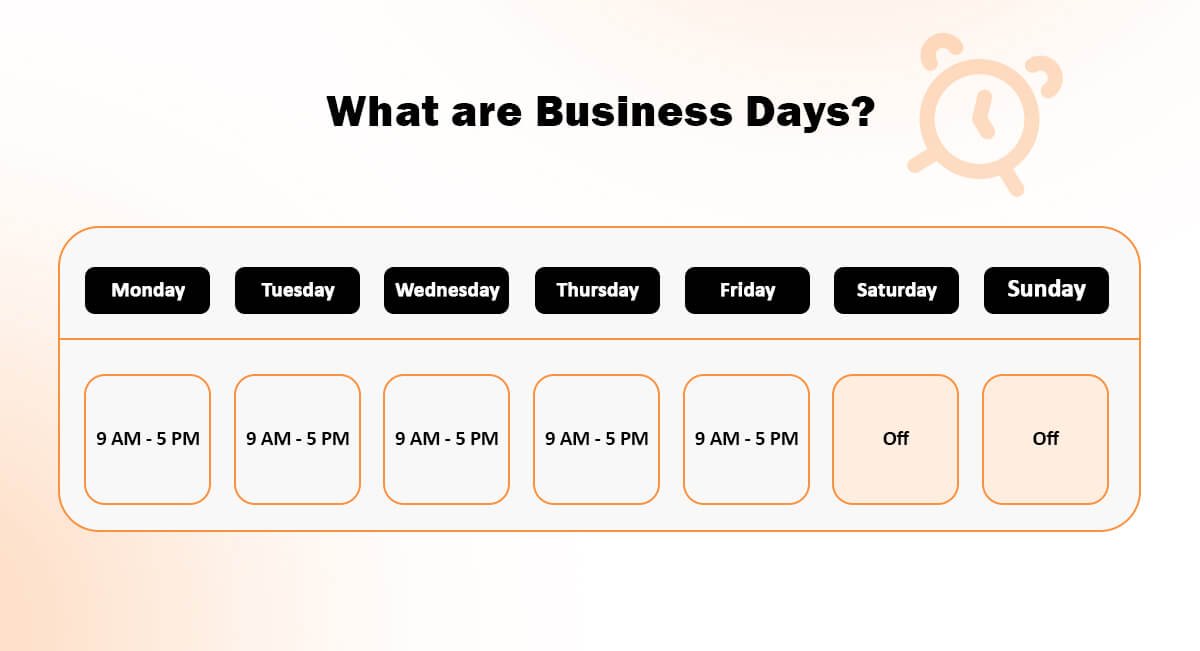
Business days are the weekdays on which most companies, banks, and organizations operate as part of their regular work schedule. Most countries–notably in the US–consider Monday through Friday as business days for professional activities, transactions, and communication purposes.
A typical business day consists of 8 working hours from 9 a.m. to 5 p.m. local time. Although these times may differ depending on your company or industry, these hours are widely recognized as standard business practice.
Business days differ from calendar days as they are limited to the working week (Saturday through Friday inclusive), excluding Saturday, Sunday, and holidays.
Note: The business days may differ based on region, culture, or industry. Certain countries follow differing weekend structures, while certain businesses operate during evening or night shifts.
How Long Is a Business Day For Payroll And Paystub?
Payroll and paycheck stub purposes typically define “business day” as one day during a typical workweek in the U.S.
This typically entails Monday through Friday, excluding weekends and federal holidays; though technically, a 24-hour calendar day could also count. Payroll terminology often uses hours 9:00 am-5 pm as definitions.
Business days matter when you process a payroll or figure out a pay period, and weekends/holidays are not counted as business days, so it might take more calendar days than you expect in order for the deposit to hit; one day is Monday -> Tuesday and so on until Friday-> Monday if there aren’t any holidays celebrated in the meantime.
Businesses typically count only business days when calculating payroll timelines, processing pay stubs, or setting payment schedules; thus extending processing time if weekends or holidays fall between business days.
Below is how common business day timelines are calculated when no holidays are involved:
- 1 Business Day (1 BD): From Monday to Tuesday or from Friday to the following Monday
- 2 Business Days (2 BDs): from Tuesday to Thursday or from Friday to Tuesday, respectively
- 3 Business Days (3 BDs): For orders placed between Wednesday and Monday or from Friday to Wednesday.
- 5 Business Days (5 BDs): In general, from Monday to Monday or Wednesday to Wednesday are considered 5 Business Days.
If a public or federal holiday occurs during this period, its timeline extends by one business day.
Calculating Business Days: What Counts and What Doesn’t
United States business Days are considered other than Saturdays, Sundays, or federal holidays. They constitute when the majority of offices, banks, and government facilities are open for business, and are essential to your payroll calculations, deposit concerns, delivery requirements, deadlines, or meeting deadlines in a contracted agreement.
What Doesn’t Count as a Business Day
These days are not included when calculating business days:
- Saturdays and Sundays
- U.S. federal holidays such as New Year’s Day, Independence Day, Thanksgiving, and Christmas Days when businesses are officially closed
How U.S. Federal Holidays Affect Business Days
Federal holidays may disrupt business timelines even if they fall on weekdays; for instance, if a holiday occurs on Monday and business resumes the following Tuesday. This can have serious repercussions, including:
- Direct deposits and payroll processing
- Bank transfers
- Shipping and delivery schedules
Since not all businesses adhere to a unified holiday schedule, it’s always wise to verify which holidays apply before planning holiday events or schedules.
Simple Rule to Remember
When counting business days in the USA:
- Only count Monday through Friday when calculating business days
- Skip weekends and federal holidays
If the date falls on a non-business day, move it forward by one business day.
Difference Between Business Days vs. Calendar Days
The main distinction between business days and calendar days lies in how each is measured: calendar days count every day in an entire month, while business days only include weekdays during regular workweeks that exclude weekends and non-working holidays.
Calendar days refer to all seven days of the week–Monday through Sunday–as well as weekends and public holidays.
This distinction becomes particularly essential in areas like payroll, shipping, and international business, where different countries observe differing public holidays or workweeks.
Business Days vs. Calendar Days: Comparison Table
| Criteria | Business Days | Calendar Days |
|---|---|---|
| Days counted | Monday to Friday | All days |
| Public holidays | ❌ No | ✅ Yes |
| Weekends | ❌ No | ✅ Yes |
| Common usage | Contracts, payroll, banking | General timelines and deadlines |
Business Days vs. Working Days
Although business days and working days are sometimes used interchangeably, they can have different meanings depending on their context. Business days usually refer to standard weekdays when banks and offices are open, while working days depend on an organization’s actual work schedule.
Example:
- Business Days: Monday to Friday (9 a.m. to 5 p.m.)
- Workdays: Tuesday to Saturday (4 p.m. to 1 a.m.)
Workdays tend to be job-specific and may involve overtime or non-standard hours; in contrast, business days usually follow more standardized structures for official and financial matters.
How Long Are Business Days In The USA?- (1 to 8 Business Days Explained)
American business days typically run Monday through Friday, excluding weekends and federal holidays. Here are all the business days from 1 to 8 mentioned.
How Long is 1 Business Day?
One business day refers to any 8-hour working day when most U.S. businesses operate; typically between 9 a.m. and 5 p.m. local time on weekdays.
If it were Monday, one business day later would be Tuesday; for Fridays, they are Mondays, respectively. When federal holidays fall between these dates, however, this timeline shifts accordingly and moves one working day later than that.
Here is an example of 1 business day:
- Start Day: Monday – End Day: Tuesday
- Start Day: Wednesday – End Day: Thursday
- Start Day: Thursday – End Day: Friday
- Start Day: Friday – End Day: Monday
How Long is 2 Business Days?
2 business days refers to two consecutive working weekdays and not calendar days. In the United States, business days usually include Monday through Friday, with no exceptions for weekends or public holidays; when someone mentions two consecutive working days starting with one working day in between.
Examples of Two Business Days:
- Start Day: Monday – End Day: Wednesday (2 Calendar Days).
- Start Day: Tuesday – End Day: Thursday (2 Calendar Days).
- Start Day: Wednesday-End Day: Friday (2 calendar days).
- Start Day: Thursday – End Day: Monday (4 Calendar Days).
- Start Day: Friday – End Date: Tuesday (4 calendar days).
If a U.S. federal holiday falls during this period, its end date moves forward by one business day – this definition is often used when dealing with shipping timelines.
How Long is 3 Business Days?
3 business days refers to 3 consecutive working weekdays, not 3 calendar days. In the US, business days usually occur Monday through Friday without taking into account weekends and public holidays.
Depending on what day it is, Wednesday through Monday are counted as business days; Thursday through Tuesday are counted.
Examples of Three Business Days:
- Start Day: Monday- End Day: Thursday (3 calendar days).
- Start Day: Tuesday- End Day: Friday (3 calendar days).
- Start Day: Wednesday – End Day: Monday (5 calendar days).
- Start Day: Thursday – End Day: Tuesday (5 calendar days).
- Start Day: Friday – End Day: Wednesday (5 calendar days).
How Long is 4 Business Days?
4 business days means 4 consecutive working weekdays in the United States; not calendar days. Business days generally encompass Monday through Friday without taking into account public holidays or weekends as part of this tally.
Examples of Four Business Days:
- Start Day: Monday – End Day: Friday (4 calendar days).
- Start Day: Tuesday – End Day: Monday (6 calendar days).
- Start Day: Wednesday – End Day: Tuesday (6 calendar days).
- Start Day: Thursday – End Day: Wednesday (6 calendar days).
- Start Day: Friday – End Day: Thursday (6 Calendar days).
How Long is 5 Business Days?
Five business days refers to five working weekdays rather than 5 calendar days in the United States. Although more calendar days may pass during a workweek, five working days have actually elapsed.
Example of Five Business Days:
- Start Day: Monday – End Day: Next Monday (7 calendar days)
- Start Day: Tuesday – End Day: Next Tuesday (7 calendar days).
- Start Day: Wednesday- End Day: Next Wednesday (7 Calendar Days).
- Start Day: Thursday – End Day: Next Thursday (7 calendar days).
- Start Day: Friday – End Date: Next Friday (7 calendar days later).
How Long is 6 Business Days?
Six business days means six working weekdays in the US; not six calendar days. Business days generally fall between Monday and Friday and exclude weekends and federal holidays.
Example of 6 Business Days:
- Start Day: Monday- End Day: Next Tuesday (8 calendar days).
- Start Day: Tuesday – End Day: Next Wednesday (8 calendar days).
- Start Day: Wednesday – End Day: Next Thursday (8 Calendar Days).
- Start Day: Thursday – End Day: Next Friday (8 calendar days).
- Start Day: Friday- End Day: Next to Next Monday (10 calendar days).
This method of counting is widely employed for business deadlines, payroll processing, shipping timelines, and service completion estimates.
How Long is 7 Business Days?
When something takes seven business days to complete, this refers to seven working days from its starting day, excluding weekends and public holidays.
Example of Seven Business Days:
- Start Day: Monday – End Day: Wednesday (9 calendar days).
- Start Day: Tuesday – End Day: Next Thursday (9 calendar days).
- Start Day: Wednesday – End Day: Next Friday (9 Calendar Days).
- Start Day: Thursday – End Day: Next to Next Monday (11 calendar days).
- Start Day: Friday – End Day: Next to Next Tuesday (11 Calendar Days).
As is evident above, weekends extend the total number of business days necessary.
How Long is 8 Business Days?
When we refer to “8 business days, this indicates eight working days as opposed to calendar days.
To calculate 8 business days, begin counting from the next business day forward and include only weekdays – skipping weekends and US federal holidays as you count down.
Example of 8 Business Days:
- Start Day: Monday – End Day: Next Thursday (10 Calendar Days).
- Start Day: Tuesday – End Day: Next Friday (10 calendar days).
- Start Day: Wednesday- End Day: Next Monday (12 calendar days).
- Start Day: Thursday – End Day: Next Tuesday (12 Calendar Days).
- Start Day: Friday – End Day: Next Wednesday (12 calendar days).
How Long is 2-3 Business Days?
2-3 business days refers to two to three working days starting on any given weekday and typically not counting weekends or public holidays in their calculation.
How Long is 3-5 Business Days?
When told that their order should arrive in three to five business days, this means delivery should take place between these dates (not including weekends and public holidays).
How Long is 10 Business Days?
3 to 5 Business Days refers to three to five working days only – no weekends or public holidays are considered when counting these dates.
Example of 10 Business Days:
- Start Day: Monday – End Day: Next to Next Monday (14 Calendar Days).
- Start Day: Tuesday – End Day: Next to Next Tuesday(14 days).
- Start Day: Wednesday – End Day: Next to Next Wednesday (14 Calendar Days).
- Start Day: Thursday-End Day: Next to Next Thursday (14 calendar days).
- Start Day: Friday -End Day: Next to Next Friday(14 calendar days).
How Does a Free Paystub Generator Help Count Business Days?
Paystub Creator makes it simple and accurate to calculate business working days when creating pay stubs. As an automated payroll check generator, it considers standard U.S. work schedules to reduce errors caused by weekends or non-working days to generate pay stubs.
StubCreator also provides sample pay stubs that outline how working days, pay periods, and earnings are structured. This feature helps employers and contractors better understand how business days affect payroll calculations before creating the final pay stub.
Bottom Line
Being aware of the business days in your region or country is crucial for providing an accurate paystub. Your company’s unique work schedule also affects payroll frequency and hourly rates, while monitoring workweeks across countries can help businesses more effectively serve international clients.
Business days and workdays, often used interchangeably, may have subtle distinctions that impact planning and communication efforts. May this guide help you to understand this.
People May Ask
1) Do business days include weekends?
No, business days do not include weekends. They generally run from Monday to Friday, excluding any major holidays that might fall on those days.
2) Is Saturday a business day?
No, Saturday is generally not considered a business day; typically, Monday-Friday are business days.
3) What does exclude weekends mean?
“Exclude weekends” refers to not including Saturdays and Sundays when counting business days; only weekdays are taken into consideration when making this calculation.
4) How long is 1 to 2 business days?
1 to 2 business days refer to 2 weekdays; starting on Monday, 1 business day ends Tuesday, while 2 ends Wednesday.
5) How long is 7 to 10 business days?
7 to 10 business days typically span 1.5 – 2 calendar weeks; weekends and holidays extend this total timeframe.
FAQ's
Is 3 business days 3 weeks?
+
No. 3 business days refers to three weekdays rather than 3 weeks. Depending on when work starts, this could encompass 3 to 5 calendar days.
How long is 7 business days?
+
7 business days usually span nine to 11 calendar days; weekends and holidays between start and end dates can alter this duration significantly.
What is the difference between business days VS working days?
+
Business days typically fall from Monday to Friday, excluding holidays; working days may extend past this duration depending on your organization and may include Saturdays as needed.