.png)


 Chat with us now!
 Send Email!
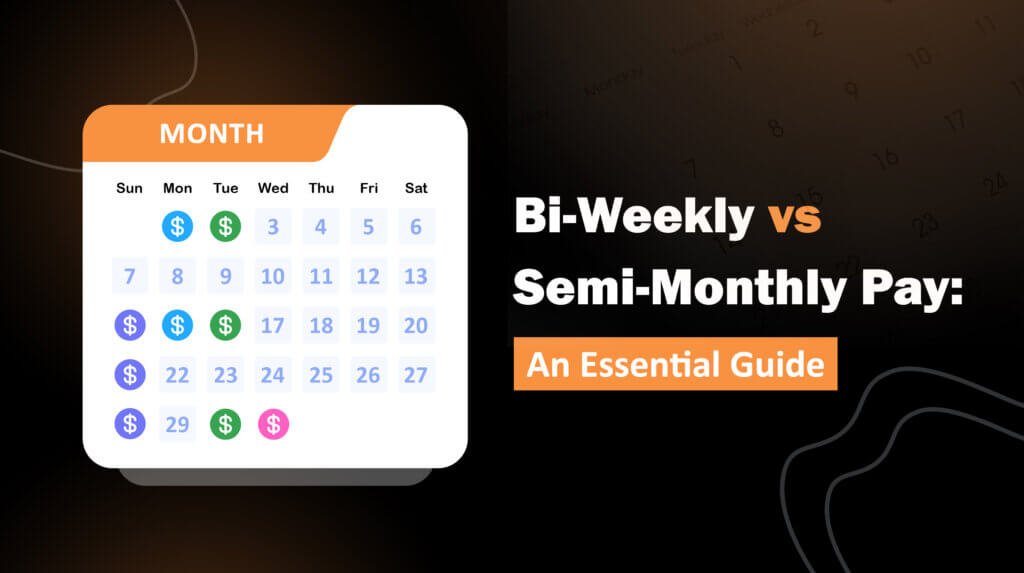
What is the difference between bi-weekly and semi-monthly pay? The main difference is frequency: Bi-weekly pay occurs every two weeks (26 times per year), while semi-monthly pay occurs twice a month on fixed dates (24 times per year). Bi-weekly is better for hourly workers due to easier overtime tracking, whereas semi-monthly is ideal for salaried employees who need to generate check stubs.
Have you ever looked at your bank account on payday and felt relieved?- Most of the employees, because it’s payday after all!
For most employees, payday isn’t just a date; it is a moment that informs financial planning and peace of mind, and even trust in their workplace. And for employers, how and when to pay your team can impact everything from payroll-related productivity to employee happiness.
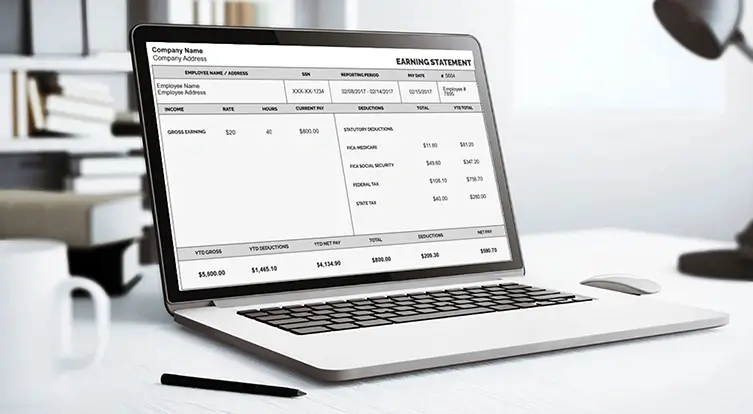
Understanding these payroll schedules helps everyone to maintain accurate records, while an online pay stub maker can simplify the whole paystub creation process.
The decision of whether to consider Bi-weekly vs Semi-monthly pay is among the most common, yet confounding decisions in the world of employee paycheck stubs. When it comes to HR teams and business owners choosing the correct schedule, it’s not a clerical decision; It’s a strategic choice with potential impacts on morale, compliance, and day-to-day financial planning.
In this post, we’re going to clarify the difference between semi monthly vs biweekly pay, what the pros and cons of each are, and point you in the right direction based on your business or personal financial requirements. By knowing these variances, you can generate free pay stubs with clarity, prevent scrambling, and make sure that payday is a consistent, predictable occasion for employees.
What is Bi Weekly Pay?
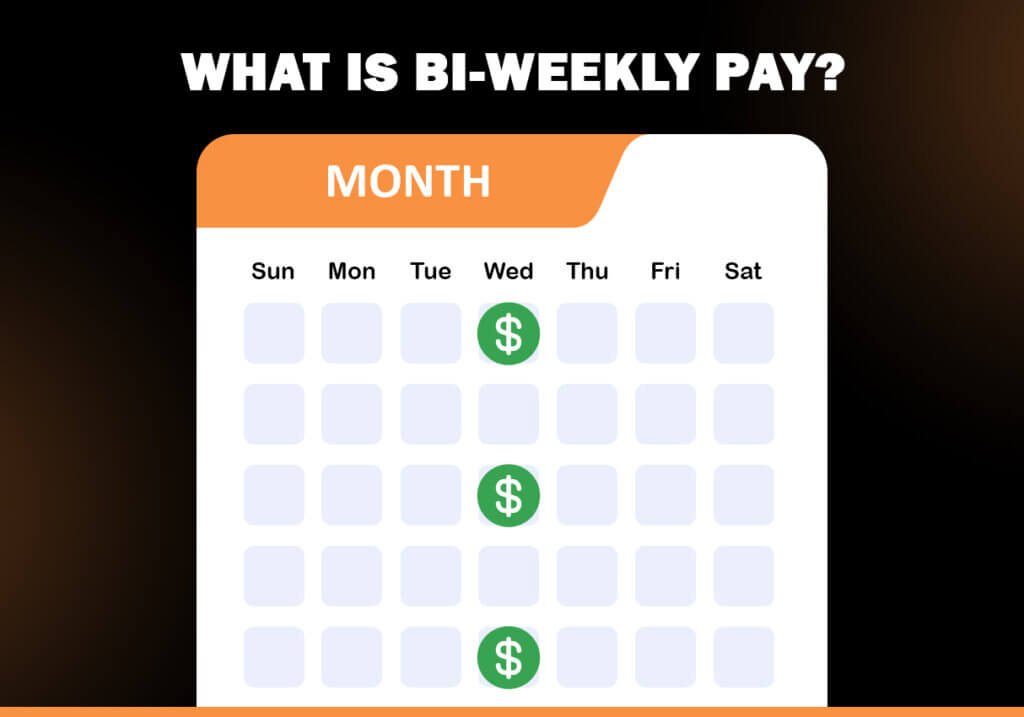
Bi Weekly Pay refers to a payroll schedule in which employees are paid every other week rather than once or more times a month. This pay period schedule has mostly 26 pay periods in a year, so for some months, employees will receive 3 paychecks instead of two! -that employees might enjoy as a nice surprise.
Bi-weekly pay doesn’t depend on the days of certain decided dates in order to be paid, but instead is paired with an every-other-day weekday. This helps workers prepare their weekly finances and helps employers make time tracking and payroll simpler. But since the schedule doesn’t match precisely to calendar months, monthly budgeting might take a bit more planning.
However, bi-weekly payroll provides a reliable cash flow, manageable payroll, and a predictable compensation schedule that most U.S. businesses prefer, especially full of hourly employees or varying hours.
How To Calculate Bi Weekly Pay
Bi-weekly pay is on an alternate week; that is, where employees are paid every other week, generally on the same day of the week (eg, every other Friday). For those who are salaried, the math is even easier because you can divide an annual salary by 26 (the number of pay periods per year) to arrive at a bi-weekly figure.
Formula: Bi-weekly pay = Yearly salary ÷ 26
Example:
If a worker annually earns $62K, their biweekly pay would be computed by:
Bi-weekly pay = $62,000 ÷ 26 ≈ $2,384.62
That means that the employee would get just about $2,384.62 every two weeks.
For hourly workers, things get a little bit more complicated. The hourly rate multiplied by the number of hours worked in that two-week period. If you work in a default 40-hour week, that’s usually a total of 80 hours over two weeks.
For instance, if an hourly worker makes $25 per hour:
$25 × 80 hours = $2,000 for every bi-weekly paycheck.
This approach allows both salaried and hourly employees to easily calculate bi-weekly earnings.
What is Semi-Monthly Pay?
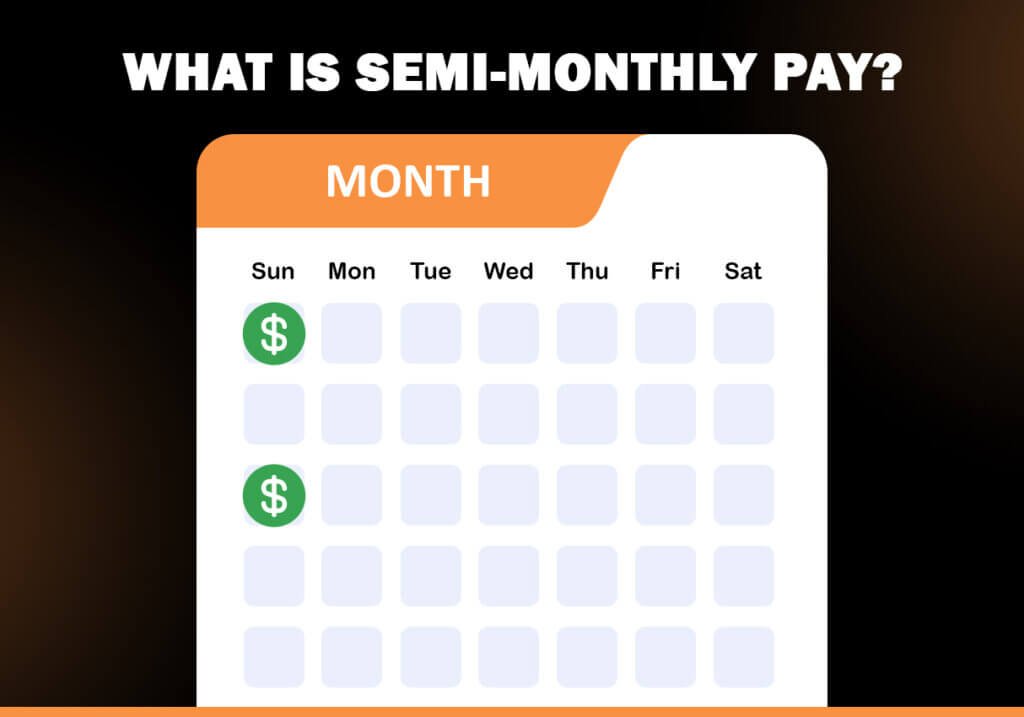
Semi-monthly pay is a payroll type in which the employee gets paid twice during one month at fixed dates, 1st and 15th or 15th and last day of the month. This would be 24 pay periods in a year.
Unlike weekly or bi-weekly pay, semi-monthly pay has nothing to do with the days of the week – it is about certain calendar dates. As a result, paydays can land on various weekdays during the month, and even (in some instances) weekends or holidays. Employers must take the necessary steps to ensure timely payment can be made, as in many states, employees must be paid on or before the scheduled payday, notwithstanding bank closures.
This routine also allows employees to budget and keep monthly costs more predictable. For employers, semi-monthly payroll means that you have to monitor hours and attendance closely, usually with help from a time-tracking system, and then count actual pay with the free paystub generator to make sure you compensate your employees fairly and accurately.
Overall, semi-monthly pay offers a consistent schedule for employees and employers. It has fewer pay periods than bi-weekly pay, but the consistent dates allow employees to better predict when they will receive their money & schedule bills coming through. Because of this, it is a popular practice for many businesses.
How To Calculate Semi-Monthly Pay
Under semi-monthly pay, employees are paid at defined set dates in a month (e.g., 1st and 15th or 15th and the last day of the month). Calculating gross pay for semimonthly salaried employees requires the process of considering the annual salary is divided by 24 (twice a month payment frequency x 12 months).
Formula: Twice per month, Salaried pay = Annual Salaried Pay ÷ 24
Example:
An employee has an annual salary of $72,000; they would have a semi-monthly rate of:
Semi-monthly pay = $72,000 ÷ 24 ≈ $3,000
So, the staffer would be getting about $3,000 on the decided date on a paycheck.
For employees paid hourly, calculate semi-monthly pay by multiplying the hours worked within that particular pay period by their hourly rate. Remember, if there is one month that has a different number of workdays 1 than in other months, it can change the number of hours worked and therefore, the amount of your paycheck.
This approach allows salaried and waged employees to calculate their semi-monthly pay with confidence, bringing predictability and stability to budgeting and payroll forecasting.
Advantages Of Bi-Weekly Pay
Tallying time every two weeks has its advantages for both the employee and employer, and it’s about as intuitive as they come in America.
Simplified Tracking
Bi-weekly payrolls coincide with weekly (and hourly) work schedules, simplifying the calculation of overtime and hours worked. This simple payroll solution saves time and prevents mistakes for employers, payroll managers, or HR managers. Before processing, you can preview a free pay stub sample template to visualize exactly how these periods and overtime hours appear on the final document.
Consistent Pay Schedule
In a bi-weekly pay schedule, the employee is paid once every two weeks on a day of your choosing (e.g. Every Wednesday). This steady beat makes it easy for workers to plan financially in the short-run, count their money, and handle weekly or biweekly expenses.
Extra Paychecks Each Year
There are 26 pay schedules in the year, so employees receive two more paychecks as compared to semimonthly. This puts a bit of money in workers’ pockets that can be spent on surprise expenses, saved, or invested.
Flexible Payroll Management
It is adaptable to the exact number of days each month for bi-weekly operation as a payroll clock. This would make it easier to manage hourly employees and differing schedules.
Advantages Of Semi-Monthly Pay
Semi-monthly pay schedule has a number of advantages that are appealing to both sides; they tend to lead to greater consistency and less administrative hustle.
Simplified Deductions
Gross pay, net pay, and all other deductions are more convenient to administer because there are only two pay periods per month. This consistency is what allows for sound deductions and prevents bad decisions.
Predictable Pay Dates
Employees know exactly when they will be paid each month—usually around the middle of one month and the end of the next. This predictability is also beneficial in setting monthly budgets, organising your bill-paying weeks, and addressing recurring bills.
Fewer Payroll Runs
Because it has 24 pay periods in a year, employers issue payroll less often compared to bi-weekly. This decreases administrative burden, facilitates reductions in operational costs, and streamlines businesses’ payroll processes.
Streamlined Monthly Planning
Semi- monthly pay makes employees’ lives easy as it matches payday with monthly bills, rent or mortgage payments, and other recurring expenses.
So in effect, semi-monthly pay provides employees with an organized and dependable schedule, while employers have more efficiency and structure over the payroll process.
What is Semi Monthly vs Bi Weekly?
Semi-Monthly vs. Bi-Weekly: What’s the Difference? If you are confused, what’s the difference and which one is better, you need to read the section.
Structure of Pay Periods
Semi-monthly pay is split up each month into two fixed periods: the 1st through the 15th and the 16th through the end of a particular month.
Biweekly pay schedules do not align with calendar months and are not based upon a fixed range of calendar days, but rather comprise two weeks.
Pay Schedule Cadence
Semi-monthly pay is predictable, with two designated pay days each month (typically the 1st and 15th of the month, or the 15th and last day of the month).
Bi-weekly payment, however, is performed once every two weeks – so there are 26 pay periods in a year.
Budgeting
Semi-monthly pay is very consistent, and the paycheck falls on literally the same days each month, helping employees understand when to expect their money to plan bills/savings/spending, etc.
With payday shifting from month to month under bi-weekly pay, the dates can require employees to budget a bit differently, but workers love it when they get that occasional extra paycheck in the year.
Key Differences Between Biweekly and Semimonthly Pay
Selecting the appropriate payroll schedule makes a big difference, not only for employees but also for employers. By understanding the preferred option, you should choose bi-weekly or semimonthly pay, depending on your workforce needs, payroll capacity, and budgeting.
| Aspect | Bi-Weekly Pay | Semi-Monthly Pay |
| Definition | All employees receive a cheque every other week on a specific day of the week, defined by the employer. | Workers are typically paid twice a month on scheduled days, often the 1st and the 15th or the 15th and last day. |
| Pay Periods per Year | 26 pay periods | 24 pay periods |
| Pay Schedule | Regular day, twice monthly (e.g., 1/2 time every other Friday) | Fixed calendar 2 dates each month |
| Payday Timing | It is never on the same day of the week | Could land on weekends or holidays and be needed to pay early or late |
| Administrative Burden | Up on more payroll runs | Lower as a result of fewer payroll runs |
| Payroll Costs | A little higher, since you run payroll more frequently. | Lower as a result of reduced Payroll processing |
| Direct Deposit & Bank Timing | Consistent banking day | May vary according to holidays or weekends |
| Payroll Taxes & Withholdings | More often kept by you on 26 paychecks | A little bit more withholding each pay period |
| Overtime Tracking | Easier—aligns with standard 40-hour workweeks | More complex—may split workweeks |
| Pros | More regular pay, smoother cash flow for workers, and easier overtime calculations | Regular paydays, less HR work, simplified cashflow planning |
| Cons | More hours or potential cash flow crunches for employers | Infrequent payments, varying on weekdays, can confound workers |
Also Read: OBBB Act 2026 Explained: A Complete Guide to Payroll Revolution
Bi-Weekly vs Semi-monthly Pay- Which One Is Better?
Selecting bi-weekly vs semi-monthly pay depends on the workforce you’re managing and the setup of your company.
- For businesses with shift-based operations or full-time hourly-paid workers, every two weeks makes more sense as a payment schedule. It easily integrates with a weekly timesheet, simplifying the process of calculating overtime under FLSA laws and reducing the likelihood of payroll mistakes.
- Semi-monthly pay makes more sense for salaried employees. Semi-monthly will offer some flexibility between the 26 and 27 biweekly pay periods, as you can choose when to fall your semi-monthly payroll. Since paydays are on the same date, this type of schedule also happens to conveniently coincide with your standard monthly bill payments, such as rent, mortgage, or loan bills.
In the end, your best option will depend on the circumstances of your employees, the type of workforce, and the functionality you have in place with payroll. Taking these considerations into account, employers can opt for a schedule that offers an effective compromise between efficiency, compliance, and employee experience. A free paystub generator for employees can be a great asset in maintaining this balance.
What Other Pay Periods Can Be Included In Paycheck Stubs?
Bi-weekly and semi-monthly are among the most popular pay schedules in the United States, but companies also have other pay frequencies to select based on their workforce and operational preferences.
Daily Payroll
For working people, daily payroll is a new trend, enabled by fintech platforms: you can get paid every day. This approach is especially prevalent in the gig economy or among workers with urgent demands for their pay.
Weekly Payroll
You pay your employees once a week; maybe you pay them all on Fridays. The schedule is prevalent in industries that employ hourly workers, such as retail, hospitality, and construction, whose employees increasingly depend on a steady and predictable flow of income to pay for weekly expenses.
Monthly Payroll
Monthly payroll is paid monthly, normally at the end of each month. Although it’s less common in the U.S, monthly payroll is popular all across Europe and beyond. This means it makes payroll easier for businesses and prevents them from having to incur the time and expenses of administrative fees.
Paystub Generator And Pay Schedule Management
Both employers and employees benefit from the efficient handling of payroll. With a trusted paystub generator free, you can automate this task and save your time by computing your earnings, deductions, and tax withholdings according to the pay period.
No matter your pay schedule, whether your company is paid every bi-weekly/semi-monthly, weekly, or monthly, a free paystub generator serves to guarantee employees are provided with up-to-date and elaborate payslips.
With StubCreator, you can save time and cut down on mistakes while you generate a pay stub free. A good paystub allows employees to see how they earn, what benefits are provided, and how much they are actually being paid. At the end of the day, for companies big and small, a well-organized pay schedule is dependable.
Conclusion
Choosing the right payroll schedule is more than just an administrative decision—it impacts financial planning, employee morale , and, in the final analysis, business performance. Two common choices, both semi-monthly and bi-weekly, are among the 10 methods of pay frequency. You can choose any of them as per your business requirement.
We have thoroughly described everything regarding bi-weekly & semi-monthly pay. Read the guide again to clear your doubt!
FAQs:
1) What Is Semi Monthly Payment?
Semimonthly payment – Employees are paid twice a month on set days (1st and 15th of every month or 15th and last day of the month).
2) Is Semi-monthly the Same as Biweekly?
No, biweekly and semi-monthly are not synonymous. Semi-monthly is twice a month, and biweekly is every two weeks.
3) How Many Days Are in a Semi-Monthly Pay Period?
A semimonthly pay period has about 15 days on average, and that typically refers to 13-16 workdays in the month, depending on the month.
4) How Many Semi-Monthly Payments Are in a Year?
Each payment occurs twice a month, or 24 times in the year.
5) What Is the Difference Between Biweekly and Semi-Weekly?
Every two weeks is biweekly; twice a week is normally semi-weekly.
6) What Is Getting Paid Semi-Monthly?
According to the semi-monthly definition, you get paid twice per month on specific dates.
7) What Is Bi-Monthly vs Semi-Monthly?
Now, bimonthly can be either twice per month or every two months, whereas semi-monthly is always twice a month.
8) What Does Semi-Monthly Mean for Insurance?
For insurance policies, semimonthly means the premiums are deducted from two paychecks each month.
9) Is Bi-Monthly Every Other Month?
Strictly speaking, bi-monthly is not every other month in the context of payroll.
10) What Is the Difference Between Weekly and Bi-Weekly Pay Periods?
Weekly pay is once a week, while bi-weekly doesn’t mean two times in one week, but rather occurs every second week.
11) How Many Bi-Weekly Pay Periods Are in 2026?
There are 26 bi-weekly pay periods in 2026.
12) What Are the Disadvantages of Getting Paid Biweekly?
Some drawbacks associated with biweekly pay are greater payroll processing expenses and more administrative work for employers.
13) Do You Get Taxed More With Biweekly Pay?
No, you are not taxed more than if paid monthly with biweekly pay; your taxes are just divided among more paychecks.
14) What Pay Period Is the Best?
The optimal pay period varies based on how much you need to take home, the way you want to budget, and your employer’s payroll process.
15) What Are the Cons of Semi-Monthly Pay?
One of the cons is that semi-monthly pay can lead to irregular pay periods and require more complicated overtime calculations.
Also Read:
Top 10 Payroll Mistakes of 2026 (And how to fix them)
Open Door Policy: Meaning, Examples & Workplace Guide
List of Federal Holidays in 2026
Types of Payroll Services: A Complete Guide for Business Owners
FAQ's
How Does a Semi-Monthly Pay Schedule Work?
+
A semi-monthly frequency breaks the month into two fixed pay periods and establishes pay dates.
Does Semi-Monthly Mean Every 2 Weeks?
+
No, semi-monthly is not the same as biweekly; it’s 1/2 of a month.
Is It Better to Get Paid Semi-Monthly?
+
It probably helps with budgeting monthly costs, but it’s up to you.
Which Is Better, Semi-Monthly or Biweekly?
+
Neither is objectively better; semi-monthly fits with salaried jobs, bi-weekly works for hourly ones.
Is Semi-Monthly Twice a Month?
+
Yes, Semi- monthly is twice a month, on decided dates.
Why Do Employers Pay Semi-Monthly?
+
Salaried is paid semi-monthly, so it cuts down on the number of payroll runs you need to do and keeps construction accounting easier at month.
How Does a Semi-Monthly Payroll Work?
+
Semi-monthly payroll is a system that pays the employees on two specific dates in one month, such as the 15th and the last day of the month, excluding weekends.
How to Calculate Your Semi-Monthly Pay?
+
For your semi-monthly (twice-monthly) paycheck, you need to divide your annual salary by 24.
Is Semi-Monthly 24 or 26?
+
Semi-monthly has 24, not 26 pay periods.
How Much Is $60,000 Semi-Monthly?
+
A $60,000 twice-monthly salary is the same as $2,500 per paycheck before taxes.
Is Bi-Weekly 2 Weeks of Pay?
+
Yes, two weeks of work are covered in a bi-weekly pay.
Is Biweekly 2 Times a Month?
+
Biweekly isn’t always two times a month; some months have three paychecks.
Is It Better to Get Paid Weekly or Bi?
+
With weekly, the pay is received more quickly; and with bi-weekly, you remain consistent, and also payroll time is simpler.
How Much Is $15 an Hour Bi-Weekly?
+
At $15 an hour, bi-weekly full-time pay comes to about $1,200 before taxes for 80 hours.