.png)


 Chat with us now!
 Send Email!
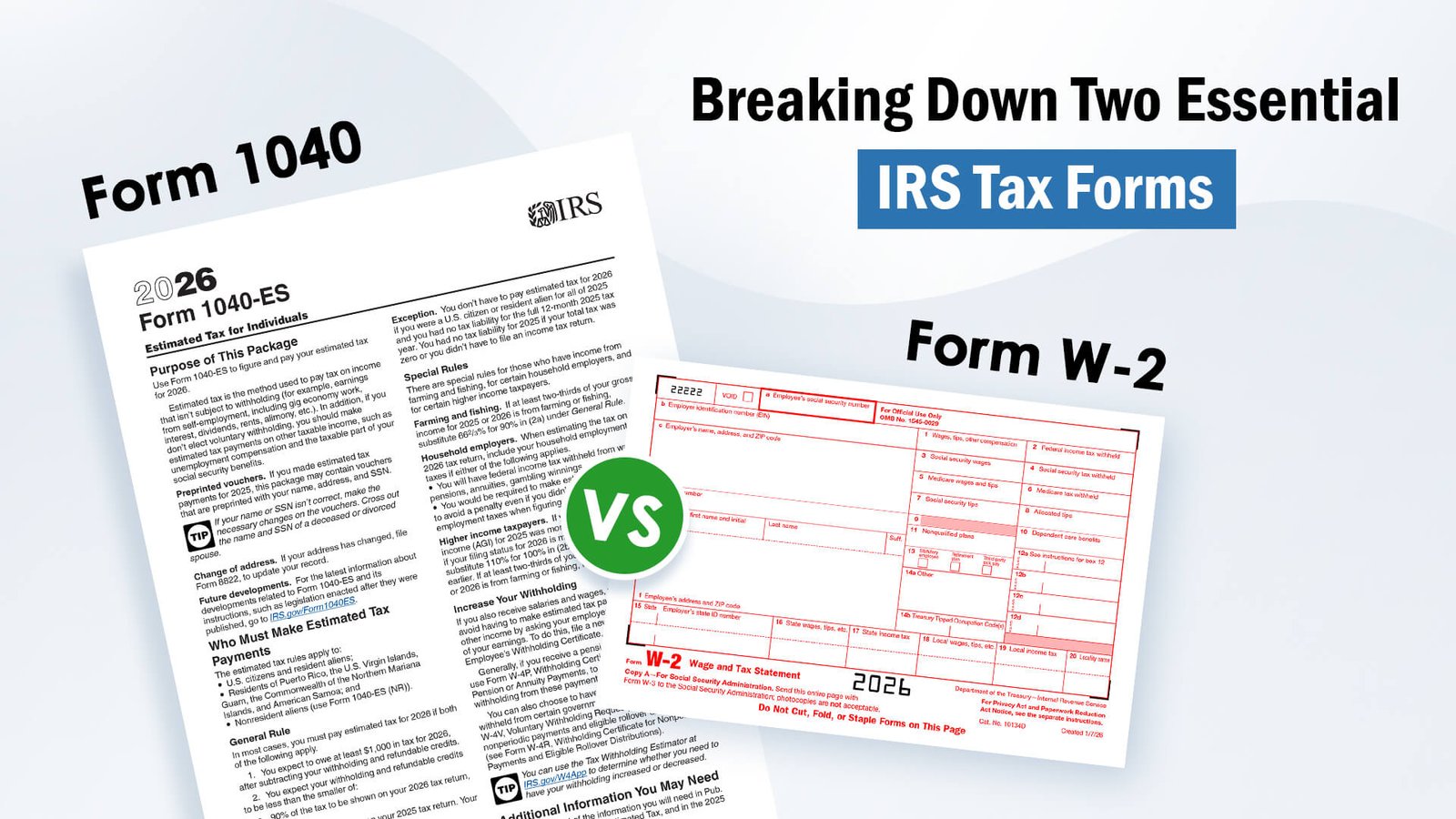
Every tax season, thousands of Americans sit down with a stack of tax documentation and think to themselves: Is a W2 Form the same as a 1040 Form?
Form 1040 vs W-2 is a term searched by actual users online. Both are significant records required for tax filing, because they serve very different purposes and operate at different levels in the tax process. While your W2 form shows the wages you earned and taxes withheld by your employer, Form 1040 is the document you use to officially file your individual income tax return with the IRS.
If you’re missing income documentation or want to better understand your payroll breakdown before filing, using a free paystub generator can help you review your earnings details alongside your W-2 for accuracy.
In this complete guide, we’ll go over what each form actually is and does, break down 1040 vs. W2 in simple terms, and answer your burning questions so you can file like a pro.
What is a 1040 Form?
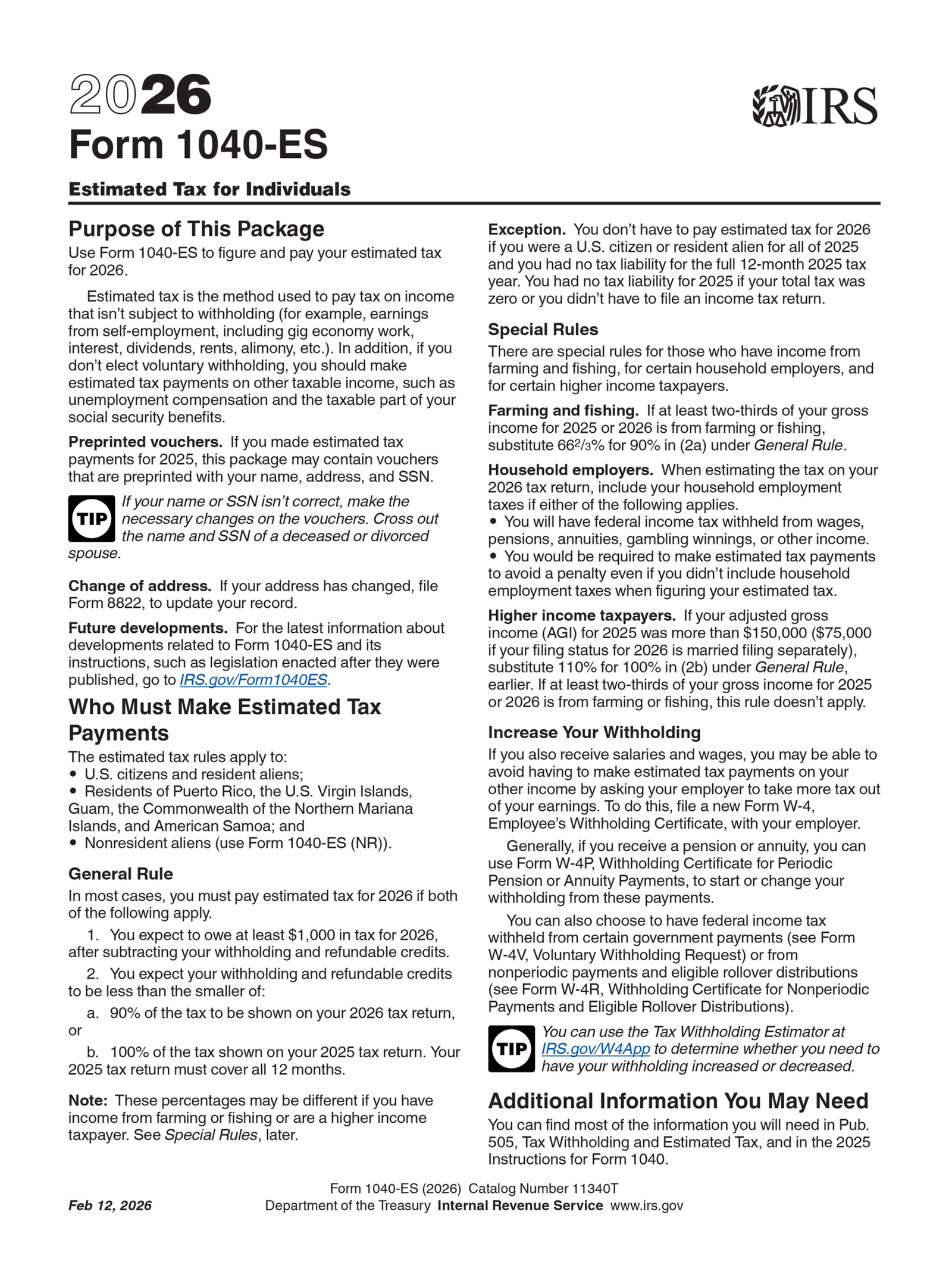
The U.S. Individual Income Tax Return, also known as Form 1040, is the main federal tax return that is used to report income and calculate taxes owed or refunded for most Americans. In other words, the W-2 is filled out by your employer; Form 1040 is completed by you and submitted directly to the IRS.
Key Facts about Form 1040:
- Issued by: The IRS.
- Filing deadline: April 15 each year.
- Who files it: Most U.S. citizens and resident aliens with taxable income.
- Purpose: Reports all sources of income, claims deductions, and credits, and calculates taxes owed or refund due.
- It is your actual tax return. This is what you submit to the IRS.
- Uses information from W-2s, 1099s, and other tax documents as inputs.
The IRS has been using an entirely new collection of optional Schedules (Schedule A for itemized deductions, Schedule B for interest and dividends, Schedule C for self-employment income, etc.) that you can add depending on your sources of income since 2025.
What is a W2 Form?
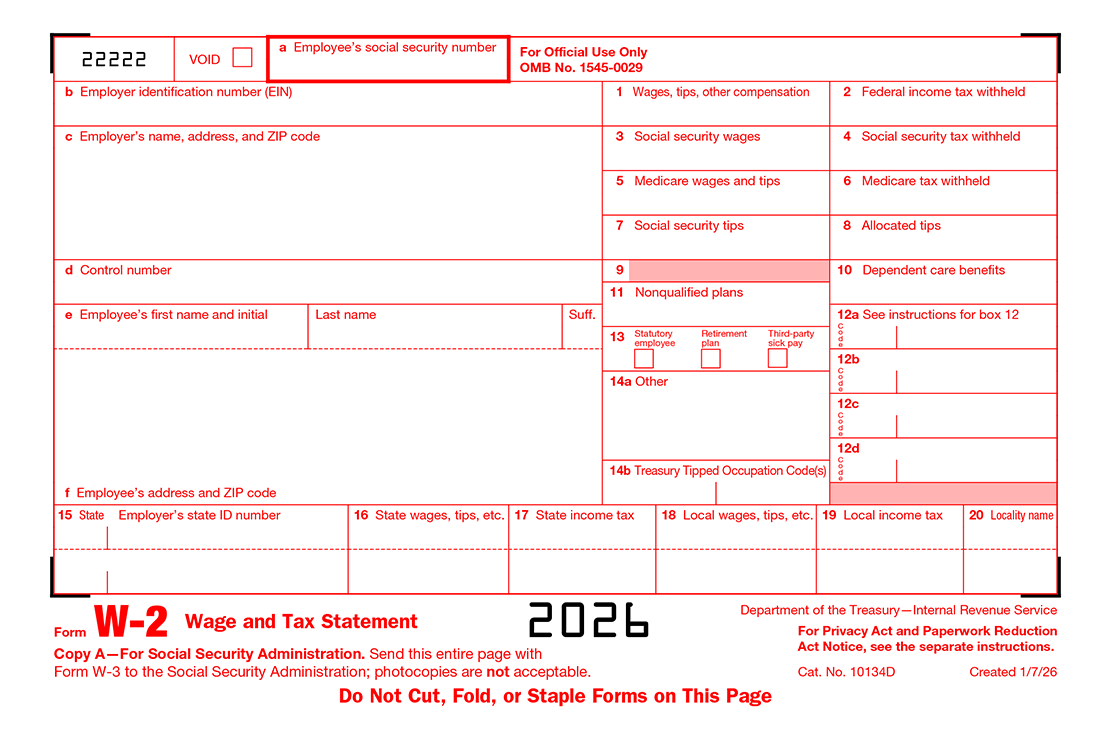
The W2 form is a form your employer must provide to you once every calendar year, as required by the IRS. It breaks down how much money you made from that employer and what was taken out of your paycheck to pay for federal income tax, social security, and medicare taxes.
Key facts about Form W2 Form:
- Issued by: Your employer.
- Deadline: Employers must send W-2s by January 31 each year.
- Who receives it: All employees.
- Purpose: Reports your annual wages and tax withholdings to both you and the IRS.
- Number of copies: You receive multiple copies, one for federal, one for state, and one for your records.
It is not a tax return; it is an informational document.
The W-2 includes boxes labeled with letters and numbers that will report certain income or deductions paid to the employee. Total taxable wages go in Box 1, federal income tax withheld is in Box 2; Boxes 3 through 6 are for Social Security and Medicare wages and taxes.
Differences Between 1040 and W2
| Factors | 1040 Form | W2 Form |
| Purpose | Reconcile total earnings, credits, and tax due | Report wages and tax withheld to the IRS |
| Prepared by | Employee | Payer |
| Key data | Includes every W-2 and 1099 | Boxes 1–6: Wages + federal/FICA withholdings |
| Due date | File return by April 15 | Furnish and e-file by 31 Jan |
| Payer impact | Errors prompt employees to amend returns | An accurate W-2 form prevents the IRS |
Is a W2 The Same As a 1040?
A W2 is not the same as a 1040. They’re two completely different types of tax documents that you both use for different purposes. The easiest way to put it is this:
The W-2 is your income report card: It tells you how much money you made. The 1040 is your tax homework; it’s what you do with that information when it mixes up at the end of the year, to settle up with the government.
- Is Form 1040 the same as W2? Absolutely not.
- Is a 1040 a W2? No.
- Is a W2 a 1040? No.
- Is a 1040 form a W2? No.
The answer to each of them is the same: They are two different IRS forms that partner up at tax time, but they are not interchangeable, nor can you substitute one for the other.
Think of it this way: Your W-2 is like a bank statement, detailing transactions. Your Form 1040 is basically your budget spreadsheet; every one of those transactions helps calculate where you stand with the I.R.S. financially.
And if you ever need to better understand how your wages and deductions build up throughout the year before they appear on your W-2, W2 form generator can help you visualize payroll details in a structured way.
How do the 1040 Form and W2 Form work together?
Understanding the relationship between the W-2 form vs 1040 is crucial for accurate tax filing. Here’s how the two documents connect:
Step-by-Step Guide: Working Together 1040 & W2 Forms
- Receive your W-2 from your employer by January 31.
- Locate Box 1: This is your taxable income from that job.
- Enter this amount on Line 1a of Form 1040 under Total amount from Form W-2.
- Add any other income sources to complete your total income.
- Subtract deductions to arrive at your Adjusted Gross Income.
- Apply applicable tax credits.
- Compare your total tax liability to what was already withheld (Box 2 of W-2) to determine a refund or amount owed.
- Sign, date, and submit your Form 1040 to the IRS by April 15.
The information from your W-2 flows directly into your 1040. Without your W-2, you can’t accurately complete your 1040. And without the 1040, your W-2 serves no tax-filing purpose.
If you ever need to cross-check your earnings before filing, previewing a paystub template alongside your W-2 can help you better understand how your wages and withholdings translate into your final tax return.
Who Receives a W-2 Form vs. Who Files a 1040 Form?
To understand how these two different tax forms fit into the entire tax filing process, it helps to know who gets a W-2 and who needs to file a 1040.
W-2 Recipients: Any individual classified as an employee receives a W-2. This includes full-time employees, part-time employees, and even some seasonal workers. Independent contractors and freelancers do not receive W-2s; they receive 1099-NEC forms instead.
1040 Filers: Most U.S. citizens with income above the filing threshold must file a 1040 form. This includes employees, self-employed individuals (who use Schedule C), retirees, investors, and more. In 2026, the filing threshold for single filers under 65 is $14,600 in gross income.
Common Misconceptions of W2 vs 1040 Forms
Here are some common misconceptions you should check.
My W2 is My Tax Return: This is the most common misunderstanding. Your W-2 is not your tax return. It’s a document you receive that you use to help prepare your tax return. Sending in just your W-2 without a Form 1040 does not constitute filing your taxes.
If I Only Have One Job, I Don’t Need a 1040 Form: Even if you have a single employer and receive only one W-2, you still need to file a Form 1040 if your income exceeds the filing threshold.
The 1040 and W-2 Forms are filed at the same time by the same person: Your employer files the W-2 form by January 31. You file the 1040 form by April 15.
Key Takeaways
The confusion between the W2 form vs 1040 form is completely understandable; both are critical tax documents, and both are associated with your annual income. But now you know: they’re not the same, not interchangeable, and not even filed with the same agency.
People May Also Ask
1) What are the major differences between 1040 and W2 Forms?
W2 and 1040 are both required to file the tax, but they serve different purposes. The W2 is an employer’s payroll statement, while the 1040 is the individual’s tax return.
2) Is W2 same as 1040 Form?
No, Form 1040 and W2 are not the same; The W2 is a statement from your employer that reports your wages and taxes withheld, while Form 1040 is your personal income tax return, where you use the W2 information (and other income/deductions) to calculate your total tax liability and file with the IRS.
3) What is the purpose of 1040?
The 1040 Form is used by U.S. taxpayers for filing an annual tax income return.
4) What is W-2 form in the USA?
A W-2 employee is a person who works directly for your company with all the official paperwork, tax deductions, and legal protections that come with it.
5) What if I filed my taxes and forgot a W2?
If you originally filed electronically, you can also submit your amended return online. If you filed paper, mail the form to the correct IRS address. Attach a copy of your W-2: When filing Form 1040-X, you’ll need to attach a copy of the W-2 you forgot.
6) What happens if you don’t file 1040 form?
When failure to file and failure to pay penalties run concurrently, the maximum penalty prescribed is generally 47.5%. If your return is more than 60 days late, the minimum penalty for failure to file is $485 (for 2024) or 100% of the tax required to be shown on the return.
7) Should I be filing a 1040?
If you’re a U.S. taxpayer and earned income during the tax year, you will likely need to file Form 1040.
8) Is a 1040 the same as a W2 form?
No, a 1040 form is not the same as a W2 form. The W2 form is a wage statement sent by the employer, whereas the 1040 form is the individual tax return you file with the IRS.
Also Read:
What Is a TIN (Taxpayer Identification Number) ? and Why Is It Important?
Open Door Policy: Meaning, Examples & Workplace Guide
940 vs 941 Forms: What Is The Major Difference?
FAQ's
Is W-2 form only for U.S. citizens?
+
No, the W2 form is not just for US citizens. It is issued to any employee working in the US who earns income, including foreign citizens, permanent residents, and nonresident aliens on working visas, if they are considered employees for tax purposes.
Can I file a W-2 if I have fewer than 10 returns?
+
Yes, you can file, but e-filing is a quick method and provides instant SSA acknowledgement.
Does a payer ever file Form 1040?
+
No, a payer does not file Form 1040. He only files a W2 form. Form 1040 is the employee’s individual tax form.
What is Form 1040 Schedule 3?
+
The Schedule 3 tax form 1040 is used to report additional credits and payments that aren’t listed directly on Form 1040. You can add the education credits or foreign tax credits.
What is Form 1040 NR?
+
Form 1040-NR is the U.S. tax return for nonresident individuals to report income earned in the United States and calculate taxes owed.